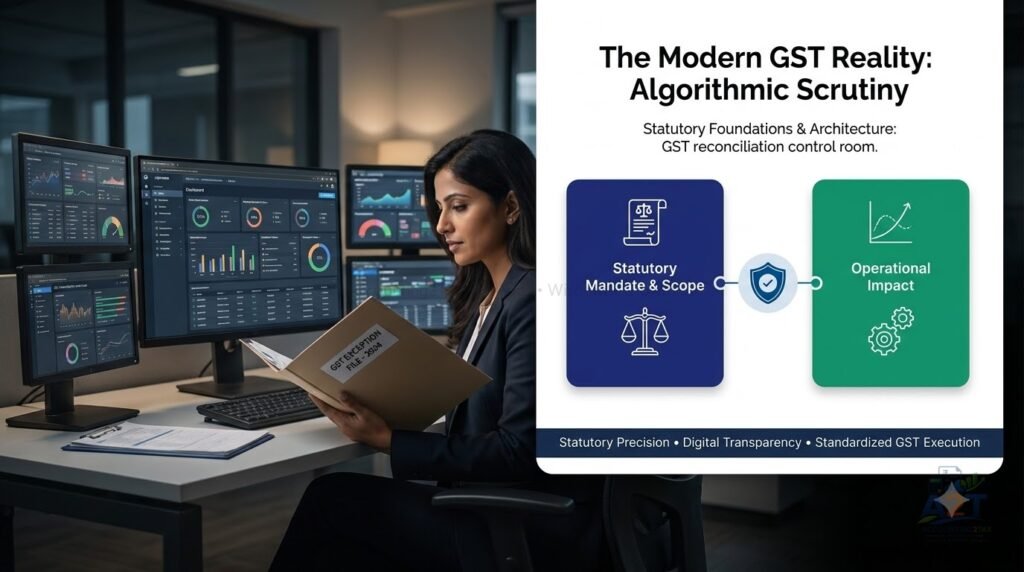
- • The Modern GST Reality: Algorithmic Scrutiny
- • 1. The 4 Essential Reconciliation Matrices
- • 2. The Common Reconciliation Variances & How to Resolve Them
- • Master 5-Step Monthly Close Reconciliation SOP
- • Frequently Asked Questions (FAQs)
Last Verified: 1 September 2026
Key verification sources: 56th GST Council recommendations, CBIC Tax Information Portal, GSTN advisories (IMS, DRC-03A).
In the modern Indirect Tax ecosystem, filing your monthly GST return on time is only half the battle.
The real test of tax compliance lies in GST Reconciliation: the systematic, mathematical verification that your accounting books, tax filings, vendor uploads, logistics data, and financial statements match with 100% precision.
In earlier tax systems, discrepancies were often uncovered years later during departmental audits.
Today, the GST Network (GSTN) deploys real-time algorithms that cross-examine every data point:
- If sales in your audited Profit & Loss statement exceed your GSTR-1 turnover, an automated notice is generated for undeclared revenue.
- If your claimed Input Tax Credit (ITC) in GSTR-3B exceeds your supplier uploads in GSTR-2B, a Form DRC-01C notice is served.
- If your E-Way bill dispatches do not match your outward tax invoices, tax authorities flag your supply chain for physical audit.
Why is monthly reconciliation far cheaper than annual audit firefighting? What are the 4 Essential Reconciliation Matrices every finance team must execute? How do you manage the Invoice Management System (IMS) control layer? And what 5-Step Monthly Close SOP ensures your business remains audit-proof year-round?
This comprehensive guide breaks down the architecture of GST reconciliation, provides step-by-step matching frameworks, and details resolution mechanisms like DRC-03A.
The Modern GST Reality: Algorithmic Scrutiny
The GST portal operates as an interconnected digital web where data flows continuously across a strict reconciliation chain:
Books → e-invoice/e-way bill → GSTR-1/GSTR-1A → supplier filing → IMS action → GSTR-2B → GSTR-3B → electronic ledgers.
THE RECONCILIATION WEB
                                       │
        ┌───────────────────┬──────────┼──────────┬───────────────────┐
        ▼                   ▼          ▼          ▼                   ▼
 [ 1. BOOKS ]        [ 2. GSTR-1 ]  [ 3. IMS ]  [ 4. GSTR-2B ]  [ 5. GSTR-3B ]
  ERP / Tally       Outward Tax     Inward      Auto-Populated    Monthly Tax
  Records           Declarations    Control     Vendor Credits    Payments
                                       │
                                       ▼
  [ THE CORE OBJECTIVE: 100% MATHEMATICAL ALIGNMENT ACROSS ALL NODES. ]
1. The 4 Essential Reconciliation Matrices
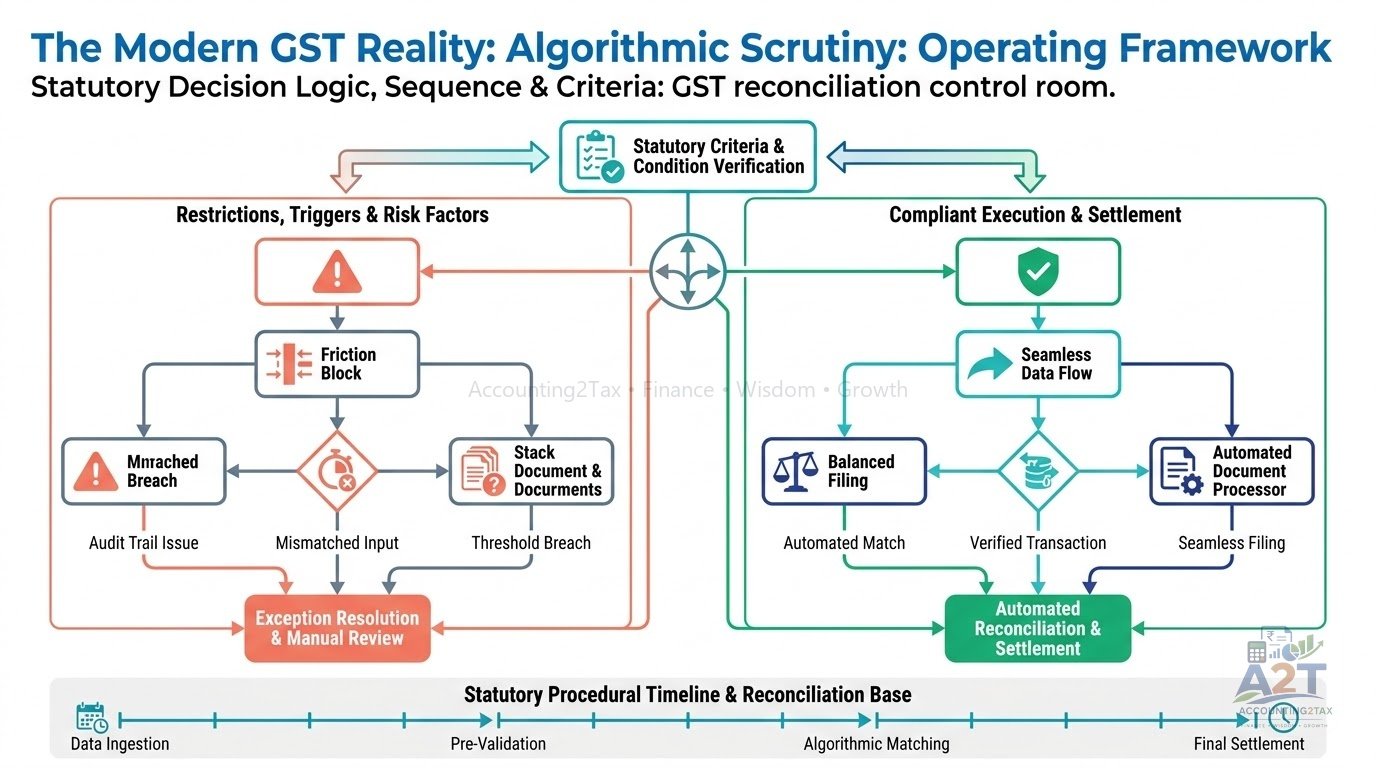
4 RECONCILIATION MATRICES
                                       │
 ┌─────────────────────────────────────────────────────────────────────────────┐
 │  MATRIX 1: SALES RECONCILIATION (Books vs GSTR-1/1A vs GSTR-3B)             │
 │  Ensures all sales invoices are declared and exact output tax is paid.      │
 ├─────────────────────────────────────────────────────────────────────────────┤
 │  MATRIX 2: ITC RECONCILIATION (Purchase Register vs IMS/GSTR-2B)            │
 │  Ensures zero excess ITC claims while identifying non-compliant vendors.    │
 ├─────────────────────────────────────────────────────────────────────────────┤
 │  MATRIX 3: LOGISTICS RECONCILIATION (E-Way Bills / IRN vs GSTR-1)           │
 │  Ensures every physical goods movement is backed by a valid tax invoice.    │
 ├─────────────────────────────────────────────────────────────────────────────┤
 │  MATRIX 4: ANNUAL AUDIT RECONCILIATION (Trial Balance vs GSTR-9 / 9C)       │
 │  Reconciles audited turnover, other income, and Table 8D ITC balances.      │
 └─────────────────────────────────────────────────────────────────────────────┘
Matrix 1: Outward Sales Reconciliation (Books vs. GSTR-1 vs. GSTR-3B)
- The Check: Compare your ERP Sales Register with GSTR-1 (and GSTR-1A amendments) and GSTR-3B (Table 3.1).
- The Golden Rule:
📐 Books Taxable Turnover = GSTR-1 Turnover = GSTR-3B Turnover
- The Danger: If GSTR-1 outward liability exceeds GSTR-3B payments, the portal serves an automated Form DRC-01B notice under Rule 88C.
Matrix 2: Inward Purchase & ITC Reconciliation (Books vs. IMS vs. GSTR-2B)
With the introduction of the Invoice Management System (IMS), reconciliation is no longer just downloading a static 2B. Your finance team must actively manage invoices in the IMS before GSTR-2B is generated:
THE IMS & 3-BUCKET ITC MATCHING
                                       │
        ┌──────────────────────────────┼──────────────────────────────┐
        ▼                              ▼                              ▼
 [ BUCKET 1: MATCHED ]      [ BUCKET 2: IN BOOKS ONLY ]   [ BUCKET 3: IN IMS/2B ONLY ]
 Invoice matches Books.     Vendor failed to upload.      Credit is on portal, but
 IMS Action: ACCEPT.        Cannot claim ITC.             missing in ERP. Check for
 Claim 100% ITC in 3B.      Hold payment & follow up.     unrecorded invoices.
- IMS Actions: You can Accept, Reject, or keep Pending the invoices. Only accepted or no-action invoices flow into GSTR-2B.
- Form DRC-01C: If your ITC claimed in GSTR-3B exceeds the final auto-populated GSTR-2B, Rule 88D triggers a DRC-01C mismatch notice.
Matrix 3: Logistics & E-Invoicing Reconciliation (E-Way Bills vs. GSTR-1)
- Match all generated E-Way bills and Invoice Reference Numbers (IRN) against your final GSTR-1 sales tables.
- Identify:
- Dispatches made without a corresponding tax invoice in GSTR-1 (leads to tax evasion notices).
- Cancelled E-Way bills where the underlying invoice was accidentally left active.
Matrix 4: Annual Audit Reconciliation (P&L vs. GSTR-9 / 9C)
- Reconcile audited Profit & Loss revenue (including forex gains, scrap sales, asset sales) with GSTR-9.
- Table 8D Reconciliation: Historically derived from GSTR-2A, Table 8D now compares total ITC auto-populated in GSTR-2B against ITC actually claimed in GSTR-3B. Ensure missing credits are tracked and lapsed credits are accounted for.
2. The Common Reconciliation Variances & How to Resolve Them
| Variance Nature | Root Cause | Practical Resolution Mechanism |
|---|---|---|
| Vendor Non-Compliance | Supplier collected tax but failed to file GSTR-1 | Issue vendor demand notice; hold subsequent payments until credit reflects in IMS |
| Clerical B2C Mismatch | Vendor entered your invoice under B2C table | Request supplier to amend invoice in GSTR-1 Table 9A; take action in IMS |
| Outward Liability Mismatch | Paid tax voluntarily but DRC-01B still issued | Map the voluntary payment to the specific demand using Form DRC-03A |
| Timing Differences | Goods received next month | Mark invoice as “Pending” in IMS; claim in the month goods are received |
Master 5-Step Monthly Close Reconciliation SOP
 ┌─────────────────────────────────────────────────────────────────────────────┐
 │  STEP 1: LOCK SALES & PURCHASE REGISTERS ON 5TH OF THE MONTH                │
 │  Freeze all accounting ERP entries for the preceding month.                 │
 ├─────────────────────────────────────────────────────────────────────────────┤
 │  STEP 2: REVIEW IMS DASHBOARD & TAKE ACTIONS                                │
 │  Accept, Reject, or hold Pending the supplier invoices before 14th.         │
 ├─────────────────────────────────────────────────────────────────────────────┤
 │  STEP 3: DOWNLOAD GSTR-2B JSON / EXCEL ON THE 14TH                          │
 │  Run final matching script between purchase register and finalized 2B.      │
 ├─────────────────────────────────────────────────────────────────────────────┤
 │  STEP 4: ALIGN GSTR-1/1A OUTWARD TAX WITH GSTR-3B TABLE 3.1                 │
 │  Ensure zero mismatch between outward supply filing and cash tax payment.   │
 ├─────────────────────────────────────────────────────────────────────────────┤
 │  STEP 5: PREPARE AND FILE GSTR-3B BEFORE THE 20TH                           │
 │  Claim strictly matched Bucket 1 ITC + reverse ineligible Section 17(5) items.│
 └─────────────────────────────────────────────────────────────────────────────┘
Frequently Asked Questions (FAQs)
Q1. What is the role of IMS in monthly reconciliation?
Answer: The Invoice Management System (IMS) allows recipients to Accept, Reject, or keep Pending the invoices reported by suppliers. This provides a control layer before GSTR-2B is generated, ensuring only verified ITC flows to GSTR-3B.
Q2. How is GSTR-9 Table 8D populated now?
Answer: Historically, Table 8D was populated based on GSTR-2A. It is now derived entirely from GSTR-2B, streamlining annual reconciliation with your monthly ITC claims.
Q3. How do I resolve a demand if I already paid the tax via DRC-03?
Answer: You can use Form DRC-03A to map your voluntary DRC-03 payment against the specific demand order generated by the system, resolving the mismatch.
Q4. Does DRC-01C mean my ITC is automatically denied?
Answer: No. DRC-01C is a system intimation of an ITC mismatch between GSTR-2B and GSTR-3B under Rule 88D. You have the opportunity to reply in Part B with a valid explanation (e.g., reclaiming past reversed ITC).
Calculate Your GST Output Liabilities and Matched Credits
Model your monthly outward tax liabilities, reconcile input tax credit balances, and project cash requirements using the Accounting2Tax Financial Tools.
Use the GST Calculator to verify your tax calculations and credits.
Related Financial Wisdom
- GST Returns Explained: Understanding the Filing System
- GSTR-1 and GSTR-3B: Key Differences
- ITC Reconciliation: Matching Purchase Records with GSTR-2B
- GST Return Filing Mistakes and Penalty Prevention
- GST Compliance Checklist for Small Businesses
Key Takeaways
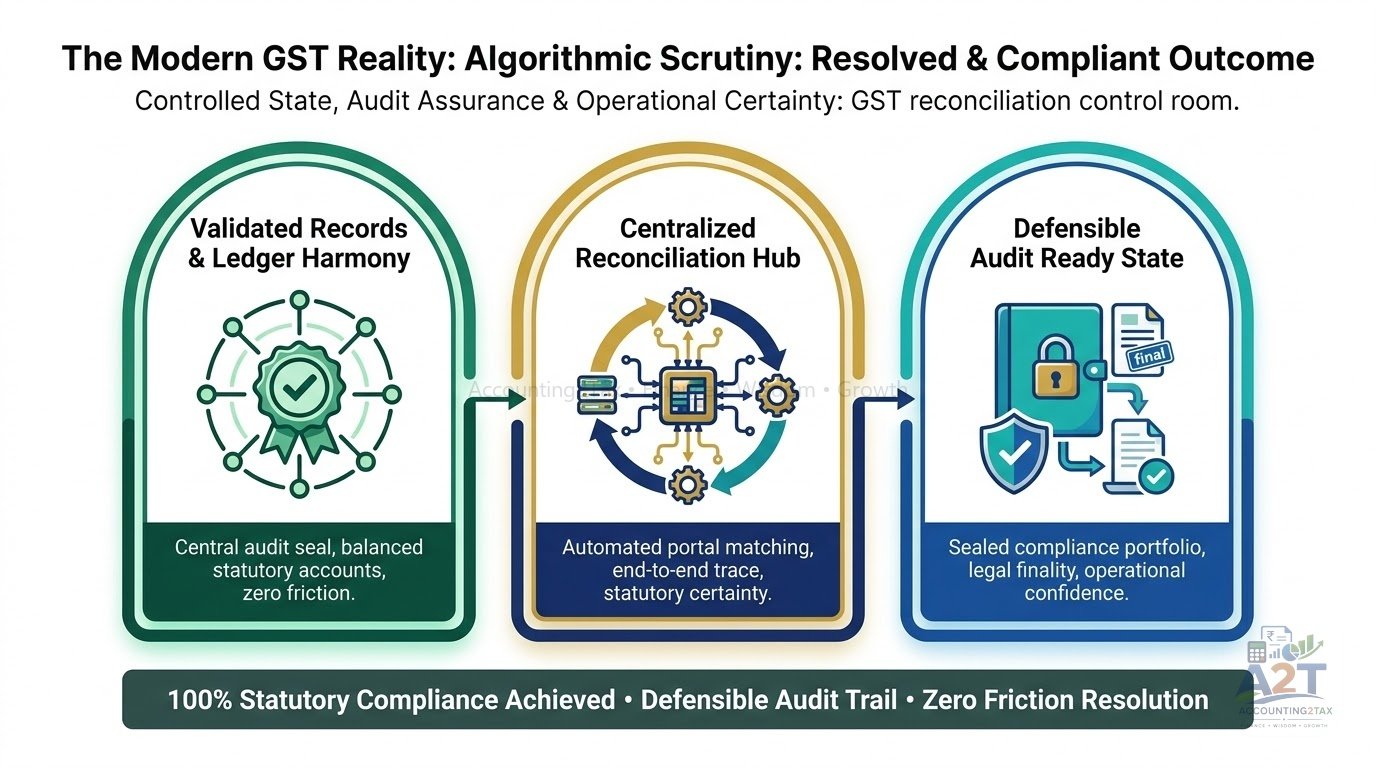
- GST reconciliation is the foundation of indirect tax risk management, preventing automated DRC-01B and DRC-01C notices.
- Execute 4 essential reconciliation matrices: Sales, Purchase ITC, E-Way bills, and Annual P&L.
- Under Section 16(2)(aa), only claim ITC that is 100% matched in your auto-populated GSTR-2B, factoring in your IMS actions.
- Use the Invoice Management System (IMS) actively before the 14th of every month to control your ITC flow.
- Reconcile logistics and E-Way bills with GSTR-1 outward invoices to eliminate unbilled transit risks.
- Use Form DRC-03A to seamlessly map existing voluntary payments to specific mismatch demands.
📚 Sources & Official Regulatory References
| Topic / Statutory Regulation | Source | Authority | Checked On | Effective Date |
|---|---|---|---|---|
| Section 37, 38, 39 & Section 44 | CGST Act, 2017 | Tier 1 | 2026-09-01 | Current |
| Rule 88C (DRC-01B) & Rule 88D (DRC-01C) | CGST Rules, 2017 | Tier 1 | 2026-09-01 | Current |
| IMS Guidelines & DRC-03A Mapping | GSTN Advisories | Tier 1 | 2026-09-01 | Current |
📚 Explore More in Compliance (GST)
Taxonomy Series
Discover related guides, taxonomy series, and interactive financial calculators:
This publication is strictly for educational, research, and informational purposes and does not constitute formal financial, investment, tax, or legal advice.
- Data Accuracy & Inadvertent Errors: While every reasonable effort is made to maintain accuracy, all information, interest rates, tax thresholds, formulas, and statutory data are provided on an “as-is” basis. Accounting2Tax makes no express or implied warranties regarding absolute completeness, timeliness, or typographical and computational infallibility. Statutory authorities (Ministry of Finance, RBI, CBDT, CBIC, SEBI, PFRDA) update guidelines periodically. Readers must independently verify current rates and rules on official government portals before executing financial transactions.
- Illustrations, Simulations & Limitations of Liability: Mathematical models, compounding simulations, case studies, and hypothetical return projections are conceptual tools designed solely to demonstrate financial principles. They do not constitute guaranteed returns, profit forecasts, or capital safety commitments. Accounting2Tax and its authors disclaim all liability for any direct, indirect, or consequential financial losses, tax penalties, or investment outcomes arising from inadvertent errors, omissions, calculation discrepancies, or reliance placed on this material.
- Professional Consultation: Readers must independently evaluate their individual financial goals, tax positions, and risk tolerance, and consult a SEBI-registered financial advisor or certified chartered accountant before making financial decisions.