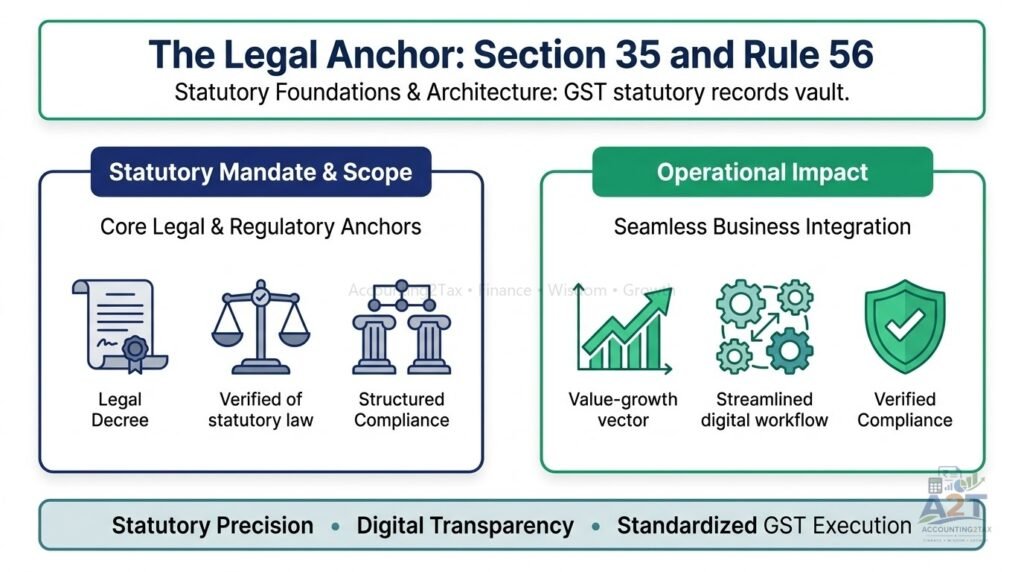
- • The Legal Anchor: Section 35 and Rule 56
- • 1. Detailed Breakdown of the 7 Mandatory Registers
- • 2. Section 36: The 72-Month Retention Rule
- • 3. Electronic Record-Keeping (Rule 56 vs. MCA Rules)
- • 4. Special Rules for Warehouse Keepers and Transporters (Rule 58)
Last Verified: 1 September 2026
Key verification sources: 56th GST Council recommendations, CBIC Tax Information Portal, CGST Rules 56 & 58.
In business operations, maintaining accurate financial records is essential for tracking profitability and managing cash flow.
Under the Goods and Services Tax (GST) regime, record-keeping is an explicit statutory obligation enforced by severe legal consequences.
During departmental audits and special scrutinies under Section 65 of the CGST Act, the burden of proof rests entirely on the taxpayer:
- If your stock register cannot account for physical inventory in your warehouse, the tax officer will invoke Section 35(6), deeming the missing stock as an unbilled sale and levying full output tax with 100% penalties!
- If you discard purchase invoices before the statutory 72-month retention window closes, your Input Tax Credit for past years can be cancelled retroactively.
- If your electronic accounting software lacks reliable source-document linkage under Rule 56, your digital records can be rejected during department investigations.
What are the 7 Mandatory Books of Accounts that every registered business must maintain under Section 35 and Rule 56? Where must these records be physically or digitally stored? How is the 72-month (6 years) retention period under Section 36 calculated? What special compliance rules apply to warehouse keepers and transporters (Rule 58)? And what is the Master Document Checklist required for audit readiness?
This comprehensive guide breaks down the legal framework of GST record-keeping, details statutory registers, and provides an audit-ready compliance SOP.
The Legal Anchor: Section 35 and Rule 56
Under Section 35(1) of the Central Goods and Services Tax (CGST) Act, 2017:
THE MANDATORY RECORD-KEEPING MANDATE
                                         │
Every registered person MUST maintain a true and correct account of all business
transactions at their PRINCIPAL PLACE OF BUSINESS and all ADDITIONAL PLACES OF BUSINESS.
                                         │
 ┌─────────────────────────────────────────────────────────────────────────────┐
 │  THE 7 STATUTORY CORE REGISTERS (RULE 56):                                  │
 │  1. Production or manufacture of goods.                                     │
 │  2. Inward supply of goods and services (Purchase Register).                │
 │  3. Outward supply of goods and services (Sales Register).                  │
 │  4. Stock and inventory of goods.                                           │
 │  5. Input Tax Credit (ITC) claimed and utilized.                            │
 │  6. Output tax payable and actually paid.                                   │
 │  7. Advances received, paid, and adjustment vouchers.                      │
 └─────────────────────────────────────────────────────────────────────────────┘
1. Detailed Breakdown of the 7 Mandatory Registers
THE 7 STATUTORY REGISTERS
                                         │
        ┌────────────────────┬───────────┴───────────┬────────────────────┐
        ▼                    ▼                       ▼                    ▼
 [ 1. SALES REGISTER ] [ 2. PURCHASE LEDGER ] [ 3. STOCK INVENTORY ] [ 4. ITC LEDGER ]
 Invoice-wise B2B &    Inward invoices with   Opening stock,         Eligible ITC claimed,
 B2C outward supplies  supplier GSTIN & HSN   receipts, damages &    ineligible reversed
                                              closing stock
A. Inward & Outward Supply Registers (Purchase & Sales)
Must maintain an invoice-by-invoice record containing:
– Serial number, date, and customer/vendor GSTIN
– HSN / SAC codes, quantity, and unit price
– Taxable value and explicit columns for CGST, SGST, IGST, and Cess
– Place of supply and state code for inter-state deliveries
B. Stock and Inventory Register (The Anti-Theft Ledger)
A critical record detailing:
– Opening inventory balance at the start of the period
– Receipt of raw materials, traded goods, and capital machinery
– Goods manufactured, processed, or assembled
– Goods supplied / sold
– Goods lost, stolen, destroyed, written off, or given as free samples
– Closing balance of physical stock on hand
C. Input Tax Credit (ITC) & Tax Payment Ledgers
Reconciles taxes paid to suppliers against credits utilized in GSTR-3B. Must clearly document ineligible blocked credits reversed under Section 17(5) and non-payment reversals under the 180-day rule.
2. Section 36: The 72-Month Retention Rule
Under Section 36 of the CGST Act, books of accounts cannot be destroyed after filing annual taxes:
 ┌─────────────────────────────────────────────────────────────────────────────┐
 │  CASE STUDY: RETENTION TIMELINE FOR FINANCIAL YEAR 2025-26                  │
 │  • Financial Year: FY 2025-26 (01-April-2025 to 31-March-2026)              │
 │  • Due Date of Annual Return (GSTR-9): 31st December 2026                   │
 │  • Statutory 72-Month Period Begins: 31st December 2026                     │
 │  • Expiry of 72 Months: 31st December 2032                                  │
 │                                                                             │
 │  RESULT: YOU MUST PRESERVE ALL INVOICES, REGISTERS, AND BANK STATEMENTS     │
 │  UNTIL AT LEAST 31ST DECEMBER 2032!                                         │
 └─────────────────────────────────────────────────────────────────────────────┘
Special Rule for Litigations & Appeals: If any invoice or transaction is subject to an appeal, revision, or department investigation, records must be retained for 1 year after final disposal of the case, or 72 months, whichever is later.
3. Electronic Record-Keeping (Rule 56 vs. MCA Rules)
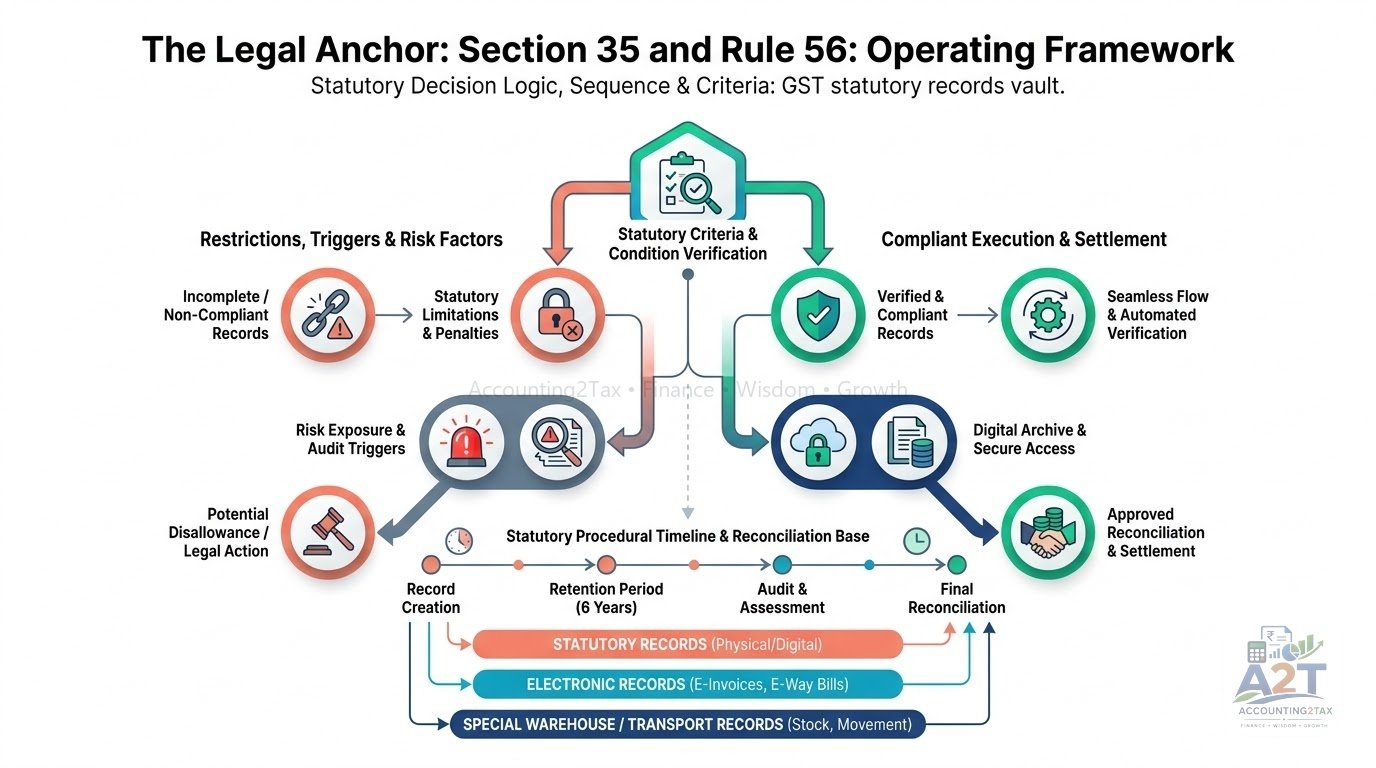
When keeping records electronically, it is crucial to distinguish between company law and GST law:
- MCA Audit Trail (Companies Act): Applies to companies. Software must track every edit and date change via an immutable edit log.
- GST Rule 56(15) & (16): Applies to ALL registered persons (including proprietors and partnerships). You must ensure proper backup of records, ensure records can be reproduced in an intelligible form, and provide tax officers with on-demand access (passwords/decrypted records) during inspections.
4. Special Rules for Warehouse Keepers and Transporters (Rule 58)
Under Section 35(2), operators of warehouses, godowns, and transport services must maintain distinct records, even if they are unregistered under GST:
 ┌─────────────────────────────────────────────────────────────────────────────┐
 │  WAREHOUSE OPERATORS MUST RECORD:                                           │
 │  • Period for which goods remain in the warehouse.                          │
 │  • Details of consignor, consignee, and description of packages.            │
 │  • Dispatch, movement, receipt, and disposal records of all stored goods.   │
 └─────────────────────────────────────────────────────────────────────────────┘
5. The Dangerous Penalty: Section 35(6) “Deemed Supply” Trap
If a registered taxpayer fails to account for goods in their stock registers:
 ┌─────────────────────────────────────────────────────────────────────────────┐
 │  THE STATUTORY CONSEQUENCE:                                                 │
 │  1. The officer assesses full output GST on the missing goods.              │
 │  2. Levies applicable penal interest under Section 50.                      │
 │  3. Imposes a 100% penalty under Section 122(1) for tax evasion!            │
 └─────────────────────────────────────────────────────────────────────────────┘
Master GST Document Retention Checklist
| Document Category | Specific Records Required | Minimum Retention Window | Statutory Basis |
|---|---|---|---|
| Outward Sales | Tax Invoices, Bills of Supply, Credit/Debit Notes | 72 Months from GSTR-9 Due Date | Section 35(1)(c) |
| Inward Purchases | Tax Invoices, Delivery Challans, Bills of Entry | 72 Months from GSTR-9 Due Date | Section 35(1)(b) |
| Stock & Inventory | Quantitative Stock Register, Wastage Logs | 72 Months from GSTR-9 Due Date | Rule 56(2) |
| Logistics & Transit | E-Way Bills, Transporter Receipts (LR/GR) | 72 Months from GSTR-9 Due Date | Rule 56(3) |
| Banking Records | Bank Statements, Payment Vouchers, Cheque Slips | 72 Months from GSTR-9 Due Date | Rule 56(7) |
| Production Records | Raw Material Consumption vs Finished Yield | 72 Months from GSTR-9 Due Date | Rule 56(12) |
| Litigation Files | Notices, Appeals, Tribunal/Court Submissions | 1 Year Post Final Disposal | Section 36 Proviso |
Frequently Asked Questions (FAQs)
Q1. Do I need an MCA-compliant audit trail software for GST?
Answer: The MCA audit trail requirement applies specifically to companies under the Companies (Accounts) Rules. However, under GST Rule 56, ALL taxpayers keeping digital records must ensure proper backup and ability to produce records on demand.
Q2. How long do I actually need to keep my records?
Answer: The minimum statutory period is 72 months from the due date of filing GSTR-9 for that financial year. However, if any audit or appeal is ongoing, you must keep them until 1 year after the final disposal of the case.
Q3. Does an unregistered transporter need to maintain records?
Answer: Yes, under Rule 58, even unregistered transporters and warehouse keepers must maintain records of the consignor, consignee, and movement of goods.
Calculate Your GST Liabilities and Tax Reconciliations
Model your inventory tax splits, verify electronic credit and cash ledger balances, and ensure complete reconciliation using the Accounting2Tax Financial Tools.
Use the GST Calculator to verify your output taxes and input credits.
Related Financial Wisdom
- GST Compliance Checklist for Small Businesses
- GST Notices Explained: What Businesses Must Do
- GST Invoice Explained: Mandatory Rules and E-Invoicing
- Input Tax Credit Explained: How GST Purchases Work
- Late GST Return Filing: Late Fees and Interest
Key Takeaways
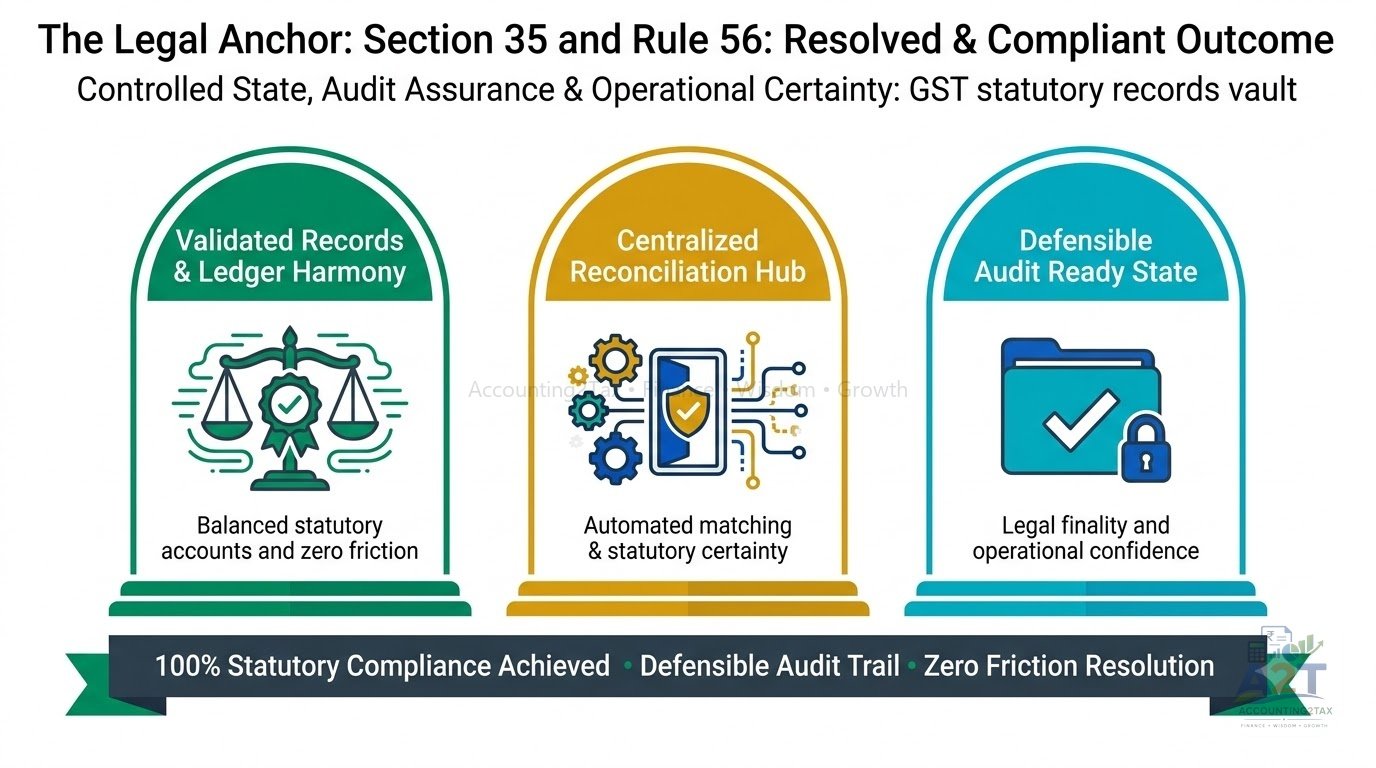
- Businesses must maintain 7 core statutory registers under Section 35 and Rule 56 at their Principal and Additional Places of Business.
- Under Section 36, all records must be preserved for 72 months (6 years) from the due date of filing the Annual Return (GSTR-9).
- Electronic records must be backed up properly and readily reproducible under Rule 56(15).
- Warehouse keepers and transporters must maintain consignor-wise inventory records under Rule 58.
- Unaccounted inventory is treated as a deemed taxable supply under Section 35(6), triggering full GST plus 100% penalties.
📚 Sources & Official Regulatory References
| Topic / Statutory Regulation | Source | Authority | Checked On | Effective Date |
|---|---|---|---|---|
| Section 35 & 36 (Accounts, Records, Retention) | CGST Act, 2017 | Tier 1 | 2026-09-01 | Current |
| Rule 56 & Rule 58 | CGST Rules, 2017 | Tier 1 | 2026-09-01 | Current |
| Section 65 (Audit) & Section 122 (Penalties) | CGST Act, 2017 | Tier 1 | 2026-09-01 | Current |
📚 Explore More in Compliance (GST)
Taxonomy Series
Discover related guides, taxonomy series, and interactive financial calculators:
This publication is strictly for educational, research, and informational purposes and does not constitute formal financial, investment, tax, or legal advice.