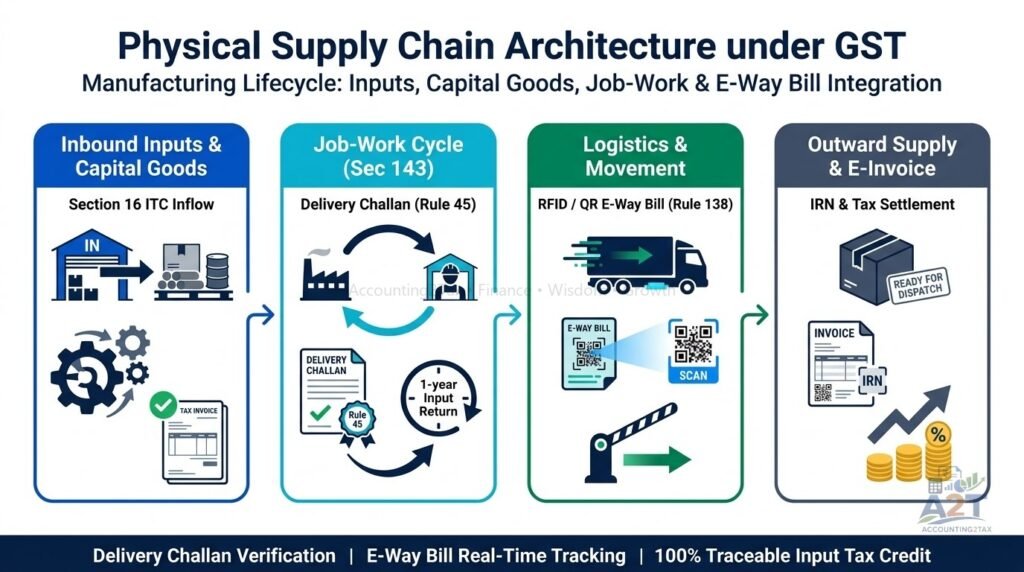
- • The Physical Supply Chain Architecture under GST
- • 1. Job Work Mechanism under Section 143 (Tax-Free Processing)
- • 2. Inverted Duty Structure: Claiming Cash Refunds (Section 54(3))
- • 3. E-Way Bill Logistics & Rule 138 Protocols
- • 4. Capital Goods ITC: The Capital-Goods ITC and Rule 43
Last Verified: 1 September 2026. Key verification sources: GST Council 56th Meeting (Sept 2025), CBIC Tax Information Portal, GSTN/GST Portal advisories.
For physical businesses—factories producing goods, wholesale distributors, and multi-tier traders—the Goods and Services Tax (GST) is deeply integrated into daily supply chain operations.
Unlike service providers who primarily manage digital invoices, manufacturers and traders must orchestrate the physical movement of raw materials, outsourced job-work processing, warehouse stock transfers, transport logistics, and inventory scrap.
A single operational slip in the physical supply chain can disrupt operations:
- If semi-finished goods sent to a job worker are not returned within the statutory 1-year window, the transaction counts as an unbilled sale, triggering GST with 18% penal interest.
- If your raw materials attract tax at 18% while your finished products attract tax at 5%, your working capital becomes trapped in an Inverted Duty Structure.
- If a transport truck moves goods valued at ₹55,000 without an active E-Way Bill, tax enforcement squads can seize the vehicle and levy a 200% penalty under Section 129!
How does the Job Work framework under Section 143 allow tax-free processing using Delivery Challans? How can factories claim cash bank refunds for Inverted Duty Structures under Section 54(3)? What are the E-Way bill threshold (₹50,000) and validity rules under Rule 138? How is Capital Goods ITC apportioned over 60 months under Rule 43? And what is the legal difference between inherent manufacturing process loss and taxable inventory shrinkage?
This comprehensive guide breaks down the indirect tax framework for Indian manufacturers and traders, details statutory mechanics, and provides an actionable operational roadmap.
The Physical Supply Chain Architecture under GST
In physical commerce, GST follows goods across every transformation and transit milestone:
THE MANUFACTURING & TRADING GST LIFECYCLE
                                         │
 ┌─────────────────────────────────────────────────────────────────────────────┐
 │  RAW MATERIALS ──► 1. Procure inputs & capital goods; claim 100% ITC.       │
 │        │                                                                    │
 │  JOB WORK      ──► 2. Send to job worker via Delivery Challan (No tax u/s 143)│
 │        │                                                                    │
 │  MANUFACTURE   ──► 3. Transform into finished goods (Track normal vs bad loss)│
 │        │                                                                    │
 │  LOGISTICS     ──► 4. Generate E-Way Bill (Consignment value > ₹50,000).    │
 │        │                                                                    │
 │  DISTRIBUTION  ──► 5. Issue Tax Invoice, collect GST & offset inward ITC.   │
 └─────────────────────────────────────────────────────────────────────────────┘
1. Job Work Mechanism under Section 143 (Tax-Free Processing)
Job work means undertaking any treatment or process on goods belonging to another registered person (e.g. dyeing fabric, machining engine parts, packaging).
Under Section 143 of the CGST Act, a registered manufacturer (the Principal) can send inputs or capital goods to a job worker without paying GST, subject to strict conditions:
THE JOB WORK COMPLIANCE TIMELINES
                                         │
        ┌────────────────────────────────┴────────────────────────────────┐
▼ ▼
[ INPUTS & SEMI-FINISHED GOODS ] [ CAPITAL GOODS (MACHINERY) ]
• Must be brought back to factory or sold • Must be brought back or sold
directly WITHIN 1 YEAR (extendable by 1 yr). WITHIN 3 YEARS (extendable by 2 yrs).
• Transported under DELIVERY CHALLAN (Rule 55). • Transported under DELIVERY CHALLAN.
                                         │
▼
[ THE PENALTY FOR DELAY: SECTION 143(3) & (4) DEEMED SUPPLY TRAP ]
If goods are not returned within 1 year (or 3 years for capital goods), they are
STATUTORILY DEEMED AS A TAXABLE SALE on the day they were originally sent out.
The Principal must pay full output GST + 18% penal interest from Day 1.
Filing Declaration: The Principal must submit Form GST ITC-04 detailing all goods dispatched to and received from job workers. Note the frequency per Notification 35/2021-CT: businesses with AATO > ₹5 Cr file half-yearly, and businesses with AATO ≤ ₹5 Cr file annually (not quarterly).
2. Inverted Duty Structure: Claiming Cash Refunds (Section 54(3))
In several manufacturing sectors, the rate of tax on raw material inputs is higher than the rate of tax on the finished product:
 ┌─────────────────────────────────────────────────────────────────────────────┐
 │  EXAMPLE: TEXTILE & GARMENT MANUFACTURING                                   │
 │  • Inward Raw Materials (Polyester Yarn / Dyes): Taxed at 18% GST           │
 │  • Outward Finished Goods (Apparel < ₹1,000): Sold at 5% GST                │
 │                                                                             │
 │  RESULT: Input Tax Credit accumulates faster than output liability,         │
 │  trapping working capital in the Electronic Credit Ledger!                  │
 └─────────────────────────────────────────────────────────────────────────────┘
The Cash Refund Remedy:
Under Section 54(3) and Rule 89(5), manufacturers can apply for a direct cash bank refund of this unutilized accumulated ITC. Notification 14/2022-CT amended the Rule 89(5) formula to correctly apportion the reduction of tax payable:
3. E-Way Bill Logistics & Rule 138 Protocols
Under Rule 138 of the CGST Rules, every registered person who causes the movement of goods must generate an electronic E-Way Bill (Form GST EWB-01) prior to dispatch:
THE E-WAY BILL ESSENTIALS
                                       │
 ┌─────────────────────────────────────────────────────────────────────────────┐
 │  1. MANDATORY THRESHOLD: Consignment value exceeding ₹50,000.               │
 │  2. DUAL PART STRUCTURE:                                                    │
 │     • Part A: Consignor/Consignee GSTIN, HSN, Taxable Value, Invoice No.   │
 │     • Part B: Transporter ID, Vehicle Registration Number / LR Number.     │
 │  3. VALIDITY DISTANCE FORMULA:                                              │
 │     • Regular Cargo: 1 Day for every 200 km (or part thereof).             │
 │     • Over-Dimensional Cargo (ODC): 1 Day for every 20 km.                 │
 │  4. TRANSIT DETENTION PENALTY (SECTION 129):                                │
 │     • Moving goods without a valid E-Way Bill attracts a penalty equal to   │
 │       200% OF THE TAX PAYABLE on the detained goods!                        │
 └─────────────────────────────────────────────────────────────────────────────┘
4. Capital Goods ITC: The Capital-Goods ITC and Rule 43
When a factory purchases heavy machinery, the asset is used over several years to produce both taxable and exempt products:
- Under Rule 43 of the CGST Rules, the statutory economic life of all capital goods is fixed at 5 years (60 months).
- If a machine is used partly for taxable goods and partly for exempt goods, the ITC is divided by 60. The monthly exempt portion is credited back to output liability in Form GSTR-3B every month for 5 years. (This must be read in conjunction with Sections 16 and 17 based on the asset’s specific use).
5. Manufacturing Process Loss vs. Unaccounted Wastage
PROCESS LOSS VS UNACCOUNTED WASTAGE
                                       │
        ┌──────────────────────────────┴──────────────────────────────┐
▼ ▼
[ INHERENT PROCESS LOSS / SCRAP ] [ UNACCOUNTED LOSS / THEFT / DAMAGE ]
• Normal chemical evaporation, cutting scrap, • Goods stolen from warehouse, fire damage,
or machining yield loss. or unexplained physical inventory shortage.
• NO ITC REVERSAL REQUIRED. ✅ • STATUTORILY BLOCKED U/S 17(5)(h). ❌
• (Scrap sold is charged to output GST). • Full ITC claimed on inputs MUST BE REVERSED.
6. Modern GST Enhancements
- IMS (Invoice Management System): Manufacturers must track inward supply flows where they Accept, Reject, or mark Pending for inbound invoices before GSTR-2B is formed.
- GSTR-1A: This new facility allows a factory to amend its GSTR-1 prior to the GSTR-3B filing to catch errors proactively.
- DRC-03A: Links ad-hoc payments via DRC-03 directly to pending demand orders.
- E-Invoice 30-day reporting restriction: Required for AATO ≥ ₹10 Crore, ensuring invoices reach the IRP within 30 days.
Master Comparison: Manufacturers vs. Traders

| Compliance Dimension | Physical Goods Manufacturer | Wholesale & Retail Trader |
|---|---|---|
| Primary Statutory Sections | Section 35(1)(a), Section 143, Sec 54(3) | Section 35(1)(d), Section 12, Rule 138 |
| Job Work Compliance | Mandatory Form GST ITC-04 & Delivery Challan | Rarely applicable |
| Inverted Duty Refund | Available on Input Goods (Rule 89(5)) | Limited (no refund on input services) |
| Stock Records | Raw materials, WIP, Finished goods yield | Inward receipts, Sales, Closing inventory |
| E-Way Bill Generation | Dispatches to distributors & job workers | Stock transfers & dispatches to retailers |
| HSN Code Disclosure | 4 digits ($\le ₹5\text{Cr}$) / 6 digits (> ₹5Cr) | 4 digits ($\le ₹5\text{Cr}$) / 6 digits (> ₹5Cr) |
Frequently Asked Questions (FAQs)
Q1. How often do I need to file Form GST ITC-04?
Answer: Per Notification 35/2021-CT, taxpayers with an Annual Aggregate Turnover (AATO) over ₹5 Crore file half-yearly, and those with an AATO up to ₹5 Crore file annually.
Q2. My E-way bill expired due to truck breakdown. What should I do?
Answer: The E-way bill validity is 1 day per 200 km. You can extend the validity of the E-way bill within 8 hours before or after its expiry. Failure to do so can invite 200% penalty on tax amount if detained.
Q3. Can I claim refund on inverted duty structure for both input goods and services?
Answer: No. Rule 89(5) permits inverted duty refund calculation primarily for accumulated ITC on input goods, not input services.
Q4. Does normal manufacturing scrap require ITC reversal?
Answer: No. Normal process loss or scrap inherently generated during manufacturing does not require ITC reversal. However, you must charge applicable output GST when selling the scrap.
Q5. What happens if job-worked goods are not returned in 1 year?
Answer: The goods will be deemed as a taxable supply from the date they were sent out, triggering output GST liability along with 18% penal interest.
Calculate Your GST Liabilities and Inverted Duty Refunds
Model your Inverted Duty Structure refund claims, calculate E-Way bill consignment thresholds, and manage input tax credits across your manufacturing pipeline using the Accounting2Tax Financial Tools.
Use the GST Calculator to model your production costs and tax structures.
Related Financial Wisdom
- GST Rates Explained: 5%, 18%, 40% Slabs — rate schedules.
- GST Invoice Explained: Mandatory Rules and E-Invoicing — invoicing standards.
- Input Tax Credit Explained: How GST Purchases Work — ITC fundamentals.
- GST Records and Books of Accounts Rules — record-keeping rules.
- GST Compliance Checklist for Small Businesses — compliance checklist.
Key Takeaways
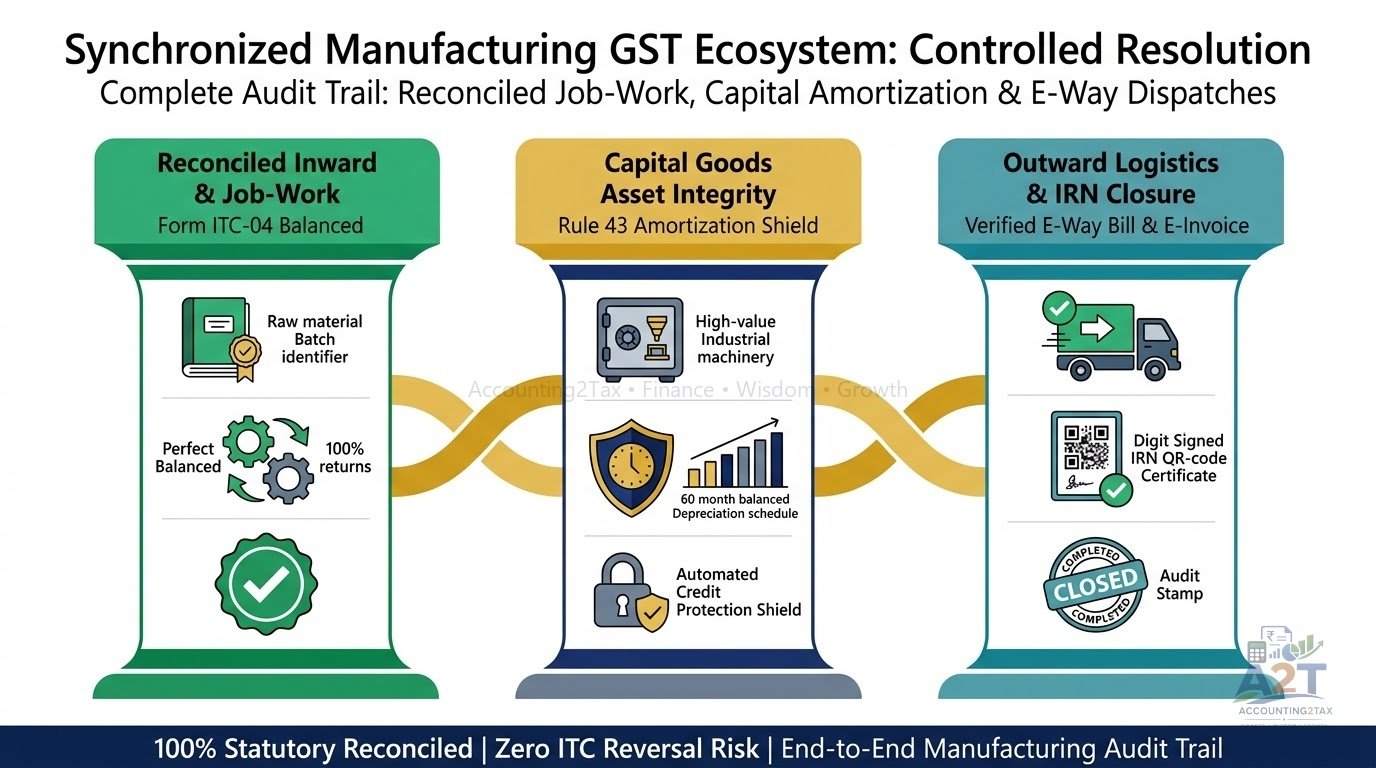
- Physical manufacturers can send goods for tax-free Job Work under Section 143 using Delivery Challans.
- Job work goods must return within 1 year (inputs) or 3 years (capital goods) to avoid deemed supply penalties.
- Businesses with Inverted Duty Structures can claim direct cash refunds under Section 54(3) utilizing the updated Rule 89(5) formula.
- Consignments exceeding ₹50,000 must carry an active E-Way Bill (valid for 200 km per day).
- Capital goods ITC is statutorily apportioned over 60 months under Rule 43 relative to exempt/taxable supplies.
- Inherent normal process loss requires no reversal, while unaccounted inventory shortages require full ITC reversal under Section 17(5)(h).
📚 Sources & Official Regulatory References
| Topic / Statutory Regulation | Source | Authority | Checked On | Effective Date |
|---|---|---|---|---|
| Section 143 (Job Work Procedure) & Form GST ITC-04 Rules | Central Goods and Services Tax Act, 2017 | Tier 1 | 2026-08-26 | Current |
| Section 54(3) & Rule 89(5) (Inverted Duty Structure Refund Formula) | CBIC (Notification 14/2022-CT) | Tier 1 | 2026-08-26 | Current |
| Rule 138 to 138E (E-Way Bill Rules, Thresholds and Validity) | Central Goods and Services Tax Rules, 2017 | Tier 1 | 2026-08-26 | Current |
| Rule 43 (Apportionment of ITC on Capital Goods over 60 Months) | Ministry of Finance, Government of India | Tier 1 | 2026-08-26 | Current |
📚 Explore More in Business GST (GST)
Taxonomy Series
Discover related guides, taxonomy series, and interactive financial calculators:
This publication is strictly for educational, research, and informational purposes and does not constitute formal financial, investment, tax, or legal advice.
- Data Accuracy & Inadvertent Errors: While every reasonable effort is made to maintain accuracy, all information, interest rates, tax thresholds, formulas, and statutory data are provided on an “as-is” basis. Accounting2Tax makes no express or implied warranties regarding absolute completeness, timeliness, or typographical and computational infallibility. Statutory authorities (Ministry of Finance, RBI, CBDT, CBIC, SEBI, PFRDA) update guidelines periodically. Readers must independently verify current rates and rules on official government portals before executing financial transactions.
- Illustrations, Simulations & Limitations of Liability: Mathematical models, compounding simulations, case studies, and hypothetical return projections are conceptual tools designed solely to demonstrate financial principles. They do not constitute guaranteed returns, profit forecasts, or capital safety commitments. Accounting2Tax and its authors disclaim all liability for any direct, indirect, or consequential financial losses, tax penalties, or investment outcomes arising from inadvertent errors, omissions, calculation discrepancies, or reliance placed on this material.
- Professional Consultation: Readers must independently evaluate their individual financial goals, tax positions, and risk tolerance, and consult a SEBI-registered financial advisor or certified chartered accountant before making financial decisions.