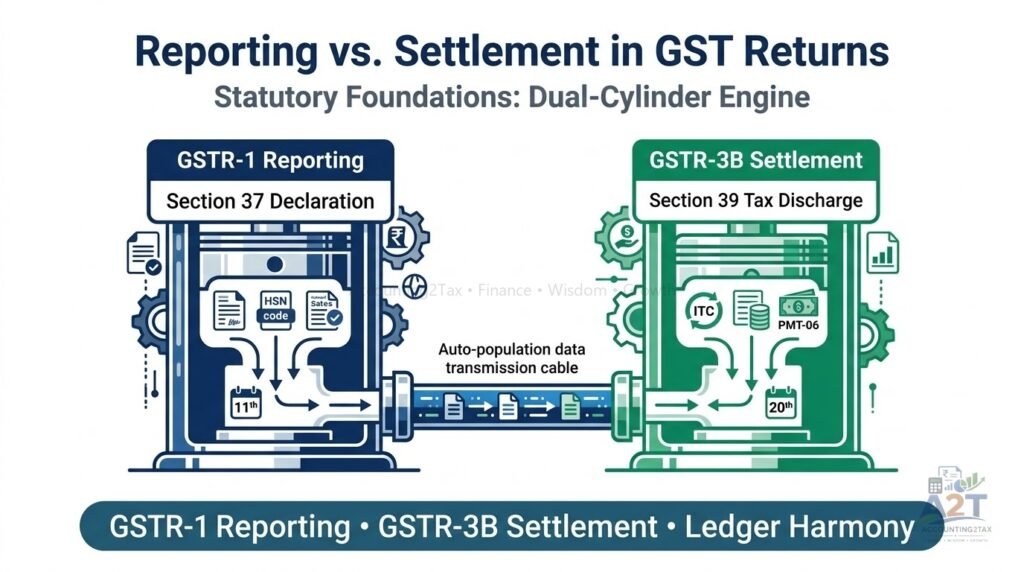
- • The Core Distinction: Reporting vs. Settlement
- • Head-to-Head Comparison Matrix
- • The Interconnected Workflow: How GSTR-1 and GSTR-3B Interact
- • The Sequential Filing Rule: The Anti-Evasion Lock
- • The Mismatch Trap: Rule 88C & Form DRC-01B
Last Verified: 1 September 2026
Key verification sources: GST Council 56th Meeting (Sept 2025), CBIC Tax Information Portal, GSTN/GST Portal advisories.
For every GST-registered business in India, monthly compliance revolves around two core statutory filings: GSTR-1 and GSTR-3B.
New business owners frequently ask:
“Why does the government make us file two different returns every single month?”
“If I already declared all my sales invoices in GSTR-1, why do I have to enter my sales figures again in GSTR-3B?”
“What happens if the tax figure reported in GSTR-1 does not match the tax paid in GSTR-3B?”
While GSTR-1 is a statement of outward supplies (sales), GSTR-3B is a summary return for tax payment and Input Tax Credit (ITC) settlement. They serve completely different statutory purposes, follow strict sequential filing locks, and are interconnected through the nationwide GST data pipeline.
Failing to align these two returns can trigger automated tax recovery notices under Rule 88C (Form DRC-01B) and lead to the blocking of future return filings.
This guide provides a crystal-clear breakdown of how GSTR-1 and GSTR-3B differ, how they interact, the sequential filing rules, and how to rectify errors.
GSTR-1A: The Pre-3B Correction Facility
Introduced as a critical compliance enhancement, GSTR-1A is an amendment facility available after filing GSTR-1 but before filing GSTR-3B for the same period.
– Purpose: Taxpayers can add, modify, or delete records in their filed GSTR-1 before the liability flows into GSTR-3B.
– Workflow: Any changes made via GSTR-1A automatically update the outward tax liability in the corresponding GSTR-3B.
– Legal Certainty: Settled. This ensures that minor errors in GSTR-1 do not force a mismatch (and a Rule 88C notice) in the current month.
The Core Distinction: Reporting vs. Settlement
GSTR-1 vs. GSTR-3B Roles
                                       │
        ┌──────────────────────────────┴──────────────────────────────┐
▼ ▼
[ GSTR-1: The Invoicing Ledger ]       [ GSTR-3B: The Tax Cashier ]
• Statement of Outward Supplies        • Monthly Summary Tax Return
• Detailed invoice-by-invoice data     • Aggregated totals only (no invoice lists)
• Feeds buyer's GSTR-2B for ITC        • Claims ITC and pays net cash tax
• NO TAX PAYMENT occurs here           • ACTUAL TAX SETTLEMENT occurs here
Head-to-Head Comparison Matrix
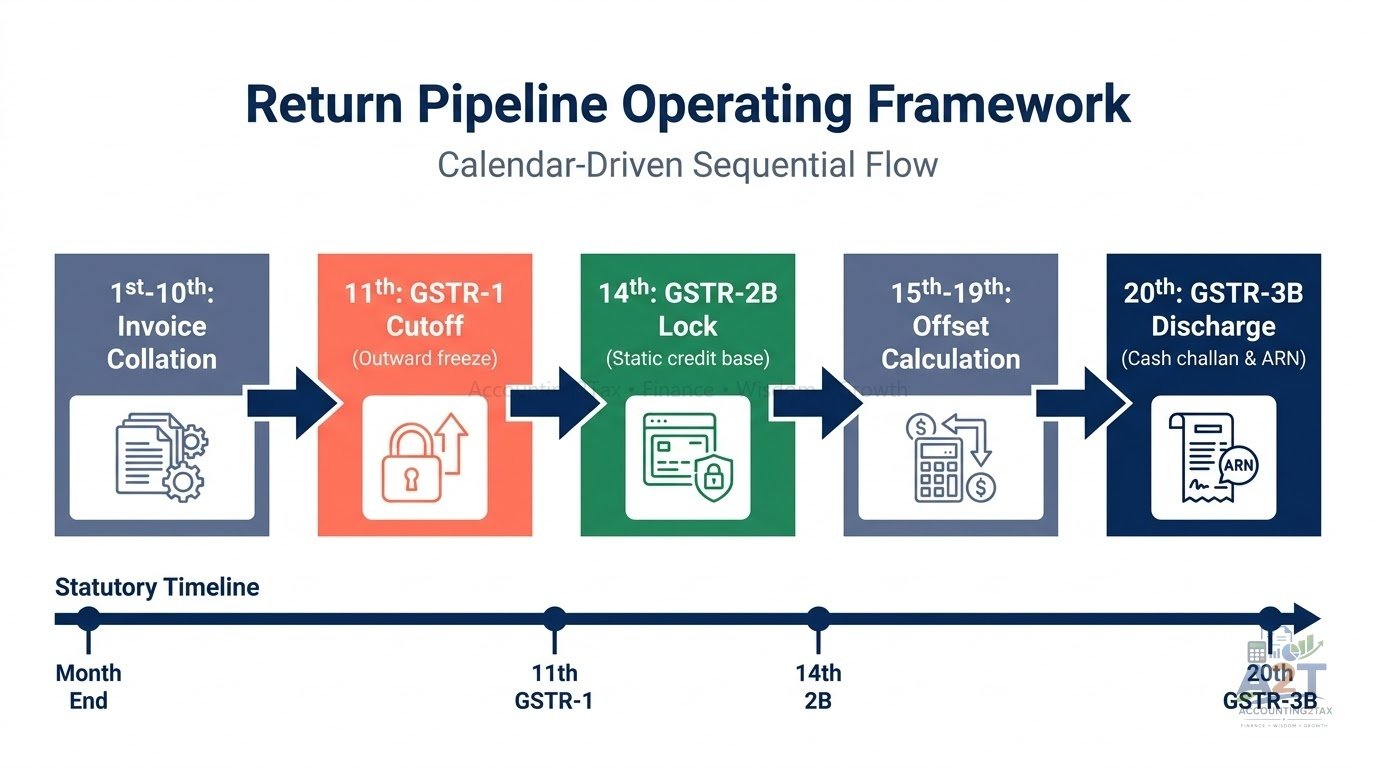
| Parameter | GSTR-1 | GSTR-3B |
|---|---|---|
| Statutory Authority | Section 37 of CGST Act | Section 39 of CGST Act |
| Primary Purpose | Report detailed sales (outward supplies) to the government and buyers | Settle net tax liability and claim Input Tax Credit (ITC) |
| Nature of Data | Invoice-level breakdown (B2B invoices, B2C large/small, HSN summaries, debit/credit notes) | Aggregated summary totals (Total taxable sales, total ITC claimed, total tax payable) |
| Tax Payment Involved? | NO (Only informational sales declaration) | YES (Tax must be paid in cash/credit to file) |
| Input Tax Credit Claimed? | NO | YES (Eligible ITC from GSTR-2B claimed here) |
| Standard Due Date | 11th of subsequent month (Monthly) / 13th (QRMP) | 20th of subsequent month (Monthly) / 22nd/24th (QRMP) |
| Late Fees Applicable? | Yes, under Section 47 (accumulated in next GSTR-3B) | Yes, under Section 47 + 18% interest under Section 50 |
| Impact on Buyers | Directly generates buyer’s GSTR-2B to claim ITC | Has no direct impact on buyer’s ITC passbook |
The Interconnected Workflow: How GSTR-1 and GSTR-3B Interact
The Invoice Management System (IMS) Pipeline
The modern GST pipeline incorporates the Invoice Management System (IMS), functional from October 2024:
1. Seller files GSTR-1.
2. Invoices flow into the buyer’s IMS dashboard.
3. Buyer exercises Accept, Reject, or Pending actions on these invoices.
4. Accepted/Pending invoices populate the buyer’s GSTR-2B, enabling ITC claims in GSTR-3B.
To see the economic beauty of the GST data pipeline, follow how an invoice flows from seller to buyer:
Step 1: Seller uploads sales invoices into GSTR-1 by the 11th.
                            │
▼
Step 2: GST Portal processes GSTR-1 and auto-populates Buyer's GSTR-2B on the 14th.
                            │
▼
Step 3: Seller files GSTR-3B by the 20th and pays the Output Tax collected.
                            │
▼
Step 4: Buyer files GSTR-3B by the 20th and claims the Input Tax Credit from GSTR-2B.
The Sequential Filing Rule: The Anti-Evasion Lock
Under Section 37(4) and Section 39(10) of the CGST Act, the GST portal enforces strict sequential return filing:
Sequential Return Filing Rules
                                    │
 ┌──────────────────────────────────┴──────────────────────────────────┐
 │ RULE 1: You CANNOT file current month GSTR-1 if previous month      │
 │         GSTR-3B remains unfiled.                                    │
 ├─────────────────────────────────────────────────────────────────────┤
 │ RULE 2: You CANNOT file current month GSTR-3B if current month      │
 │         GSTR-1 has not been filed.                                  │
 └─────────────────────────────────────────────────────────────────────┘
This prevents businesses from uploading dummy sales invoices in GSTR-1 to pass on fraudulent ITC to accomplices without subsequently filing GSTR-3B and paying the corresponding tax.
The Mismatch Trap: Rule 88C & Form DRC-01B
One of the most dangerous compliance risks for businesses is an unexplained mismatch between GSTR-1 and GSTR-3B:
GSTR-1 Output Tax Declared: ₹5,00,000      GSTR-3B Output Tax Paid: ₹3,50,000
─────────────────────────────────────────────────────────────────────────────
TAX SHORTFALL: ₹1,50,000 (Triggers Form DRC-01B)
How Rule 88C Operates:
- Automated Intimation: If the tax declared in your GSTR-1 exceeds the tax paid in GSTR-3B by a prescribed percentage (typically 20%) AND the difference exceeds ₹25 Lakhs, the GST portal automatically issues Form DRC-01B (Part A) via email and on the portal.
- 7-Day Statutory Window: The taxpayer is given 7 days to:
– Pay the differential tax liability along with applicable interest under Section 50 via Form DRC-03; OR
– Provide reasons explaining the difference in Part B of Form DRC-01B (e.g., duplicate invoice entry in GSTR-1, clerical typo, or timing difference). - Consequences of Inaction: If you fail to respond within 7 days, the portal automatically blocks the generation of your subsequent GSTR-1/IFF. Tax recovery proceedings begin under Section 79.
How to Correct Mistakes in GSTR-1 and GSTR-3B
Because GST returns cannot be revised once filed, corrections must be made using specific facilities or in subsequent tax periods:
1. Correcting Mistakes in GSTR-1:
- Errors in GSTR-1 can now be corrected in the same month before GSTR-3B filing using the GSTR-1A facility.
- For subsequent periods, if you entered an incorrect invoice value, wrong GSTIN, or wrong tax rate in GSTR-1, you can rectify it in the Amendment Tables of subsequent GSTR-1 filings (e.g., Table 9A for B2B amendments, Table 9B for credit notes, Table 10 for B2C amendments).
2. Correcting Mistakes in GSTR-3B:
- If you paid less tax in GSTR-3B, declare and pay the additional tax in the next GSTR-3B along with 18% Section 50 interest.
- If you claimed excess ITC in GSTR-3B, reverse the excess ITC in Table 4(B) of the subsequent GSTR-3B with interest.
Calculate Your Net GST Liabilities
Calculate your sales tax liabilities, compare input tax credits, and model monthly GST payments using the Accounting2Tax GST Calculator.
Use the GST Calculator to reconcile your GSTR-1 sales figures and GSTR-3B cash payments.
Related Financial Wisdom
- GST Returns Explained: Understanding the GST Filing System — return overview.
- CGST, SGST, IGST and UTGST: Understanding the Different GST Components — tax breakdown.
- Input Tax Credit Explained: How GST Paid on Purchases Works (Article 101 — coming soon).
- ITC Reconciliation: Why GSTR-2B Matters (Article 104 — coming soon).
- GST Compliance Checklist: Key Requirements for Registered Businesses (Article 105 — coming soon).
Key Takeaways
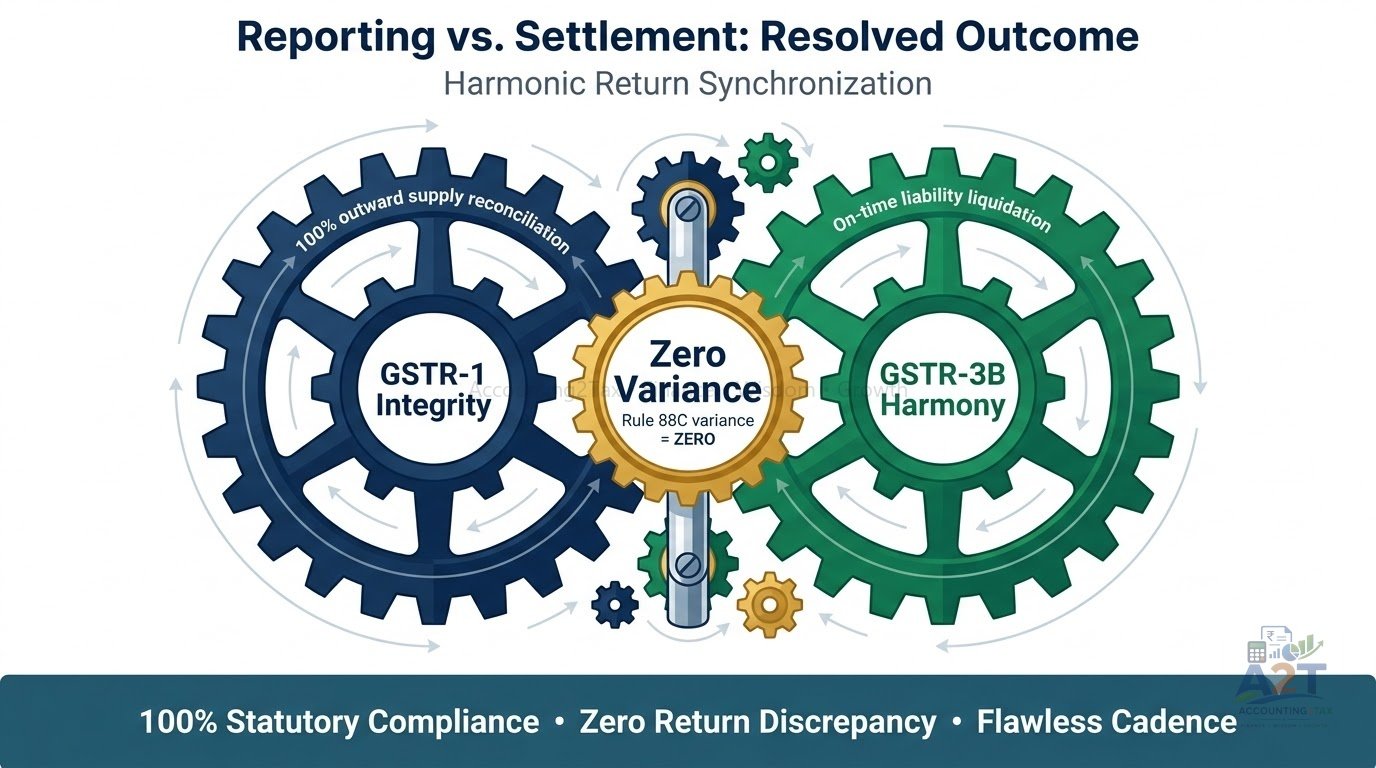
- GSTR-1 is an outward sales reporting statement with invoice-level details. GSTR-3B is a monthly summary return for ITC claims and tax payment.
- GSTR-1 generates the buyer’s GSTR-2B, enabling them to claim legitimate Input Tax Credit.
- Under sequential filing rules, you must file GSTR-1 before GSTR-3B, and previous returns must be cleared.
- Unresolved tax mismatches between GSTR-1 and GSTR-3B trigger automated Form DRC-01B notices under Rule 88C with a strict 7-day response deadline.
- Mistakes are corrected through GSTR-1A for the current month or amendment tables in subsequent return filings.
Frequently Asked Questions (FAQs)
Q1. What happens if I file GSTR-1 but fail to file GSTR-3B?
Answer: Under Section 39(10), your next month’s GSTR-1 will be blocked. Additionally, you will incur late fees and potential E-Way bill blocking under Rule 138E.
Q2. Can I revise GSTR-1 after filing?
Answer: While GSTR-1 cannot be revised, you can now use GSTR-1A to add, modify, or delete records for the current tax period before filing GSTR-3B. Past period errors are corrected using amendment tables (Table 9/10).
Q3. When is Form DRC-01B issued?
Answer: Form DRC-01B under Rule 88C is triggered automatically when the outward tax liability in GSTR-1/1A exceeds the tax paid in GSTR-3B by more than the prescribed percentage (e.g., 20%) AND ₹25 Lakhs.
📚 Sources & Official Regulatory References
| Section / Rule | Source | Authority | Checked On | Effective Date |
|---|---|---|---|---|
| Section 37 (Outward Supplies – GSTR-1) & Section 39 (Returns – GSTR-3B) | Central Goods and Services Tax Act, 2017 | Tier 1 | 2026-08-26 | Current |
| Section 75(12) & Rule 88C (Mismatches between GSTR-1 and GSTR-3B – Form DRC-01B) | CBIC Notifications / CGST Rules | Tier 1 | 2026-08-26 | Current |
| Section 37(4) & 39(10) (Mandatory Sequential Filing Restrictions) | Central Goods and Services Tax Act, 2017 | Tier 1 | 2026-08-26 | Current |
| GST Portal Architecture & Invoice Matching Protocols | Goods and Services Tax Network (GSTN) | Tier 1 | 2026-08-26 | Current |
📚 Explore More in Returns (GST)
Taxonomy Series
Discover related guides, taxonomy series, and interactive financial calculators:
This publication is strictly for educational, research, and informational purposes and does not constitute formal financial, investment, tax, or legal advice.
- Data Accuracy & Inadvertent Errors: While every reasonable effort is made to maintain accuracy, all information, interest rates, tax thresholds, formulas, and statutory data are provided on an “as-is” basis. Accounting2Tax makes no express or implied warranties regarding absolute completeness, timeliness, or typographical and computational infallibility. Statutory authorities (Ministry of Finance, RBI, CBDT, CBIC, SEBI, PFRDA) update guidelines periodically. Readers must independently verify current rates and rules on official government portals before executing financial transactions.
- Illustrations, Simulations & Limitations of Liability: Mathematical models, compounding simulations, case studies, and hypothetical return projections are conceptual tools designed solely to demonstrate financial principles. They do not constitute guaranteed returns, profit forecasts, or capital safety commitments. Accounting2Tax and its authors disclaim all liability for any direct, indirect, or consequential financial losses, tax penalties, or investment outcomes arising from inadvertent errors, omissions, calculation discrepancies, or reliance placed on this material.
- Professional Consultation: Readers must independently evaluate their individual financial goals, tax positions, and risk tolerance, and consult a SEBI-registered financial advisor or certified chartered accountant before making financial decisions.
