- • The Intangible Challenge: Location of Supplier vs. Place of Supply
- • 1. Domestic Place of Supply Rules (Section 12 of IGST Act)
- • 2. Cross-Border Services: The 5 Conditions for “Export of Services”
- • 3. Exporting Under Letter of Undertaking (LUT vs. IGST Refund)
- • 4. Import of Services & Reverse Charge Mechanism (RCM)
Last Verified: 1 September 2026. Key verification sources: GST Council 56th Meeting (Sept 2025), CBIC Tax Information Portal, Finance Act 2026, GSTN/GST Portal advisories.
In physical retail and manufacturing, determining indirect tax is straightforward: you track the physical movement of a box from a factory to a warehouse.
In the services economy—spanning IT software consulting, digital marketing, graphic design, legal counseling, architecture, and cloud engineering—goods never physically move across state or international borders.
Because services are intangible, their indirect tax treatment operates under the regulation of complex legal fictions:
“If my software firm in Pune develops code for a client in Bengaluru, do I charge CGST + SGST or IGST? What if the client is a startup in California: is my invoice 100% tax-free under Export of Services? What is a Letter of Undertaking (LUT)? Why do I have to pay 18% GST on my AWS cloud hosting invoices under Reverse Charge?”
Under the Integrated Goods and Services Tax (IGST) Act, service taxation depends on Services Accounting Codes (SAC Chapter 99), Place of Supply rules under Section 12 and Section 13, and the 5 statutory conditions for Zero-Rated Exports under Section 2(6).
How do you determine the Place of Supply for domestic B2B vs. B2C clients? What are the 5 strict conditions required for your foreign client invoices to qualify as tax-free exports? How does Filing Form GST RFD-11 (LUT) eliminate the need to pay 18% IGST upfront? And how does Reverse Charge (RCM) apply to imported software tools?
This comprehensive guide breaks down the indirect tax framework for Indian service providers, analyzes cross-border compliance, and provides an actionable operational roadmap.
The Intangible Challenge: Location of Supplier vs. Place of Supply
Under the GST framework, whether a service attracts Intra-State GST (CGST + SGST) or Inter-State GST (IGST) depends on two legal anchors:
THE SERVICE TAX JURISDICTION RULE
                                      │
     ┌────────────────────────────────┴────────────────────────────────┐
▼ ▼
[ LOCATION OF SUPPLIER ] [ PLACE OF SUPPLY (PoS) ]
The state where the service provider's registered office is situated.
The legally determined state where the service counts as to be consumed.
                                      │
▼
• If Location of Supplier == Place of Supply ──► INTRA-STATE (CGST + SGST).
• If Location of Supplier != Place of Supply ──► INTER-STATE (IGST).
• If Place of Supply is OUTSIDE India ──► ZERO-RATED EXPORT (0% with LUT).
1. Domestic Place of Supply Rules (Section 12 of IGST Act)
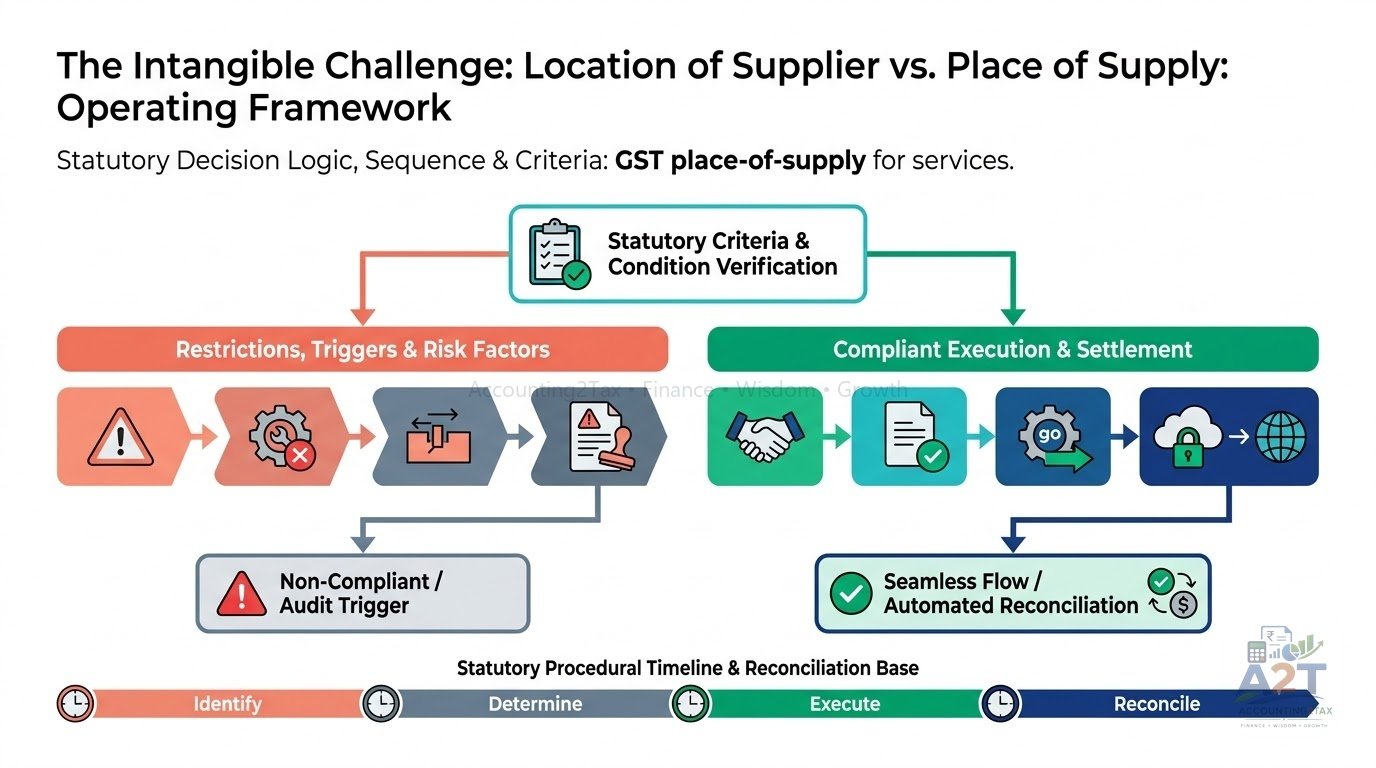
When providing services to clients within India, Section 12 establishes statutory determination rules:
DOMESTIC PLACE OF SUPPLY RULES
                                          │
 ┌─────────────────────────────────────────────────────────────────────────────┐
 │  B2B GENERAL RULE [Sec 12(2)(a)]:                                           │
 │  The Place of Supply is the REGISTERED LOCATION OF THE CLIENT (RECIPIENT).   │
 │  (Example: Delhi agency bills Mumbai client $\rightarrow$ PoS is MH $\rightarrow$ 18% IGST).│
 ├─────────────────────────────────────────────────────────────────────────────┤
 │  B2C GENERAL RULE [Sec 12(2)(b)]:                                           │
 │  1. Location of the recipient if customer address is on record.             │
 │  2. Location of the supplier if customer address is not available.          │
 ├─────────────────────────────────────────────────────────────────────────────┤
 │  IMMOVABLE PROPERTY SERVICES [Sec 12(3)]:                                   │
 │  Architects, interior designers, real estate agents:                        │
 │  Place of Supply is the LOCATION WHERE THE IMMOVABLE PROPERTY IS SITUATED.  │
 └─────────────────────────────────────────────────────────────────────────────┘
2. Cross-Border Services: The 5 Conditions for “Export of Services”
Exporting services is classified as a Zero-Rated Supply under Section 16 of the IGST Act.
However, to legally claim 0% tax, your transaction must satisfy all 5 conditions of Section 2(6) of the IGST Act:
THE 5 STATUTORY EXPORT CONDITIONS (SEC 2(6))
                                       │
 ┌─────────────────────────────────────────────────────────────────────────────┐
 │  1. SUPPLIER LOCATION: The service provider is located in India.            │
 │  2. RECIPIENT LOCATION: The recipient of service is located outside India.  │
 │  3. PLACE OF SUPPLY: The Place of Supply is outside India (Section 13).     │
 │  4. CONVERTIBLE FOREX REALIZATION: Payment is received in convertible       │
 │     foreign exchange (USD, EUR, GBP) or permitted INR via Vostro accounts. │
 │  5. INDEPENDENT ENTITIES: Supplier and recipient are not merely distinct   │
 │     establishments of the same company (e.g. branch office transfer).       │
 └─────────────────────────────────────────────────────────────────────────────┘
The Intermediary Export Transformation (Effective 30 March 2026)
One of the most litigated areas of GST has been “Intermediary Services” (such as a broker in India facilitating a supply between two foreign parties).
- Up to 29 March 2026: Under the old Section 13(8)(b) of the IGST Act, the Place of Supply for intermediary services was statutorily deemed to be the location of the supplier (India). This meant they failed Condition 3 above and could not qualify as exports, attracting 18% IGST.
- From 30 March 2026 Onward: The Finance Act 2026 OMITTED Section 13(8)(b). Now, intermediary services follow the general default rule of Section 13(2), where the Place of Supply is the location of the recipient (outside India).
Legal Certainty Classification: Fact-Dependent
Even with this omission, intermediary services do not automatically become zero-rated exports. You must still independently satisfy all 5 export conditions under Section 2(6), including proving that payment was received in convertible foreign exchange.
3. Exporting Under Letter of Undertaking (LUT vs. IGST Refund)
Service exporters have two statutory paths to execute export invoices:
TWO EXPORT FILING PATHS
                                       │
        ┌──────────────────────────────┴──────────────────────────────┐
▼ ▼
[ OPTION 1: EXPORT UNDER LUT (FORM RFD-11) ] [ OPTION 2: EXPORT WITH PAYMENT OF IGST ]
• File free annual online Letter of Undertaking (LUT) on GST portal.
• Issue export invoices with 0.0% GST.
• Claim 100% CASH REFUND of accumulated Input Tax Credit on business expenses. ✅
• Pay 18% IGST on export invoice from cash/credit.
• System auto-refunds the paid IGST upon foreign exchange realization proof (e-BRC/FIRC).
• Ties up working capital temporarily.
The Professional Recommendation: Option 1 (LUT) is standard practice for Indian IT exporters and freelancers because it protects liquid cash flow and avoids paying upfront taxes.
4. Import of Services & Reverse Charge Mechanism (RCM)
When an Indian service business purchases software tools or consulting from abroad:
- Examples: AWS Cloud Hosting, Google Workspace, GitHub, Zoom, Figma, overseas legal counsel.
- The Rule: Under Section 5(3) of the IGST Act and Notification 10/2017, this is an Import of Service subject to 100% Reverse Charge Mechanism (RCM).
- The Workflow: You must self-invoice, pay 18% IGST through your Electronic Cash Ledger in Form GSTR-3B Table 3.1(d), and simultaneously claim 100% of this amount as Input Tax Credit in Table 4(A)(2) in the exact same return.
5. Modern Compliance Tooling: IMS, GSTR-1A, and More
Service businesses must also adhere to recent digital reporting enhancements:
– Invoice Management System (IMS): Before filing GSTR-3B, you must act on your inward supplies (such as your landlord’s GST invoice) by Accepting, Rejecting, or Pending them before GSTR-2B is finalized.
– GSTR-1A: This allows you to amend your outward supply details in GSTR-1 prior to the GSTR-3B filing, avoiding interest penalties if you caught an error.
– DRC-03A: Links ad-hoc payments directly to demand orders, which is useful if you are settling an old dispute over Place of Supply.
– E-Invoice 30-day reporting restriction: Required for AATO ≥ ₹10 Crore, ensuring invoices reach the IRP within 30 days.
Master Decision Matrix for Service Providers
| Client Profile / Transaction Type | Applicable Tax Rate | Invoicing Requirement |
|---|---|---|
| Domestic B2B Client (Other State) | 18% IGST | Tax Invoice with Buyer GSTIN |
| Domestic B2B Client (Same State) | 9% CGST + 9% SGST | Tax Invoice with Buyer GSTIN |
| Foreign Client (Satisfying 5 Export Rules) | 0.0% (Zero-Rated) | “Supply under LUT without payment of IGST” |
| Foreign Intermediary (Up to 29 Mar 2026) | 18% IGST | Taxed in India (PoS = Supplier Location) |
| Foreign Intermediary (From 30 Mar 2026) | 0.0% (Fact-Dependent) | May qualify as Export (PoS = Recipient Location) if all conditions met |
| Import of Overseas SaaS (AWS / Google) | 18% IGST (RCM) | Self-Invoice + Pay Cash + Claim ITC |
Frequently Asked Questions (FAQs)
Q1. What happens if I forget to file my LUT before starting exports?
Answer: Without a valid LUT, you are legally required to pay IGST on exports (Option 2) and claim a refund later. However, courts have historically taken a lenient view if the delay was procedural, but it is best to file Form GST RFD-11 before the financial year begins.
Q2. Does my foreign intermediary service qualify as an export automatically now?
Answer: No. While Section 13(8)(b) was omitted effective 30 March 2026, setting the Place of Supply to the recipient’s location, you must still independently prove you satisfy the other 4 conditions of Section 2(6) to qualify as a zero-rated export.
Q3. Do I need to issue an E-Invoice for B2C services?
Answer: No. E-invoicing applies only to B2B supplies and export supplies for taxpayers crossing the aggregate turnover threshold. B2C supplies require dynamic QR codes for larger taxpayers, but not E-Invoices.
Q4. I am a freelancer providing graphic design to US clients. Do I need GST registration?
Answer: Under Section 24, persons making inter-state supplies (which includes exports) generally require mandatory registration. However, Notification 10/2017-Integrated Tax gives an exemption for inter-state service providers up to ₹20 Lakhs turnover. Therefore, until you cross ₹20 Lakhs, registration is not mandatory.
Q5. What is the Reverse Charge on imported cloud services?
Answer: If you use AWS or Google Cloud for business, it is an import of service. You must pay 18% IGST via RCM in GSTR-3B using cash, and you can immediately claim it back as ITC in the same return.
Calculate Your GST Breakdown and Export Invoices
Model your domestic CGST/SGST vs. IGST splits, calculate accumulated ITC refunds on zero-rated export supplies, and verify RCM obligations using the Accounting2Tax Financial Tools.
Use the GST Calculator to model your service billings and tax structures.
Related Financial Wisdom
- GST Rates Explained: 5%, 18%, 40% Slabs — rate schedules.
- CGST, SGST, IGST and UTGST: Key Differences — tax components.
- Input Tax Credit Explained: How GST Purchases Work — ITC fundamentals.
- GST Registration for Small Businesses: Thresholds — threshold rules.
- GST Invoice Explained: Mandatory Rules and E-Invoicing — invoicing rules.
Key Takeaways
- Service taxation operates under the regulation of Services Accounting Codes (SAC Chapter 99) and the legal Place of Supply.
- For domestic B2B services, Place of Supply is the registered location of the client under Section 12(2)(a).
- Export of Services is Zero-Rated under Section 16, provided all 5 statutory conditions of Section 2(6) are met.
- Section 13(8)(b) was omitted (effective 30 March 2026), allowing intermediary services to potentially qualify as exports if they meet all other Section 2(6) conditions.
- File an annual Letter of Undertaking (LUT – Form GST RFD-11) to export services with 0% GST and claim full ITC cash refunds.
- Overseas SaaS tools (AWS, Google Cloud) require 18% IGST payment under Reverse Charge (RCM), which is simultaneously claimed as ITC.
📚 Sources & Official Regulatory References
| Topic / Statutory Regulation | Source | Authority | Checked On | Effective Date |
|---|---|---|---|---|
| Section 12 & Section 13 (Place of Supply of Services) | Integrated Goods and Services Tax (IGST) Act, 2017 | Tier 1 | 2026-08-26 | Current |
| Omission of Section 13(8)(b) | Finance Act, 2026 | Tier 1 | 2026-08-26 | 30 March 2026 |
| Section 2(6) (Export of Services Definition) & Section 16 (Zero-Rated Supply) | Integrated Goods and Services Tax Act, 2017 | Tier 1 | 2026-08-26 | Current |
| Notification No. 10/2017 – Integrated Tax (Reverse Charge on Import of Services) | Ministry of Finance, Government of India | Tier 1 | 2026-08-26 | Current |
📚 Explore More in Business GST (GST)
Taxonomy Series
Discover related guides, taxonomy series, and interactive financial calculators:
This publication is strictly for educational, research, and informational purposes and does not constitute formal financial, investment, tax, or legal advice.
- Data Accuracy & Inadvertent Errors: While every reasonable effort is made to maintain accuracy, all information, interest rates, tax thresholds, formulas, and statutory data are provided on an “as-is” basis. Accounting2Tax makes no express or implied warranties regarding absolute completeness, timeliness, or typographical and computational infallibility. Statutory authorities (Ministry of Finance, RBI, CBDT, CBIC, SEBI, PFRDA) update guidelines periodically. Readers must independently verify current rates and rules on official government portals before executing financial transactions.
- Illustrations, Simulations & Limitations of Liability: Mathematical models, compounding simulations, case studies, and hypothetical return projections are conceptual tools designed solely to demonstrate financial principles. They do not constitute guaranteed returns, profit forecasts, or capital safety commitments. Accounting2Tax and its authors disclaim all liability for any direct, indirect, or consequential financial losses, tax penalties, or investment outcomes arising from inadvertent errors, omissions, calculation discrepancies, or reliance placed on this material.
- Professional Consultation: Readers must independently evaluate their individual financial goals, tax positions, and risk tolerance, and consult a SEBI-registered financial advisor or certified chartered accountant before making financial decisions.