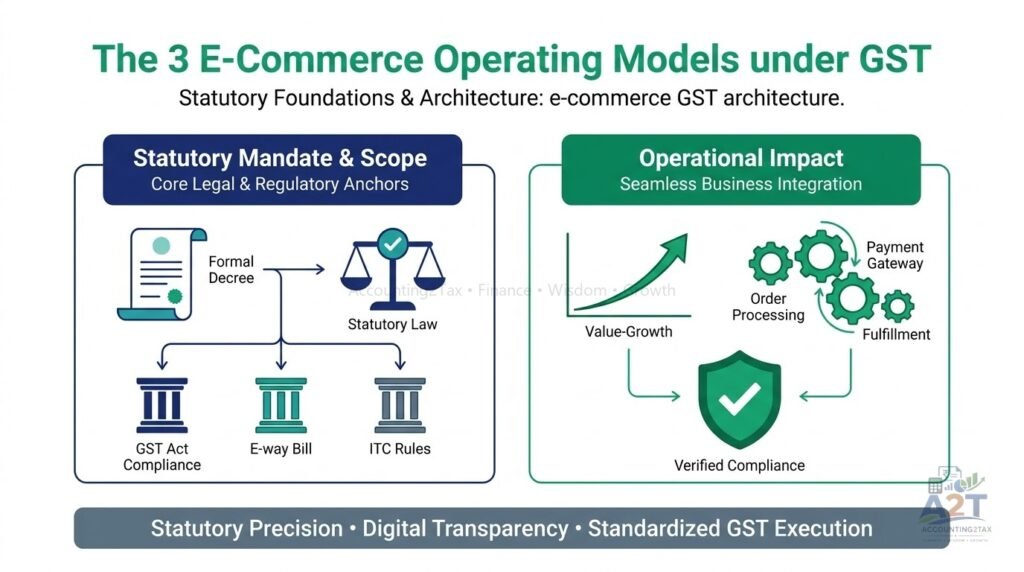
- • The 3 E-Commerce Operating Models under GST
- • 1. Model 1: The Marketplace Model & Section 52 TCS
- • 2. Model 2: Section 9(5) Aggregators (The Deemed Supplier Model)
- • 3. The Small Online Seller Exemption (Notification 34/2023)
- • 4. Multi-State Warehousing & Amazon FBA / Flipkart Advantage
Last Verified: 1 September 2026. Key verification sources: GST Council 56th Meeting (Sept 2025), CBIC Tax Information Portal, GSTN/GST Portal advisories.
The explosion of digital commerce in India has transformed how goods and services are bought and sold.
From homegrown Direct-to-Consumer (D2C) brands and Amazon/Flipkart marketplace sellers to food aggregators like Zomato and ride-hailing apps like Uber, digital commerce represents the fastest-growing segment of the Indian economy.
However, operating online introduces distinct indirect tax complexities that do not exist in traditional brick-and-mortar retail:
- Why does Amazon or Flipkart deduct a Tax Collected at Source (TCS) on every payout, and how do you recover it?
- When a customer orders food on Swiggy or books a ride on Uber, why does the app pay GST instead of the driver or restaurant under Section 9(5)?
- If you store inventory in an Amazon Fulfillment Center (FBA) across five different states, do you need five separate GST numbers?
- Can a small micro-seller sell products on Meesho without mandatory GST registration?
Under the Central Goods and Services Tax (CGST) Act, e-commerce transactions operate under the regulation of specialized provisions under Section 9(5), Section 52, and Notification No. 34/2023 – Central Tax.
What are the 3 fundamental e-commerce operating models under GST? How does Section 52 Marketplace TCS function as an advance tax credit? What is the intra-state threshold exemption for small online sellers? How do Virtual Principal Place of Business (VPOB) agreements enable multi-state warehousing?
This comprehensive guide breaks down the indirect tax framework for Indian e-commerce businesses, details marketplace tax reconciliations, and provides a clear operational roadmap.
The 3 E-Commerce Operating Models under GST
Under the GST regime, digital commerce is categorized into three distinct commercial architectures:
THE 3 DIGITAL COMMERCE OPERATING MODELS
                                         │
        ┌────────────────────────────────┼────────────────────────────────┐
▼ ▼ ▼
[ MODEL 1: MARKETPLACE (ECO) ] [ MODEL 2: AGGREGATOR SEC 9(5) ] [ MODEL 3: D2C WEBSITE ]
• Amazon, Flipkart, Myntra.    • Zomato, Swiggy, Uber.          • Own Shopify / WooCommerce.
• Platform connects buyers &   • Platform counts as SUPPLIER;   • Standard regular GST rules;
sellers; collects 0.5% TCS.    pays GST on behalf of vendor.    no marketplace intermediary.
1. Model 1: The Marketplace Model & Section 52 TCS
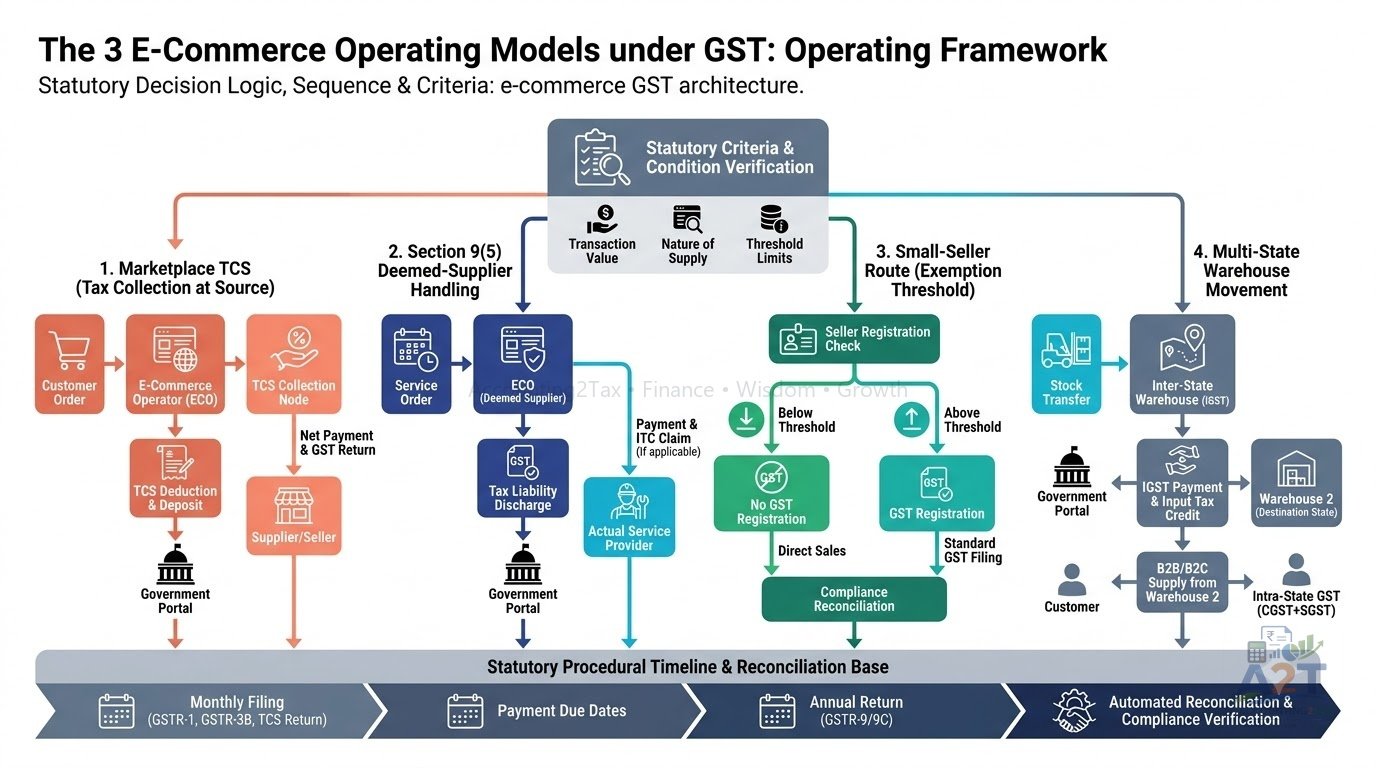
In a standard marketplace (Amazon, Flipkart, Meesho):
- The Seller sells goods directly to the customer and issues the Tax Invoice.
- The Marketplace Operator facilitates payment, provides logistics, and earns a commission.
- Section 52 Tax Collected at Source (TCS):
- The marketplace is legally mandated to deduct 0.5% TCS (0.25% CGST + 0.25% SGST or 0.5% IGST) on the net value of taxable supplies (Total Sales minus Sales Returns).
(Historical note: The TCS rate was originally 1.0% but was reduced to 0.5% via Notification 15/2024-CT effective 10 July 2024). - The platform deposits this TCS with the government monthly via Form GSTR-8.
 ┌─────────────────────────────────────────────────────────────────────────────┐
 │  HOW SELLERS RECOVER MARKETPLACE TCS:                                       │
 │  1. The marketplace files Form GSTR-8 by the 10th of the following month.   │
 │  2. The deducted TCS auto-populates on the GST portal under "TDS & TCS      │
 │     Received" tab.                                                          │
 │  3. The seller logs in and accepts the credit.                              │
 │  4. The TCS amount is CREDITED DIRECTLY to the seller's Electronic Cash      │
 │     Ledger, usable to pay monthly GSTR-3B tax dues or claimable as refund! │
 └─────────────────────────────────────────────────────────────────────────────┘
2. Model 2: Section 9(5) Aggregators (The Deemed Supplier Model)
To prevent tax leakage across millions of unorganized gig workers and small eateries, the government notified specific services under Section 9(5):
NOTIFIED SECTION 9(5) SERVICES
                                         │
 ┌─────────────────────────────────────────────────────────────────────────────┐
 │  1. PASSENGER TRANSPORT SERVICES: Taxi aggregators (Uber, Ola, Rapido).     │
 │  2. RESTAURANT & FOOD DELIVERY: Food apps (Zomato, Swiggy).                 │
 │  3. HOTEL & ACCOMMODATION: Aggregators (Oyo, Airbnb) for unregistered inns. │
 │  4. HOUSEKEEPING & PLUMBING: Home service platforms (Urban Company).        │
 └─────────────────────────────────────────────────────────────────────────────┘
The Legal Consequence: The e-commerce platform is statutorily treated as the deemed supplier. The platform must charge, collect, and deposit the applicable GST directly to the central government. The individual driver or small restaurant does not pay GST on these platform orders. Section 9(5) supplies are reported by the platform in GSTR-1 (Table 14/15) and GSTR-3B (Table 3.1.1).
3. The Small Online Seller Exemption (Notification 34/2023)
Previously, any person selling online was forced into mandatory GST registration from Rupee 1 under Section 24.
Under Notification No. 34/2023 – Central Tax, the GST Council introduced landmark relief strictly for suppliers of goods:
SMALL SELLER E-COMMERCE RELIEF RULES
                                       │
An unregistered small merchant CAN sell goods through e-commerce platforms WITHOUT
a GST registration, provided ALL of the following conditions are met:
                                       │
 ┌─────────────────────────────────────────────────────────────────────────────┐
 │  • Aggregate annual turnover is below ₹40 Lakh (Goods) / ₹20 Lakh.          │
 │  • Supplies must be strictly INTRA-STATE (within the same state only).      │
 │  • The seller must NOT make any inter-state sales.                          │
 │  • The seller must obtain a free PAN-based ENROLMENT NUMBER on the portal.  │
 │  • The marketplace does not collect Section 52 TCS from such exempt sellers.│
 └─────────────────────────────────────────────────────────────────────────────┘
4. Multi-State Warehousing & Amazon FBA / Flipkart Advantage
If your D2C brand stores inventory in third-party fulfillment centers across India to offer 1-day delivery:
MULTI-STATE WAREHOUSING COMPLIANCE
                                       │
[ THE RULE: Storing physical inventory in a state creates a "Fixed Establishment" / APoB. ]
[ You CANNOT ship customer orders from a warehouse in Karnataka using a Delhi GSTIN. ]
                                       │
▼
Step 1: Obtain a SEPARATE GST REGISTRATION in each state where inventory is stored.
                                       │
Step 2: Use Virtual Principal Place of Business (VPOB) agreements provided by
service providers or marketplaces to satisfy local address requirements.
                                       │
Step 3: Add the Amazon/Flipkart fulfillment center as an ADDITIONAL PLACE OF
BUSINESS (APoB) under that state's GST certificate.
                                       │
Step 4: Execute Stock Transfers between state branches using delivery challans
and tax invoices, claiming 100% ITC on inter-state stock transfers.
5. Modern GST Compliance Mechanics: IMS, GSTR-1A, and More
Recent compliance upgrades require e-commerce sellers to be more disciplined:
– Invoice Management System (IMS): Sellers must track inward supplies where buyers accept, reject, or keep invoices pending before GSTR-2B generation.
– GSTR-1A: This new facility allows e-commerce sellers to amend their GSTR-1 before filing GSTR-3B, correcting potential TCS or B2C HSN mismatches.
– DRC-03A: Payment mapping is available for demand orders, critical if the seller receives notices for TCS reconciliation differences.
– E-invoice 30-day reporting restriction: E-commerce sellers with an Aggregate Annual Turnover (AATO) ≥ ₹10 Crore must report e-invoices to the IRP within 30 days of generation.
Master E-Commerce Compliance Matrix
| Operating Dimension | Marketplace Seller (Amazon / Flipkart) | D2C Brand (Own Website) | Section 9(5) Aggregator (Zomato / Uber) |
|---|---|---|---|
| Tax Invoice Issued By | The Seller | The D2C Brand | The Aggregator Platform |
| Section 52 TCS | Applicable (0.5% Deducted by Platform) | Not Applicable | Not Applicable |
| GST Registration Trigger | Mandatory (unless intra-state exempt) | Standard ₹40L / ₹20L rules | Platform must register in all states |
| Warehousing Across States | Needs state GSTIN (VPOB/APoB) | Needs state GSTIN (PPoB/APoB) | Not applicable to gig workers |
| Return Monthly Filing | GSTR-1 & GSTR-3B + TCS Accept | GSTR-1 & GSTR-3B | GSTR-1 & GSTR-3B |
Frequently Asked Questions (FAQs)
Q1. How do I recover the TCS deducted by Amazon/Flipkart?
Answer: The TCS deducted at 0.5% (effective July 2024) is filed by the marketplace via GSTR-8. It will auto-populate in your GST portal under “TDS & TCS Received”. Accept it, and the amount moves to your Electronic Cash Ledger, which can be used to pay your output tax liability or claimed as a refund.
Q2. Can a small service provider get the Notification 34/2023 exemption?
Answer: No. The exemption under Notification 34/2023 applies strictly to suppliers of goods making intra-state supplies. Service providers selling through e-commerce operators follow different provisions.
Q3. Does an Uber driver need to file GSTR-8?
Answer: No. GSTR-8 is strictly for e-commerce platforms deducting Section 52 TCS. Under Section 9(5), Uber acts as the deemed supplier and pays the tax. The driver is not liable for GST on these trips.
Q4. I am selling exclusively through my own D2C Shopify website. Does TCS apply?
Answer: No. Section 52 TCS only applies when a third-party e-commerce operator collects the payment on behalf of the supplier. For your own website, you are the direct seller.
Q5. What happens if my multi-state warehouse sales cross the e-invoice threshold?
Answer: Once your PAN-level Aggregate Annual Turnover (AATO) crosses ₹5 Crore (or ₹10 Crore for the 30-day reporting restriction), e-invoicing becomes mandatory for all your B2B sales across all states, even those made through marketplace fulfillment centers.
Related Financial Wisdom
- GST Registration for Small Businesses: Thresholds — threshold rules.
- GST Invoice Explained: Mandatory Rules and E-Invoicing — invoicing rules.
- Input Tax Credit Explained: How GST Purchases Work — ITC fundamentals.
- GST Rates Explained: 5%, 18%, 40% Slabs — rate schedules.
- GST Compliance Checklist for Small Businesses — compliance checklist.
Key Takeaways
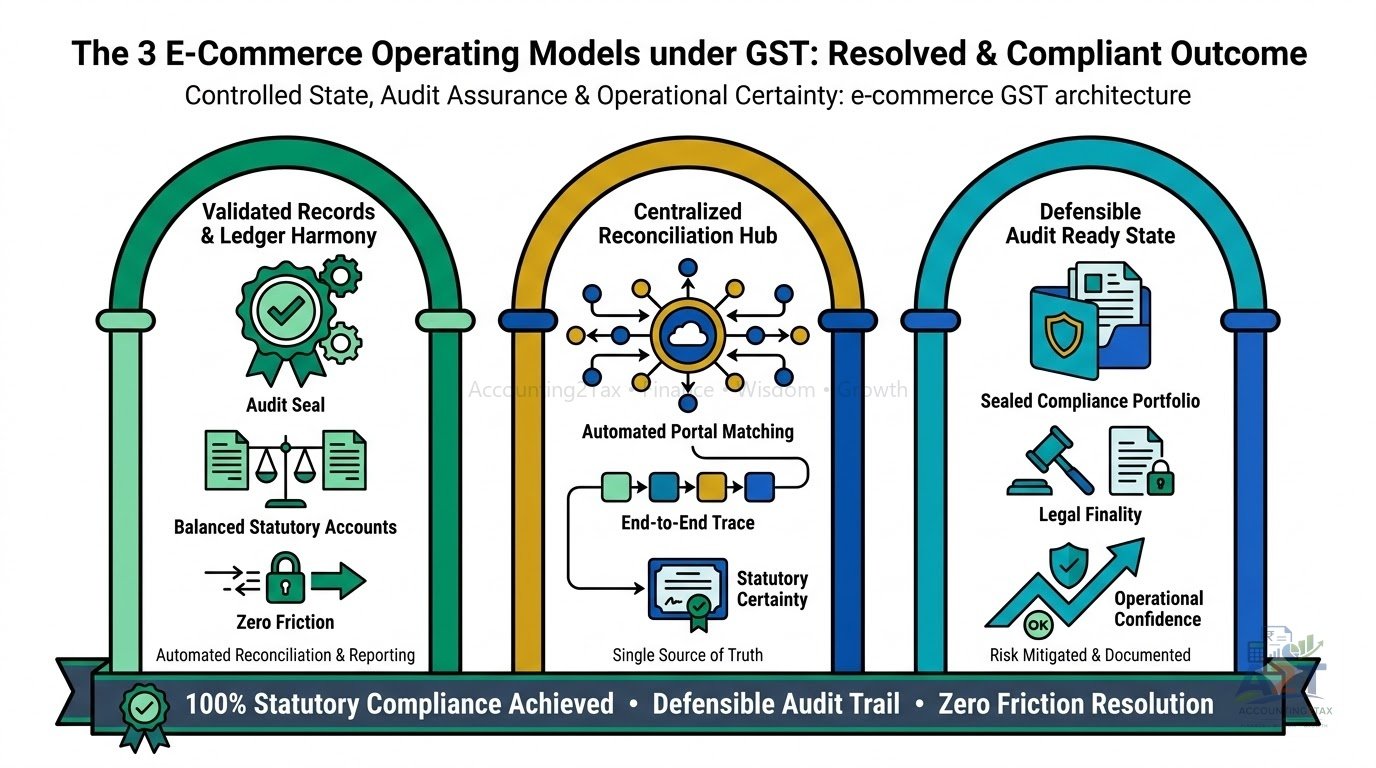
- E-commerce marketplaces deduct 0.5% Tax Collected at Source (TCS) (down from 1% effective July 2024) under Section 52, which sellers recover directly into their cash ledger.
- Under Section 9(5), platforms like Zomato, Swiggy, and Uber are deemed suppliers and pay output GST directly on ride/food orders.
- Micro-sellers can sell online without GST registration for strictly intra-state goods under Notification 34/2023.
- Storing stock in multi-state fulfillment centers (Amazon FBA) requires state-wise GST registration using VPOB/APoB agreements.
- Reconcile marketplace monthly settlement reports against TCS credits to prevent cash-flow leakages.
📚 Sources & Official Regulatory References
| Topic / Statutory Regulation | Source | Authority | Checked On | Effective Date |
|---|---|---|---|---|
| Section 9(5) (Deemed Supplier E-Commerce Aggregator Provisions) | Central Goods and Services Tax Act, 2017 | Tier 1 | 2026-08-26 | Current |
| Section 52 (Collection of Tax at Source by E-Commerce Operators) | Central Goods and Services Tax Act, 2017 | Tier 1 | 2026-08-26 | Current |
| Notification No. 15/2024-CT (TCS Rate Reduction to 0.5%) | CBIC | Tier 1 | 2026-08-26 | 10 July 2024 |
| Notification No. 34/2023 – Central Tax (Exemption for Intra-State Online Sellers) | CBIC | Tier 1 | 2026-08-26 | Current |
| Guidelines on Virtual Principal Place of Business (VPOB) & FBA Warehousing | Goods and Services Tax Network (GSTN) | Tier 1 | 2026-08-26 | Current |
📚 Explore More in Business GST (GST)
Taxonomy Series
Discover related guides, taxonomy series, and interactive financial calculators:
This publication is strictly for educational, research, and informational purposes and does not constitute formal financial, investment, tax, or legal advice.
- Data Accuracy & Inadvertent Errors: While every reasonable effort is made to maintain accuracy, all information, interest rates, tax thresholds, formulas, and statutory data are provided on an “as-is” basis. Accounting2Tax makes no express or implied warranties regarding absolute completeness, timeliness, or typographical and computational infallibility. Statutory authorities (Ministry of Finance, RBI, CBDT, CBIC, SEBI, PFRDA) update guidelines periodically. Readers must independently verify current rates and rules on official government portals before executing financial transactions.
- Illustrations, Simulations & Limitations of Liability: Mathematical models, compounding simulations, case studies, and hypothetical return projections are conceptual tools designed solely to demonstrate financial principles. They do not constitute guaranteed returns, profit forecasts, or capital safety commitments. Accounting2Tax and its authors disclaim all liability for any direct, indirect, or consequential financial losses, tax penalties, or investment outcomes arising from inadvertent errors, omissions, calculation discrepancies, or reliance placed on this material.
- Professional Consultation: Readers must independently evaluate their individual financial goals, tax positions, and risk tolerance, and consult a SEBI-registered financial advisor or certified chartered accountant before making financial decisions.