- • What Is a GST Return?
- • Master Table of Core GST Return Forms
- • 1. GSTR-1: Your Sales Declaration
- • 2. GSTR-2B and the IMS Ecosystem
- • 3. GSTR-3B: The Final Summary & Tax Settlement Return
Last Verified: 1 September 2026
Key verification sources: GST Council 56th Meeting (Sept 2025), CBIC Tax Information Portal, GSTN/GST Portal advisories.
In the Indian indirect taxation ecosystem, obtaining a GST registration is only the first step. The ongoing heartbeat of business compliance is the GST Return Filing System.
Every registered entity — from a solo freelancer or boutique shopkeeper to a multinational conglomerate — is mandated to file periodic returns declaring outward sales, inward purchases, tax liability, and Input Tax Credit (ITC).
Failing to file your GST returns on time triggers daily late fees under Section 47, penal interest of 18% under Section 50, automated blocking of your E-Way Bill generation, and eventually the suspension or cancellation of your GSTIN under Section 29.
However, with multiple forms like GSTR-1, GSTR-3B, GSTR-2B, GSTR-4, and GSTR-9, many taxpayers feel overwhelmed by acronyms, staggered due dates, and reconciliation rules.
This comprehensive guide breaks down the complete GST return landscape, explains the roles of key forms, contrasts Monthly vs. QRMP filing schemes, details statutory filing calendars, and explains how to avoid late fees.
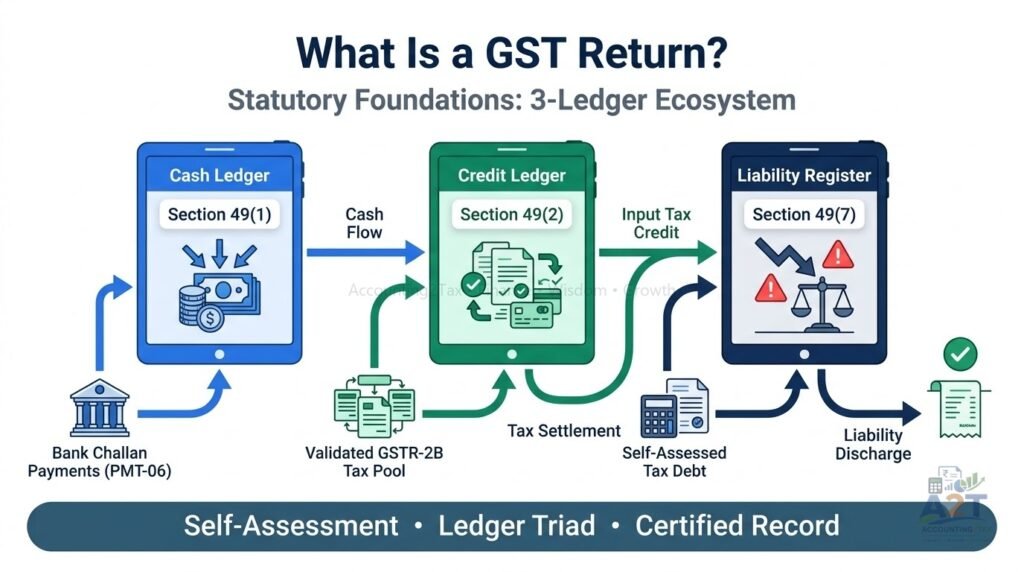
What Is a GST Return?
A GST Return is an electronic statement containing details of all sales (outward supplies), purchases (inward supplies), Output GST collected, Input Tax Credit (ITC) claimed, and net tax paid to the government for a specific tax period.
The Monthly GST Compliance Cycle
                                         │
        ┌────────────────────────────────┼────────────────────────────────┐
▼ ▼ ▼
[ GSTR-1: Sales ]              [ GSTR-2B: Purchases ]        [ GSTR-3B: Payment ]
Filed by 11th of month         Auto-generated on 14th        Filed by 20th of month
Reports all outward invoices   Static statement of ITC       Pays net tax & claims ITC
Master Table of Core GST Return Forms
| Return Form | Nature of Form | Who Files? | Frequency | Standard Due Date |
|---|---|---|---|---|
| GSTR-1 | Statement of Outward Supplies (Sales) | All Regular Taxpayers | Monthly / Quarterly (QRMP) | 11th (Monthly) / 13th (QRMP) |
| GSTR-1A | Optional Amendment Facility | All Regular Taxpayers | Monthly / Quarterly | After GSTR-1, before GSTR-3B |
| GSTR-2B | Auto-Drafted ITC Statement | Auto-generated by GST Portal | Monthly | Available on 14th of each month |
| GSTR-3B | Summary Return & Net Tax Payment | All Regular Taxpayers | Monthly / Quarterly (QRMP) | 20th (Monthly) / 22nd or 24th (QRMP) |
| IFF | Invoice Furnishing Facility (B2B only) | QRMP Taxpayers (Months 1 & 2) | Monthly (Optional) | 13th of subsequent month |
| CMP-08 | Quarterly Payment Challan | Composition Scheme Taxpayers | Quarterly | 18th of month following quarter |
| GSTR-4 | Annual Return for Composition Dealers | Composition Scheme Taxpayers | Annually | 30th June following financial year |
| GSTR-9 | Annual GST Return | Regular Taxpayers (Turnover > ₹2 Cr) | Annually | 31st December following financial year |
| GSTR-9C | Self-Certified Reconciliation Statement | Regular Taxpayers (Turnover > ₹5 Cr) | Annually | 31st December following financial year |
1. GSTR-1: Your Sales Declaration
- What It Contains: Detailed invoice-level records of all B2B sales, aggregated summary of B2C sales, exports, debit/credit notes, and HSN-wise sales summaries.
- Why It Matters: Your GSTR-1 filing is what feeds into the GSTR-2B of your buyers. If you fail to file GSTR-1 on time, your corporate clients cannot claim Input Tax Credit, damaging your business relationships.
- Due Date: 11th of the following month for monthly filers.
2. GSTR-2B and the IMS Ecosystem
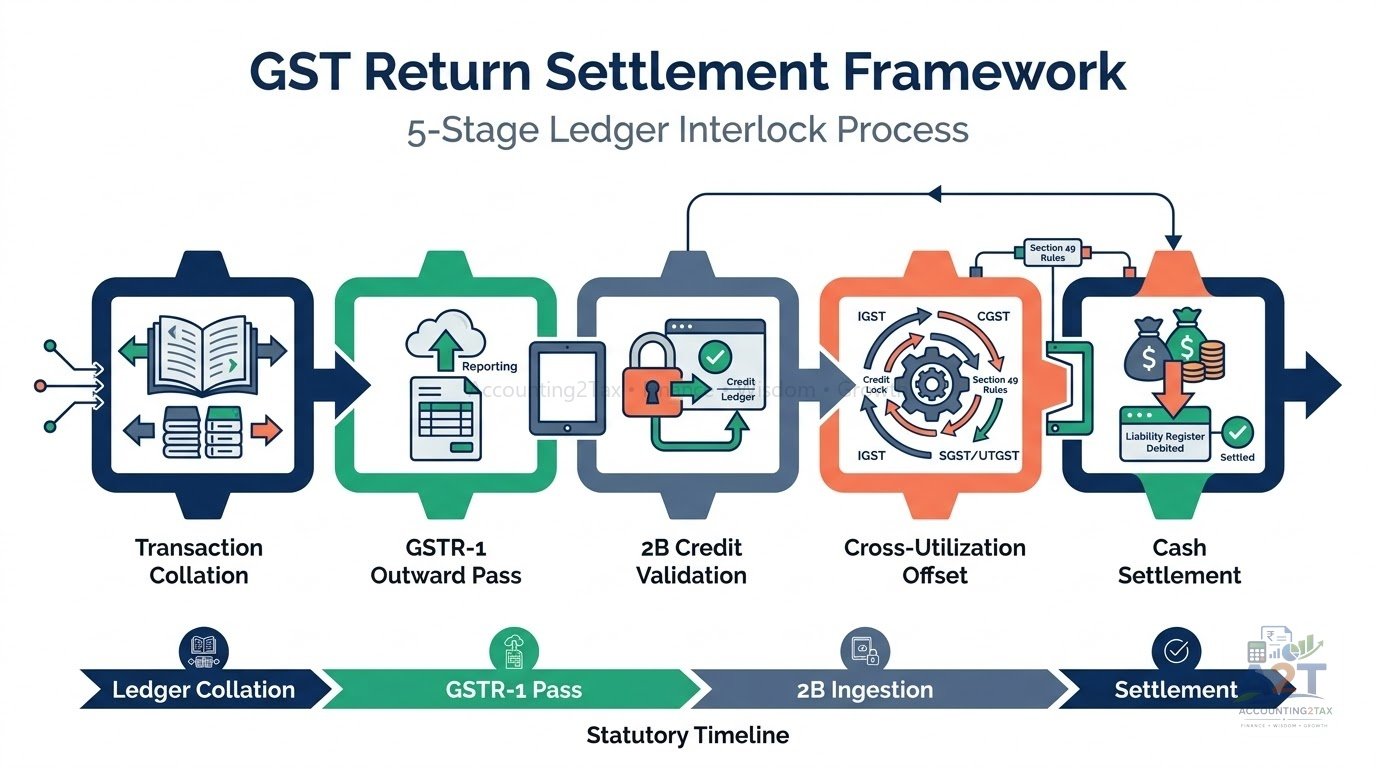
The Invoice Management System (IMS) sits between GSTR-1 and GSTR-2B. Buyers act (Accept/Reject/Pending) on supplier invoices in the IMS. Based on these actions, GSTR-2B is generated on the 14th as a static auto-drafted ITC statement. Under Section 16(2)(aa), you can ONLY claim ITC that successfully populates in this GSTR-2B statement.
3. GSTR-3B: The Final Summary & Tax Settlement Return
- What It Contains: Aggregated summary of outward taxable value, Output Tax liability (CGST + SGST + IGST), eligible ITC claimed from GSTR-2B, ineligible ITC reversed, and net tax paid in cash (via electronic cash ledger).
- Payment Mandate: GSTR-3B cannot be submitted without paying the full net tax liability.
- Due Date: 20th of the following month for monthly filers.
Monthly Scheme vs. QRMP Scheme (Turnover Up to ₹5 Crore)
Small and medium enterprises with an aggregate turnover of up to ₹5 Crore can choose the QRMP (Quarterly Return Monthly Payment) Scheme:
Monthly vs QRMP Comparison
                                          │
            ┌─────────────────────────────┴─────────────────────────────┐
▼ ▼
MONTHLY SCHEME                               QRMP SCHEME
• File GSTR-1 by 11th monthly                • File GSTR-1 by 13th quarterly
• File GSTR-3B by 20th monthly               • File GSTR-3B by 22nd/24th quarterly
• Pay tax on 20th monthly                    • Pay tax monthly via PMT-06 by 25th
• Best for high B2B transaction volume       • Best for low-volume SME operations
How Tax Payment Works in QRMP (Form PMT-06):
In Month 1 and Month 2 of the quarter, QRMP taxpayers do not file GSTR-3B. They simply pay estimated monthly tax using Challan PMT-06 by the 25th using either:
1. Fixed Sum Method (35% Challan): Pay 35% of the tax paid in cash in the preceding quarter’s GSTR-3B.
2. Self-Assessment Method: Calculate actual tax on net sales after deducting available ITC for that month.
Statutory Deadlines and Staggered Filing Calendar
To prevent server overloads on the GST portal, filing dates for quarterly GSTR-3B are staggered by State:
Staggered QRMP Deadlines
                                       │
        ┌──────────────────────────────┴──────────────────────────────┐
▼ ▼
22nd of the Month (Category 1 States)    24th of the Month (Category 2 States)
Chhattisgarh, MP, Gujarat, Maharashtra,  Karnataka, Goa, Kerala, Tamil Nadu,
HP, Punjab, Uttarakhand, Haryana,        Telangana, Rajasthan, UP, Bihar, WB,
Rajasthan, UP, Bihar, WB, Odisha,        Odisha, Assam, Delhi, and Eastern/NE
Andhra Pradesh, Dadra and Nagar Haveli   States.
and Daman and Diu, Ladakh, and J&K.
Late Fees and Interest for Delayed Return Filing
If you miss your filing deadline, the GST portal automatically calculates penalties:
1. Section 47 Late Fees (Per Day of Delay):
- Regular Taxpayers (with Tax Liability): ₹50 per day (₹25 CGST + ₹25 SGST), subject to statutory turnover-based caps.
- Nil Returns (Zero Sales and Zero Purchases): ₹20 per day (₹10 CGST + ₹10 SGST), capped at ₹500 per return.
2. Section 50 Penal Interest:
- Interest at 18% per annum is charged on the Net Tax Paid in Cash from the day following the due date until the actual date of payment.
- Note: If you wrongfully claim and utilize ineligible Input Tax Credit, penal interest is also charged at 18% per annum.
Calculate Your GST Invoice Values
Structure your outward tax invoices and calculate exact CGST, SGST, IGST components before filing GSTR-1 using the Accounting2Tax GST Calculator.
Use the GST Calculator to model invoice values and check tax breakdowns.
Related Financial Wisdom
- GST Explained: Understanding India’s Goods and Services Tax — core indirect tax guide.
- CGST, SGST, IGST and UTGST: Understanding the Different GST Components — tax components.
- GSTR-1 and GSTR-3B: Understanding Their Different Purposes (Article 98 — coming soon).
- Input Tax Credit Explained: How GST Paid on Purchases Works (Article 101 — coming soon).
- ITC Reconciliation: Why GSTR-2B Matters (Article 104 — coming soon).
Key Takeaways
- GSTR-1 is your outward sales declaration (due on 11th). GSTR-2B is your static auto-drafted ITC statement (available on 14th). GSTR-3B is your summary tax settlement return (due on 20th).
- Businesses with turnover up to ₹5 Crore can opt for the QRMP scheme, filing returns quarterly while paying tax monthly via PMT-06.
- Under Section 16(2)(aa), ITC can only be claimed if it appears in your GSTR-2B.
- Missing return deadlines incurs Section 47 late fees (₹50/day or ₹20/day for Nil returns) and 18% penal interest under Section 50.
- Annual returns (GSTR-9/9C) are due by December 31st following the close of the financial year.
Frequently Asked Questions (FAQs)
Q1. What is the difference between a return and a statement?
Answer: Forms like GSTR-1 and GSTR-3B are statutory returns that you file. GSTR-2B is an auto-generated statement of eligible ITC, and GSTR-1A is an amendment facility, not a standalone return.
Q2. Who is eligible for the QRMP scheme?
Answer: Regular taxpayers with an Aggregate Annual Turnover (AATO) up to ₹5 Crore in the preceding financial year can opt for the Quarterly Return Monthly Payment (QRMP) scheme.
Q3. What is the due date for GSTR-4?
Answer: Following Notification 12/2024-CT, the due date for filing the GSTR-4 annual return for composition scheme dealers is now 30th June following the financial year.
📚 Sources & Official Regulatory References
| Section / Form | Source | Authority | Checked On | Effective Date |
|---|---|---|---|---|
| Section 37, 38 & 39 (Furnishing Details of Outward & Inward Supplies) | Central Goods and Services Tax Act, 2017 | Tier 1 | 2026-08-26 | Current |
| Section 16(2)(aa) & Rule 60 (Mandatory GSTR-2B ITC Reconciliation) | CBIC Notifications / CGST Rules | Tier 1 | 2026-08-26 | Current |
| Section 47 (Late Fees) & Section 50 (Interest on Delayed Payment) | Central Goods and Services Tax Act, 2017 | Tier 1 | 2026-08-26 | Current |
| Quarterly Return Monthly Payment (QRMP) Scheme Circular No. 143/13/2020 | Central Board of Indirect Taxes & Customs (CBIC) | Tier 1 | 2026-08-26 | Current |
📚 Explore More in Returns (GST)
Taxonomy Series
Discover related guides, taxonomy series, and interactive financial calculators:
This publication is strictly for educational, research, and informational purposes and does not constitute formal financial, investment, tax, or legal advice.
- Data Accuracy & Inadvertent Errors: While every reasonable effort is made to maintain accuracy, all information, interest rates, tax thresholds, formulas, and statutory data are provided on an “as-is” basis. Accounting2Tax makes no express or implied warranties regarding absolute completeness, timeliness, or typographical and computational infallibility. Statutory authorities (Ministry of Finance, RBI, CBDT, CBIC, SEBI, PFRDA) update guidelines periodically. Readers must independently verify current rates and rules on official government portals before executing financial transactions.
- Illustrations, Simulations & Limitations of Liability: Mathematical models, compounding simulations, case studies, and hypothetical return projections are conceptual tools designed solely to demonstrate financial principles. They do not constitute guaranteed returns, profit forecasts, or capital safety commitments. Accounting2Tax and its authors disclaim all liability for any direct, indirect, or consequential financial losses, tax penalties, or investment outcomes arising from inadvertent errors, omissions, calculation discrepancies, or reliance placed on this material.
- Professional Consultation: Readers must independently evaluate their individual financial goals, tax positions, and risk tolerance, and consult a SEBI-registered financial advisor or certified chartered accountant before making financial decisions.
