
The Employees’ Pension Scheme, 1995 (EPS-95) is a defined-benefit social security program that the Employees’ Provident Fund Organisation (EPFO) administers under the Ministry of Labour and Employment. While the Employee Provident Fund (EPF) provides a lump-sum savings corpus with compounding interest, the EPS framework guarantees organized-sector employees a reliable monthly pension for life after retirement.
However, despite being a standard deduction on every formal employee’s pay slip, EPS mechanics remain widely misunderstood. In particular, employees often confuse contribution apportionment, the 60-month pensionable salary rules, and exit withdrawal options. Therefore, understanding these operational rules is essential for sound retirement planning.
In this master guide, we break down how the scheme operates, how EPFO calculates your monthly pension, what happens when you switch jobs, and how you can file your claims smoothly.
📢 Important 2026 Regulatory Note
Following Gazette Notifications S.O. 5109(E) and G.S.R. 890(E), the government enhanced the statutory wage ceiling for mandatory EPFO membership to ₹25,000/month. However, standard baseline EPS contributions remain strictly capped on a ₹15,000 wage base.
👉 For an in-depth analysis of payroll calculations, gazette circulars, and the Centralised Pension Payment System, read our dedicated breakdown: EPFO 2026 Mega Reforms: New ₹25,000 Wage Ceiling, G.S.R. 890(E) EPS Cap, and Nationwide CPPS Explained.
1. EPF vs. EPS: Where Does Your 12% Contribution Actually Go?
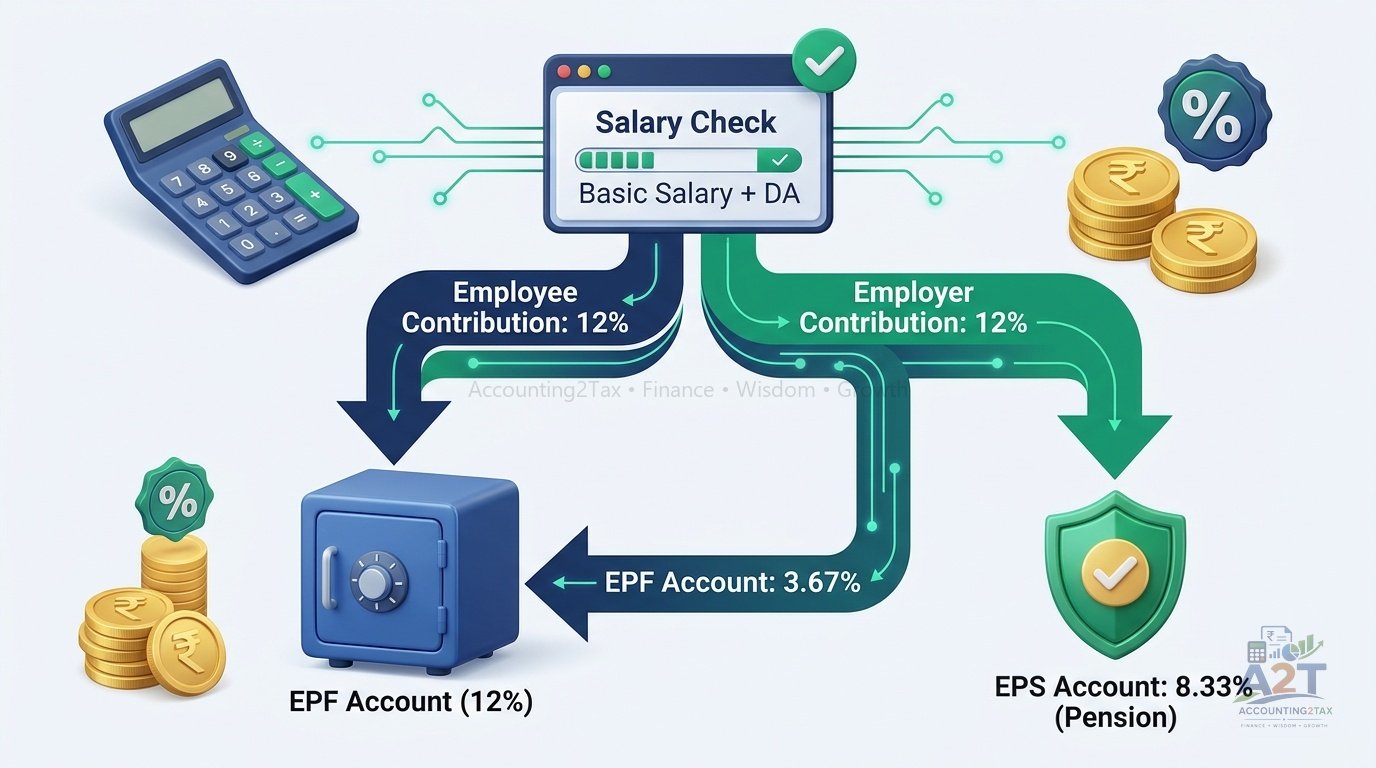
Under the Employees’ Provident Funds and Miscellaneous Provisions Act, 1952, establishments with 20 or more workers deduct 12% of the employee’s Basic Salary + Dearness Allowance (DA) each month. Simultaneously, the employer matches this with an equal 12% contribution.
Many employees believe that they contribute directly to both EPF and EPS. However, employees do not contribute a single rupee to the pension fund directly. Instead, EPFO finances the pension fund by diverting a designated slice of the employer’s share alongside a direct subsidy from the Central Government.
The Math Behind the Contribution Split
- Statutory Pension Wage Ceiling: EPFO caps this threshold at ₹15,000 per month.
- Employer EPS Share: Specifically, 8.33% of Basic + DA flows into EPS (up to the ₹15,000 ceiling):
Maximum Monthly Employer EPS Contribution = ₹15,000 × 8.33% = ₹1,250 per month - Employer EPF Share: Furthermore, the remaining 3.67%—plus the full 12% on any basic salary earned beyond the ₹15,000 ceiling—flows into the employee’s EPF account.
- Central Government Contribution: In addition, the Central Government contributes 1.16% of the employee’s basic salary (up to the ₹15,000 ceiling, capped at ₹174 per month) directly into the EPS reserve.
Practical Illustration:
| Component | Case A: Basic = ₹15,000 | Case B: Basic = ₹40,000 | Case C: Basic = ₹75,000 |
|---|---|---|---|
| Employee Share (12% to EPF) | ₹1,800 | ₹4,800 | ₹9,000 |
| Employer Share to EPS (8.33%, max ₹15k) | ₹1,250 | ₹1,250 | ₹1,250 |
| Employer Share to EPF (Balance of 12%) | ₹550 | ₹3,550 | ₹7,750 |
| Total Credited to EPF Account | ₹2,350 | ₹8,350 | ₹16,750 |
| Total Credited to EPS Account | ₹1,250 | ₹1,250 | ₹1,250 |
2. Who Is Eligible to Receive a Monthly Pension?
To qualify for a regular monthly pension under EPS-95, an employee must satisfy three fundamental criteria:
- Active EPFO Membership: First, you must work for an establishment registered with the EPFO.
- Minimum 10 Years of Eligible Service: Second, you must complete at least 10 years of contributory service. Fortunately, this service does not require continuous tenure with a single firm. Therefore, you can transfer your service history between jobs using your Universal Account Number (UAN) or preserve it with a Scheme Certificate (Form 10C).
- Age Milestones: Finally, you must reach designated age thresholds:
- Superannuation Pension: You can claim full pension upon reaching 58 years of age.
- Early (Reduced) Pension: Alternatively, you can opt for early pension between ages 50 and 57, provided you have exited service. However, EPFO applies a permanent discount of 4% per year for each year before age 58.
- Deferred Pension: In contrast, you can defer your pension start date up to age 60. Consequently, your monthly payout increases by 4% for 1 year of deferment or 8.16% for 2 years.
3. How Is the Monthly Pension Calculated? (The Formula)
For employees retiring under standard scheme rules, EPFO determines monthly pension payouts using this statutory formula:
Monthly Pension = (Pensionable Salary × Pensionable Service) ÷ 70
Deconstructing the Components:
1. Pensionable Salary: The 60-Month Rule
Under current statutory provisions, pensionable salary equals the average monthly basic pay drawn over your final 60 months of contributory service (not the last 12 months). For standard EPS members, the scheme strictly caps this average at ₹15,000.
2. Pensionable Service
Pensionable service represents your cumulative years of contribution to the scheme:
- EPFO rounds any service period of 6 months or more up to the nearest whole year (for example, 10 years and 7 months counts as 11 years).
- Bonus Weightage: In addition, if you complete 20 or more years of pensionable service, EPFO adds a 2-year bonus weightage to your record (up to a 35-year cap).
Real-World Calculation Examples:
Example 1: Full Career with Standard Cap
Suppose an employee completes 33 years of service and retires at age 58. With the +2 bonus years, total service equals 35 years. Consequently:
Monthly Pension = (₹15,000 × 35) ÷ 70 = ₹7,500 per month
Example 2: Early Retirement at Age 54 (Reduced Pension)
In contrast, consider an employee with 18 years of service who takes early pension at age 54 (4 years early):
• Standard Unreduced Amount: (₹15,000 × 18) ÷ 70 = ₹3,857
• Early Reduction Factor: 4 years early × 4% = 16% reduction
• Final Monthly Pension: ₹3,857 – 16% = ₹3,240 per month
Calculate Your EPS Pension & PF Corpus
Plan your retirement payouts and take-home pay with our free certified calculators:
|
🧮
EPF & EPS |
💼
In-Hand Salary |
📈
Retirement & |
📊
All Financial |
4. Different Types of Pensions Provided Under EPS-95
Besides normal superannuation, EPS-95 provides several protective pension streams for families:
- Superannuation Pension: Members receive full pension at age 58 after 10 years of service.
- Early Pension: Members can claim discounted payouts between ages 50 and 57.
- Permanent Total Disablement Pension: If a member suffers total disability during active employment, EPFO provides immediate monthly pension regardless of service length.
- Widow / Widower Pension: Following a member’s demise, the surviving spouse receives 50% of the pension amount (with a guaranteed minimum of ₹1,000/month).
- Children Pension: Furthermore, each dependent child receives 25% of the widow pension (payable for up to 2 children until age 25).
- Orphan Pension: Similarly, if both parents pass away, surviving orphans receive 75% of the widow pension (up to 2 orphans until age 25).
- Nominee / Dependent Parent Pension: Finally, if an unmarried member passes away without dependents, nominated parents receive a lifetime monthly pension.
5. What Happens When You Change or Leave Jobs? (Form 10C vs. Form 10D)
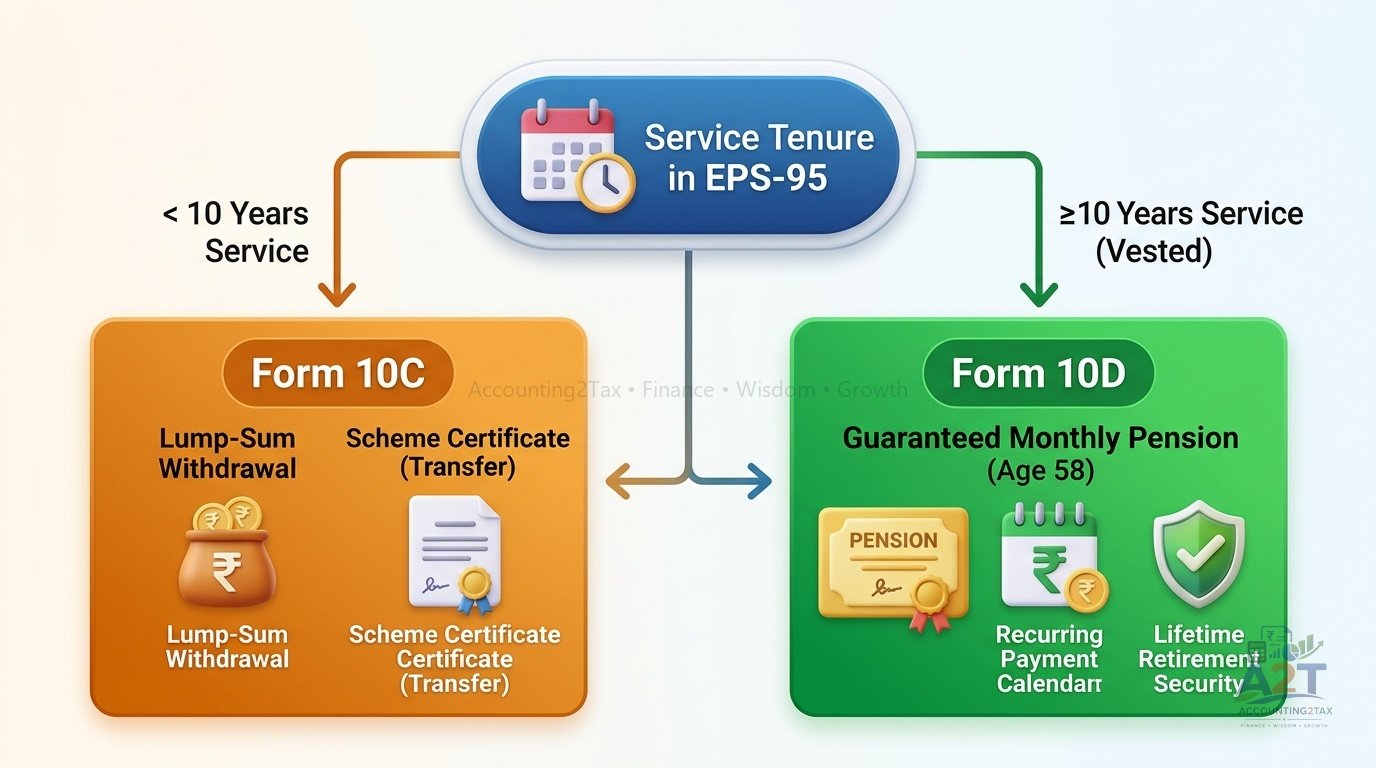
Scenario A: Total Service is LESS Than 10 Years
When you leave employment before completing 10 years of service, you have two clear choices under Form 10C:
- Withdrawal Benefit (Cash Out): First, you can withdraw your accumulated EPS balance as a lump sum based on the statutory Table ‘D’ matrix.
- Scheme Certificate (Recommended): Alternatively, if you plan to rejoin the workforce, you should obtain a Scheme Certificate. Consequently, this certificate preserves your service tenure and carries it forward to your next employer.
Scenario B: Total Service is 10 Years or MORE
Once your contributory service crosses 10 years, you achieve vested pension status. Therefore, you cannot withdraw EPS funds as a lump sum.
- If you are under 50 years of age: Apply for a Scheme Certificate via Form 10C to protect your service history.
- If you have attained age 50 or above: Submit Form 10D to commence your monthly pension payouts.
⚠️ Critical Myth Buster: Can You Take a Loan or Advance from EPS?
NO. You cannot withdraw EPS funds as a partial advance or emergency loan for marriage, housing, or medical treatment. Instead, you can only take partial advances from your EPF balance via Form 31. The EPS account remains strictly an annuity reserve.
6. How Is EPS Taxed? (Income Tax Provisions)
Taxation on pension payouts follows distinct rules under the Income Tax Act:
- Monthly Pension: Your monthly pension is fully taxable as “Income from Salaries” at normal slab rates. However, pensioners can claim the standard deduction under Section 16(ia).
- Family / Widow Pension: In contrast, survivor benefits are taxable under “Income from Other Sources”, eligible for statutory deductions under Section 57(iia).
- Lump Sum Withdrawal (Form 10C): Furthermore, lump-sum withdrawals remain completely tax-exempt if your total service exceeds 5 years under Section 10(12).
7. Modern Administration: Claiming Your Pension Digitally
Recently, EPFO introduced three major digital conveniences for members:
- Nationwide Centralised Pension Payment System (CPPS): Pensioners can now receive their pension in any bank, any branch across India. Consequently, relocating to a new city no longer requires transferring physical Pension Payment Orders (PPOs).
- Facial Authentication for Life Certificates: In addition, pensioners can submit their annual Digital Life Certificate from home using the Jeevan Pramaan Face App on any smartphone via Aadhaar verification.
- Paperless Online Filing: Finally, members can submit Form 10C and Form 10D online through the EPFO Member Portal and the UMANG mobile app.
8. Financial Planner’s Perspective: How to Treat EPS in Your Portfolio
While EPS-95 provides a reliable, sovereign-guaranteed baseline income, its statutory ceiling (limiting standard superannuation payouts to roughly ₹7,500/month) means it cannot serve as your standalone retirement solution.
Therefore, to construct a resilient, inflation-proof retirement plan, we recommend this balanced approach:
- First, treat EPS as your guaranteed annuity floor to cover utility bills and basic necessities.
- Second, maximize compounding debt reserves through EPF and Voluntary Provident Fund (VPF).
- Finally, build an inflation-beating equity corpus through low-cost market instruments like the National Pension System (NPS) and diversified Equity Mutual Funds (SIPs).
Frequently Asked Questions (FAQs)
1. Can an employee opt out of the EPS scheme?
If an employee joins an EPFO-covered establishment for the first time with a Basic Salary exceeding the statutory ceiling, they can opt out at the time of joining as an “excluded employee.” However, once enrolled, you cannot opt out.
2. What happens to the EPS balance if an employee switches jobs?
When transferring your PF account online via the Unified Member Portal from your previous Member ID to your new Member ID, your EPS service history transfers automatically. The balance is not paid out in cash.
3. What is the difference between Form 10C and Form 10D?
Form 10C allows members to claim a lump-sum withdrawal benefit (only if service is under 10 years) or request a Scheme Certificate. In contrast, Form 10D serves as the formal application to start monthly pension payments.
4. Is the bonus 2-year service weightage still applicable?
Yes. Under EPS-95 Para 10(2), members who have completed 20 or more years of contributory service and retire upon attaining age 58 receive a 2-year bonus weightage added to their pensionable service, capped at 35 years total.
