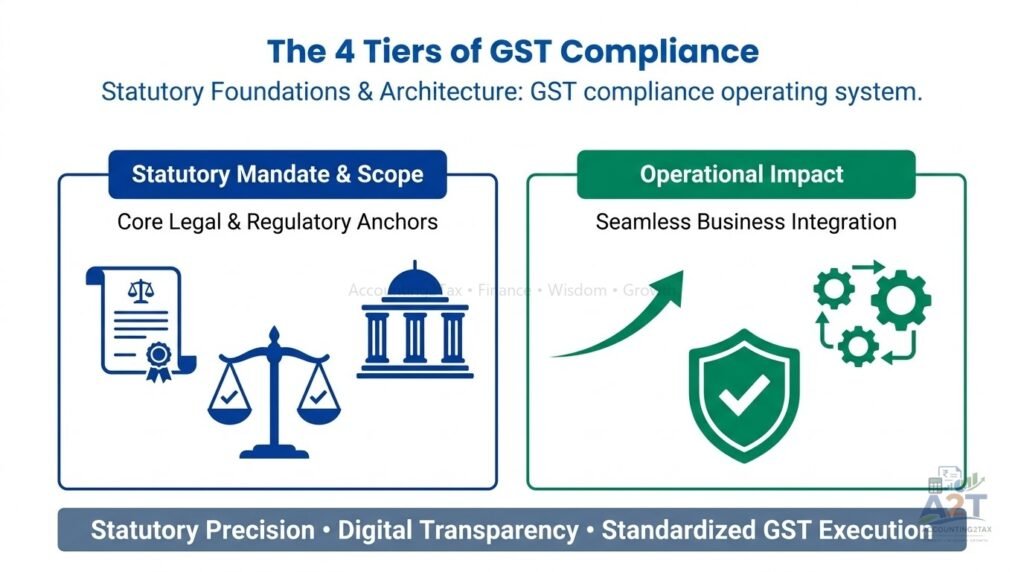
- • The 4 Tiers of GST Compliance
- • 1. Daily & Transactional Compliance Checklist
- • 2. Monthly Compliance Checklist (For Regular Taxpayers)
- • 3. Quarterly Compliance Checklist
- • 4. Annual & Year-End Compliance Checklist — Applicable Statutory Due Dates
Last Verified: 1 September 2026
Key verification sources: 56th GST Council recommendations, CBIC Tax Information Portal, GSTN advisories (IMS, GSTR-1A).
Managing a business in India requires juggling product quality, customer acquisition, cash flow, and team leadership.
Behind every commercial operation lies an equally critical responsibility: Maintaining 100% GST Compliance.
Under the Goods and Services Tax framework, compliance is not a once-a-year event. It is a continuous, calendar-driven operational rhythm. A single missed deadline, a clerical typo on a tax invoice, an unverified purchase credit, or failure to display your GSTIN on your office entrance can lead to Section 47 late fees, 18% interest penalties, automated mismatch notices, E-Way bill blocking, and even the suspension of your GST registration.
To help business owners, directors, CFOs, and accounting teams stay ahead of statutory obligations, we have synthesized the complete GST Compliance Master Checklist organized across Daily, Monthly, Quarterly, and Annual milestones.
The 4 Tiers of GST Compliance
THE 4 TIERS OF GST COMPLIANCE
                                        │
        ┌───────────────────┬───────────┴───────────┬───────────────────┐
        ▼                   ▼                       ▼                   ▼
    [ DAILY ]          [ MONTHLY ]            [ QUARTERLY ]         [ ANNUAL ]
 • Tax Invoices     • GSTR-1 Sales by 11th • QRMP Returns         • GSTR-9 Return
 • E-Invoicing      • GSTR-1A Amendments   • CMP-08 (Comp.)       • GSTR-9C Audit
 • E-Way Bills      • IMS Actions          • PMT-06 Challans      • Stock Audit
 • Signboard        • GSTR-2B Recon (14th) • IFF B2B Uploads      • Credit Reversal
                    • GSTR-3B Tax by 20th
1. Daily & Transactional Compliance Checklist
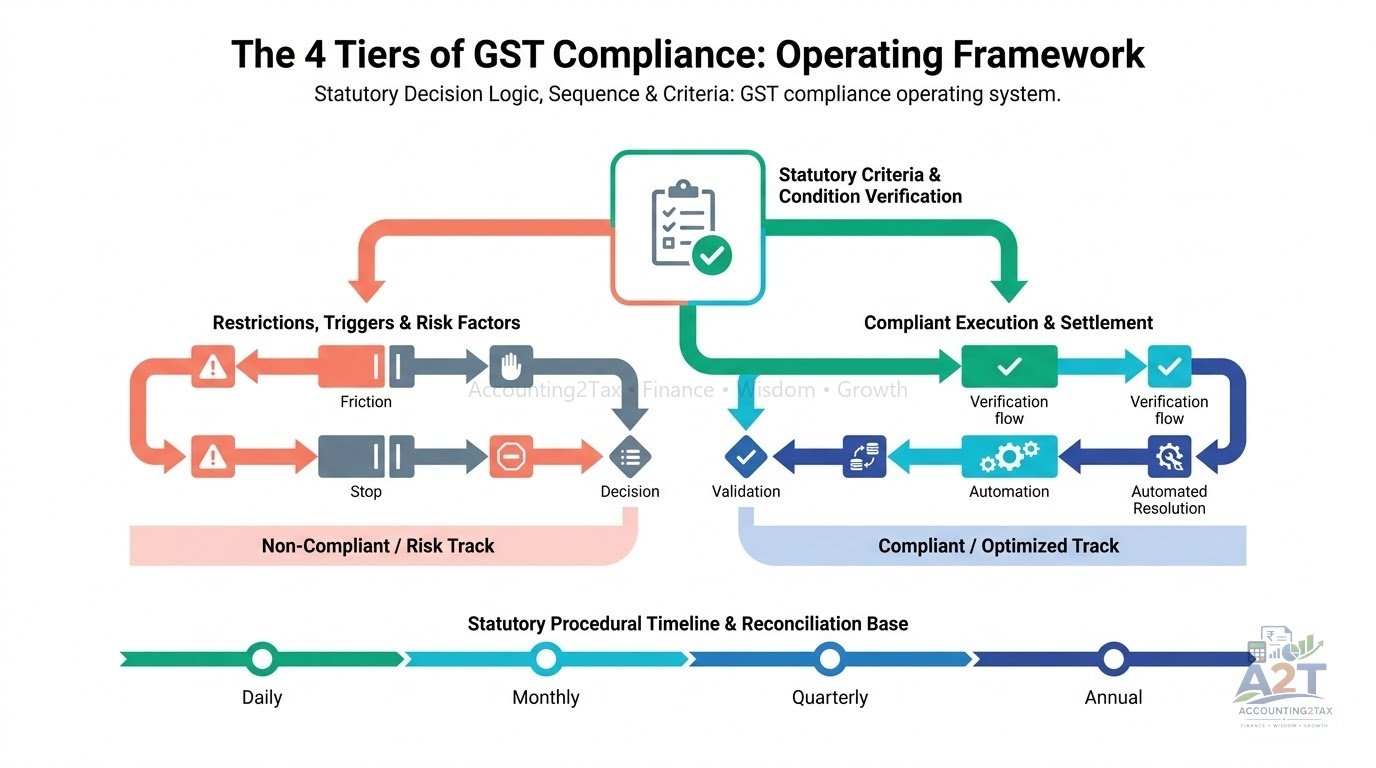
These requirements apply to every single transaction generated during daily operations:
- [ ] Compliant Tax Invoices (Rule 46): Ensure every sales invoice contains all 16 statutory fields, including:
- Consecutive serial number unique for the financial year.
- Date of issue.
- Supplier name, address, and GSTIN.
- Recipient name, address, and GSTIN (for B2B supplies).
- Place of Supply along with State Name.
- 6-digit or 4-digit HSN / SAC Code.
- Separate columns for Taxable Value, CGST, SGST, IGST, and Total Amount.
- [ ] E-Invoicing Compliance (Turnover > ₹5 Crore):
- If your aggregate turnover in any preceding financial year from 2017-18 onwards exceeded ₹5 Crore, you MUST generate an electronic invoice with an Invoice Reference Number (IRN) and QR Code via an authorized Invoice Registration Portal (IRP) before issuing B2B invoices. (Standard invoices without IRN are legally invalid).
- 30-Day Reporting Restriction: For taxpayers with an AATO ≥ ₹10 Crore, e-invoices must be reported within 30 days of the invoice date.
- [ ] E-Way Bill Generation (Rule 138):
- Generate an electronic E-Way Bill on
ewaybillgst.gov.inbefore transporting physical goods worth more than ₹50,000 (consignment value) regardless of the distance. (The 50 km relaxation applies only to updating Part B conveyance details within the same state, not to the generation of the E-Way bill itself). - [ ] Mandatory Premises Display (Rule 18):
- Prominently display your GST Registration Certificate (Form GST REG-06) inside your principal place of business and all branch offices.
- Display your 15-digit GSTIN on the business signboard outside your premises entrance.
2. Monthly Compliance Checklist (For Regular Taxpayers)
The 2026 compliance control cycle follows a strict sequence: e-invoice/IRN → GSTR-1 → GSTR-1A (corrections) → IMS actions → GSTR-2B review → GSTR-3B → payment.
- [ ] By the 11th: File Form GSTR-1:
- Upload all B2B sales invoices, debit/credit notes, exports, and aggregated B2C sales. Timely filing ensures your corporate buyers receive their ITC.
- [ ] Post GSTR-1 Filing: File Form GSTR-1A (if needed):
- Utilize the GSTR-1A amendment facility to correct mistakes or add missed invoices after filing GSTR-1 but before filing GSTR-3B.
- [ ] Take IMS Actions:
- Review the Invoice Management System (IMS) dashboard. Accept, Reject, or keep Pending the invoices uploaded by your suppliers. Your actions dictate what flows into your GSTR-2B.
- [ ] On the 14th: Download & Reconcile Form GSTR-2B:
- Download the static GSTR-2B statement from the GST portal.
- Match purchase register invoices against GSTR-2B. Identify missing vendor bills and follow up with non-compliant suppliers immediately.
- [ ] Identify Section 17(5) Blocked Credits:
- Segregate and reverse ineligible credits (motor cars, personal meals, team catering, corporate gifts, and Section 17(5)(fa) CSR expenses) so they are not claimed in GSTR-3B.
- [ ] Review Vendor Compliance (Rules 37 & 37A):
- Check the Accounts Payable ledger for unpaid vendor invoices approaching 180 days. Reverse ITC with 18% interest on bills crossing 180 days (Rule 37).
- Reverse ITC under Rule 37A if a vendor fails to file their GSTR-3B.
- [ ] Pay Reverse Charge Mechanism (RCM) Liabilities:
- Identify payments made to unregistered transporters (GTA) or legal advocates. Pay RCM GST in cash through the electronic cash ledger (cannot be paid using ITC) and claim matching ITC in the same month.
- [ ] By the 20th: File Form GSTR-3B & Pay Net Tax:
- Offset eligible ITC from GSTR-2B against output tax liability. Pay the remaining net balance in cash before submitting GSTR-3B.
3. Quarterly Compliance Checklist
For small enterprises enrolled under the QRMP Scheme or Composition Scheme:
- [ ] By the 13th of Months 1 & 2 (QRMP IFF): Upload B2B sales invoices using the optional Invoice Furnishing Facility (IFF) so clients get monthly ITC.
- [ ] By the 25th of Months 1 & 2 (QRMP PMT-06): Pay monthly estimated tax via Challan PMT-06 using either the 35% Fixed Sum Method or Self-Assessment Method.
- [ ] By the 18th following Quarter End (Composition CMP-08): Composition dealers must pay applicable turnover tax via Form CMP-08.
- [ ] By the 22nd or 24th following Quarter End (QRMP GSTR-3B): File quarterly summary return and reconcile final cash payments.
4. Annual & Year-End Compliance Checklist — Applicable Statutory Due Dates
Closing the financial year requires comprehensive audit reconciliation:
- [ ] File Form GSTR-9 (Annual Return):
- Mandatory for regular taxpayers with annual turnover exceeding ₹2 Crore.
- Reconciles aggregate sales, taxes paid, and ITC claimed across all 12 months.
- [ ] File Form GSTR-9C (Reconciliation Statement):
- Mandatory for businesses with annual turnover exceeding ₹5 Crore.
- Self-certified reconciliation between audited financial statements and GSTR-9.
- [ ] Annual Credit Reversal under Rule 42 & 43:
- Re-calculate proportional ITC reversals on common inputs and capital goods used for both taxable and exempt business activities for the entire year.
- [ ] Physical Stock vs. Book Inventory Reconciliation:
- Reconcile physical warehouse inventory with accounting books. If goods were lost, expired, or written off, reverse the corresponding ITC under Section 17(5)(h).
- [ ] Verify HSN Summary Accuracy: Ensure all goods and services sold during the year comply with mandatory 4-digit or 6-digit HSN reporting rules.
Master Compliance Calendar Reference
| Deadline | Mandatory Filing / Action | Frequency | Who Does It? |
|---|---|---|---|
| 11th Monthly | GSTR-1 (Sales declaration) | Monthly | Regular monthly filers |
| Post-11th | GSTR-1A (Amendments) | Monthly | Regular monthly filers |
| 13th Monthly | IFF (B2B sales upload) | Monthly (Months 1 & 2) | QRMP taxpayers |
| 14th Monthly | GSTR-2B Download & Purchase Match | Monthly | All registered buyers |
| 18th Post-Quarter | CMP-08 (Turnover tax challan) | Quarterly | Composition dealers |
| 20th Monthly | GSTR-3B (Summary return & tax payment) | Monthly | Regular monthly filers |
| 22nd / 24th Post-Quarter | Quarterly GSTR-3B | Quarterly | QRMP taxpayers (Staggered) |
| 25th Monthly | PMT-06 (Estimated tax challan) | Monthly (Months 1 & 2) | QRMP taxpayers |
| 30th June | GSTR-4 (Annual Composition Return) | Annually | Composition dealers |
| 31st December | GSTR-9 & GSTR-9C (Annual Return & Audit) | Annually | Regular taxpayers (>₹2Cr / >₹5Cr) |
Frequently Asked Questions (FAQs)
Q1. Is an E-Way bill required only if the transport is beyond 50 kilometers?
Answer: No. Under Rule 138, generating an E-Way bill is mandatory whenever the consignment value exceeds ₹50,000, regardless of the distance. The 50 km relaxation only applies to updating Part B conveyance details within the same state.
Q2. What if I make an error in my GSTR-1?
Answer: You can use the GSTR-1A amendment facility. This allows you to correct errors or add missing invoices after GSTR-1 is filed but before filing GSTR-3B, ensuring seamless ITC flow to your buyers.
Q3. When is the deadline for filing GSTR-4?
Answer: The due date for filing the GSTR-4 annual return for composition dealers is 30th June following the end of the financial year.
Q4. Are there 30-day reporting restrictions for E-invoicing?
Answer: Yes. Taxpayers with an Aggregate Annual Turnover (AATO) of ₹10 Crore or more must report invoices to the IRP within 30 days of the invoice date.
Calculate Your GST Invoices Instantly
Verify invoice tax values, check reverse GST splits, and calculate exact cash settlement amounts using the Accounting2Tax GST Calculator.
Use the GST Calculator to model your monthly GST liabilities accurately.
Related Financial Wisdom
- GST Explained: Understanding India’s Goods and Services Tax
- GST Registration Explained: Turnover Limits, Mandatory Triggers and Rules
- GST Returns Explained: Understanding the GST Filing System
- Input Tax Credit Explained: How GST Paid on Purchases Works
- ITC Reconciliation: Why GSTR-2B Matters
Key Takeaways
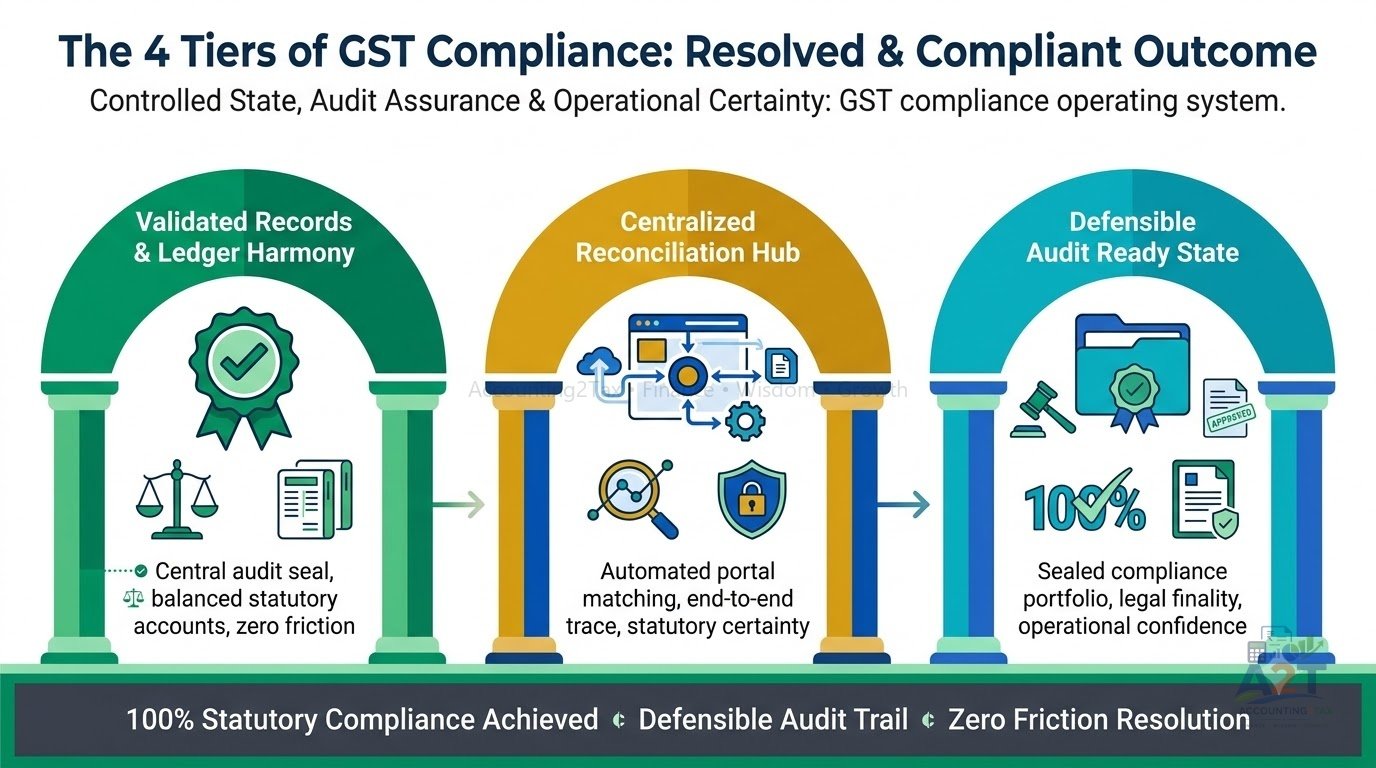
- Daily compliance mandates 16-field Rule 46 tax invoices, E-Invoicing (>₹5Cr), and E-Way Bills (>₹50,000 regardless of distance).
- Display your GST Registration Certificate inside and your 15-digit GSTIN on the outside signboard (Rule 18).
- The 2026 monthly routine is: GSTR-1 by 11th, GSTR-1A corrections, IMS Actions, GSTR-2B matching on 14th, and GSTR-3B tax payment by 20th.
- Review vendor payment aging monthly; reverse ITC on unpaid vendor bills crossing 180 days (Rule 37) or if vendor defaults on filing (Rule 37A).
- Annual compliance requires GSTR-9 (>₹2Cr) and GSTR-9C (>₹5Cr) by December 31st, and GSTR-4 by June 30th.
📚 Sources & Official Regulatory References
| Topic / Section | Source | Authority | Checked On | Effective Date |
|---|---|---|---|---|
| Rule 46 (Tax Invoice Rules) & Rule 48(4) (E-Invoicing Mandate) | CGST Rules, 2017 | Tier 1 | 2026-09-01 | Current |
| Rule 18 (Display of Registration Certificate & GSTIN) | CGST Rules, 2017 | Tier 1 | 2026-09-01 | Current |
| Section 37, 39 & 44 (Statutory Return Filing & Annual Returns) | CGST Act, 2017 | Tier 1 | 2026-09-01 | Current |
| Rule 138 (E-Way Bill Thresholds) | CGST Rules, 2017 | Tier 1 | 2026-09-01 | Current |
| IMS, GSTR-1A, and 30-Day E-invoice limits | GSTN Advisories / Notifications | Tier 1 | 2026-09-01 | Current |
📚 Explore More in Compliance (GST)
Taxonomy Series
Discover related guides, taxonomy series, and interactive financial calculators: