- • What Is GST? The Core Definition
- • The Legacy System vs. GST: Ending the “Cascading Effect”
- • The Dual GST Architecture in India
- • The GST Rate Structure — Current Framework and Historical Evolution
- • What Is OUTSIDE the Scope of GST in India?
Last Verified: 1 September 2026
Sources: 56th GST Council recommendations, CBIC Tax Information Portal.
On July 1, 2017, India executed the most comprehensive and historic indirect tax reform in its post-independence history: the rollout of the Goods and Services Tax (GST).
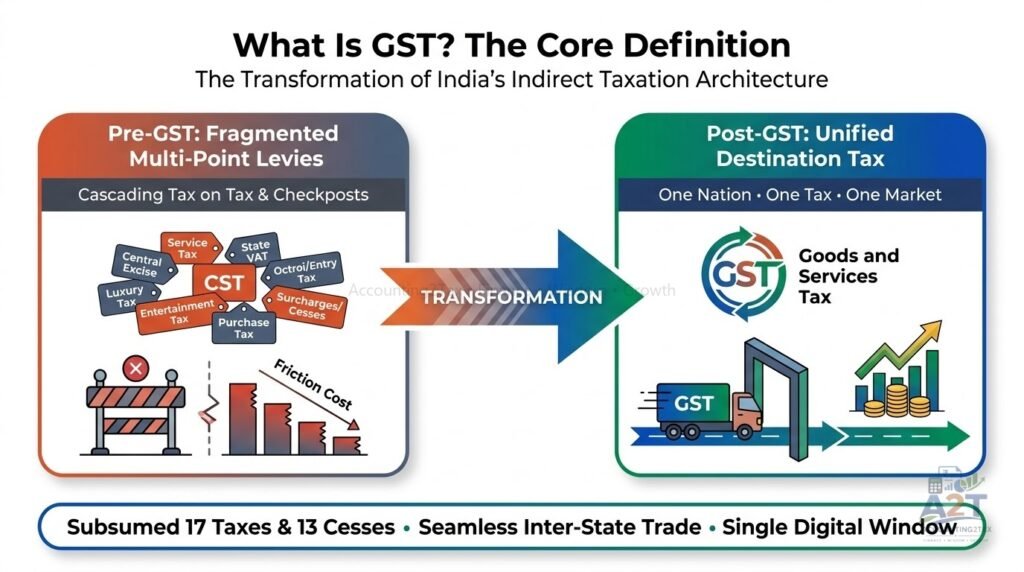
Before GST, doing business in India meant navigating a fragmented maze of over a dozen disparate Central and State levies — Central Excise Duty, Service Tax, State VAT, Central Sales Tax (CST), Entry Tax, Luxury Tax, and Octroi. Each state operated as a distinct economic territory with check-posts at every border, causing massive supply chain bottlenecks and severe “tax cascading” (tax on tax).
GST dismantled these internal fiscal barriers, creating a unified common market under the principle of “One Nation, One Tax, One Market.”
Today, whether you are a consumer buying groceries, a freelancer billing a corporate client, or a business owner managing supply chains, understanding how GST functions is fundamental to financial literacy.
This guide provides a comprehensive breakdown of what GST is, how the dual GST model works, the current multi-slab rate structure (and its historical evolution), items outside GST, and how the Input Tax Credit (ITC) chain eliminates cascading taxes.
What Is GST? The Core Definition
Goods and Services Tax (GST) is a comprehensive, multi-stage, destination-based consumption tax levied on the supply of goods and services across India.
Key Pillars of GST in India
                                       │
        ┌──────────────────────────────┼──────────────────────────────┐
      ▼                                ▼                              ▼
Comprehensive                     Multi-Stage                 Destination-Based
Levied on virtually all           Collected at every step     Tax revenue belongs to the
goods and services with           of the value-addition       State where goods/services
unified definitions               supply chain                are consumed (not produced)
- Comprehensive: It subsumed 17 legacy central and state taxes into a single unified statutory code.
- Multi-Stage: It is collected at every point in the supply chain — from raw material extraction and manufacturing to wholesale distribution and retail sale.
- Destination-Based (Consumption Tax): Unlike legacy origin-based taxes (like CST), GST revenue accrues to the State where the consumer actually receives and consumes the product or service.
The Legacy System vs. GST: Ending the “Cascading Effect”
To understand why GST was revolutionary, examine how taxes were calculated before 2017:
The Pre-GST Nightmare: “Tax on Tax”
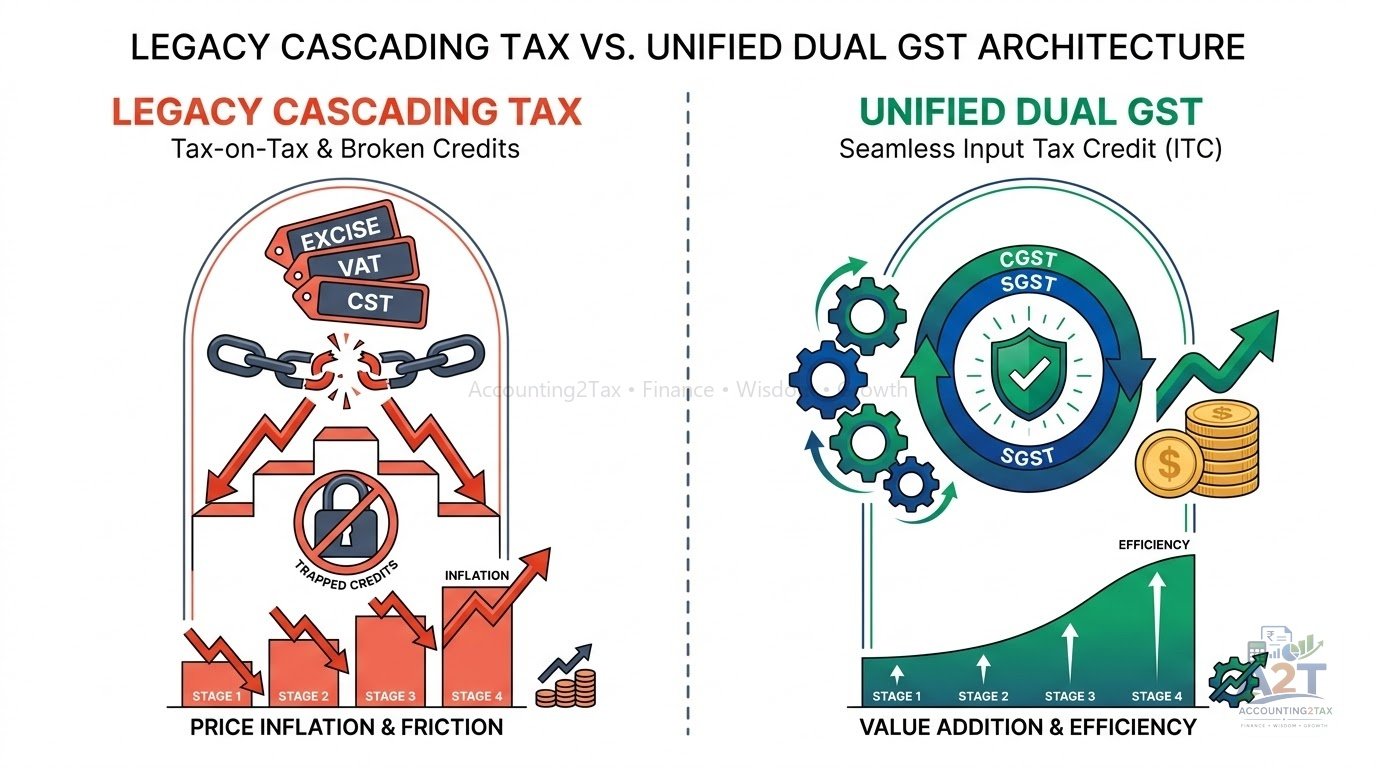
In the pre-GST era, an excise duty of 12.5% was levied when a product left the factory floor. When the wholesaler sold it to a retailer, State VAT (e.g. 14.5%) was charged on the total invoice value INCLUDING the excise duty. Consumers paid tax on top of tax.
Pre-GST: Cost (₹1,000) + Excise @ 12.5% (₹125) = ₹1,125 ──► VAT @ 14.5% on ₹1,125 = ₹163.12 (Tax on Tax!)
Post-GST: Base Price (₹1,000) + GST @ 18% (₹180) = ₹1,180 (Transparent tax on value-added only)
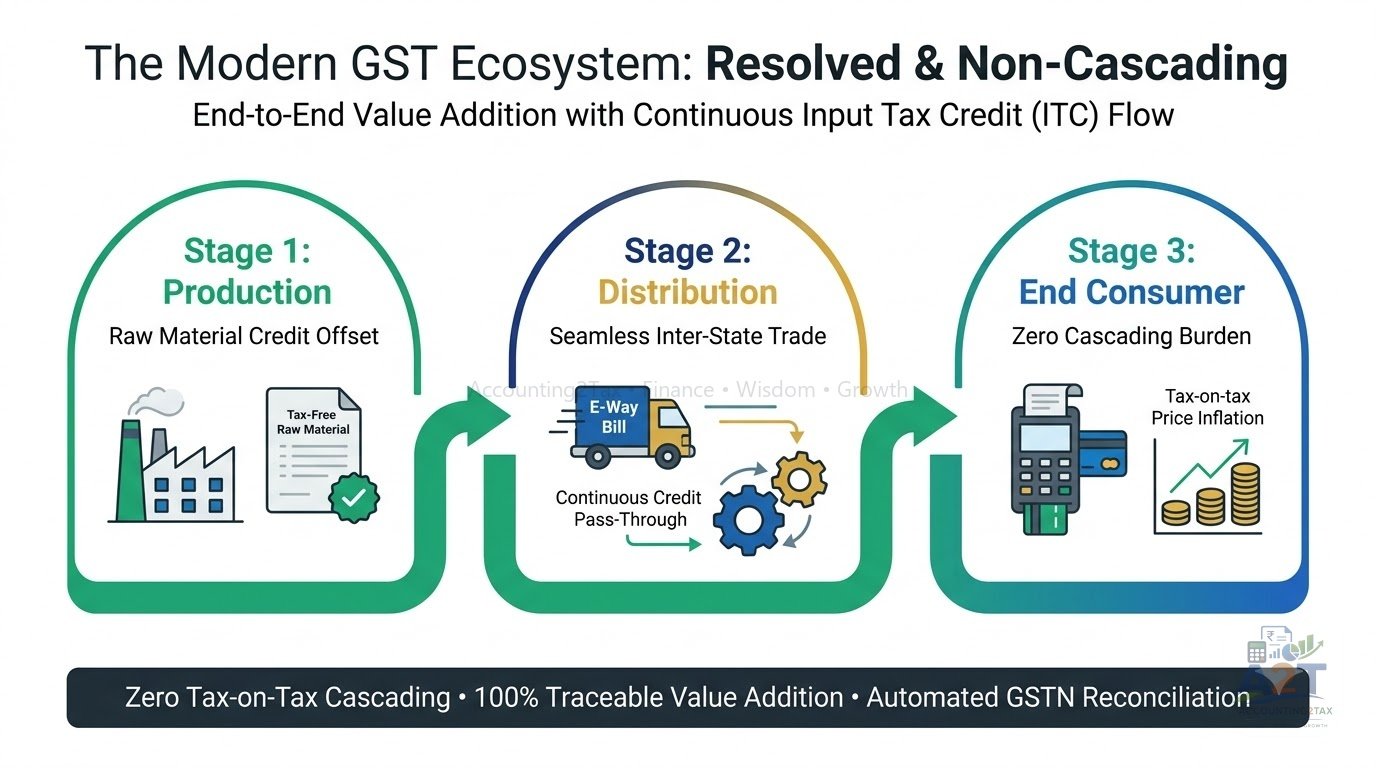
By allowing a continuous flow of Input Tax Credit (ITC) across the entire manufacturing and distribution chain, GST ensures that tax is paid only on the incremental value added at each stage.
The Dual GST Architecture in India
Because India is a federal democracy where both the Union Government and State Governments have constitutional powers to raise revenue, India adopted a Dual GST Model:
The Dual GST Structure
                                         │
        ┌────────────────────────────────┴────────────────────────────────┐
      ▼                                                                 ▼
INTRA-STATE SUPPLY (Within same State)           INTER-STATE SUPPLY (Across State Borders)
Tax split equally into:                          Single Tax Levied:
   ┌───────────────┬───────────────┐                                     │
   ▼               ▼                                                     ▼
[ CGST ]      [ SGST / UTGST ]                                        [ IGST ]
Central GST    State / UT GST                                       Integrated GST
(Union Govt)   (State Govt)                               (Collected by Center & shared)
- Intra-State Supply (e.g., Manufacturer in Mumbai sells to Retailer in Pune):
- If GST is 18%, it is divided into 9% CGST (goes to Central Government) and 9% SGST (goes to Maharashtra Government).
- Inter-State Supply (e.g., Manufacturer in Bengaluru sells to Retailer in Chennai):
- 18% IGST is charged. The Central Government collects the tax and automatically transfers the State share to Tamil Nadu (the destination consumption state).
The GST Rate Structure — Current Framework and Historical Evolution
Following the landmark 56th GST Council meeting, India’s GST rate architecture was significantly rationalized effective 22 September 2025.
Current Rate Architecture (Effective 22 Sep 2025)
The new simplified structure relies primarily on two main rates and a special de-merit rate:
| Rate Category | Economic Purpose | Typical Goods & Services |
|---|---|---|
| 0% (Nil / Exempt) | Essential Needs | Fresh produce, unbranded food grains, milk, basic healthcare, education. |
| 5% (Merit Rate) | Mass Consumption | Packaged food items, edible oils, tea, coffee, life-saving medicines, economy air travel, lower-tier hotel accommodations. |
| 18% (Standard Rate) | General / Industrial | Most services (IT, banking, telecom, hospitality), capital goods, electronics, personal care products, apparel, footwear. |
| 40% (De-merit Rate) | Special / Sin Goods | Tobacco products, pan masala, betting. (Note: Effective 1 February 2026, this rate replaces the old 28% + Compensation Cess for these specified items). |
Special Concessional Rates:
- 0.25%: Rough diamonds and precious stones.
- 3.00%: Gold, silver, platinum jewelry, and precious metals.
Historical Context (Pre-22 Sep 2025 Position):
Between 1 July 2017 and 21 September 2025, India operated on a 5-slab system: 0%, 5%, 12%, 18%, and 28%. Many goods and services were shifted across these slabs over the years. The 12% intermediate rate and 28% luxury rate are now largely historical for transactions taking place after 22 September 2025, having been merged into the 18% standard rate or escalated to the 40% de-merit rate.
What Is OUTSIDE the Scope of GST in India?
Certain high-revenue commodities were intentionally kept outside the GST net during the 2017 constitutional amendments:
Goods Outside GST Scope
                                       │
        ┌──────────────────────────────┼──────────────────────────────┐
      ▼                                ▼                              ▼
Petroleum Products             Alcoholic Liquor               Electricity & Real Estate
• Petrol, Diesel, Crude,       • For human consumption        • Electricity duties continue
  ATF, Natural Gas             • State Excise Duty +          • Sale of completed immovable
• State VAT + Central Excise     State VAT apply                property (stamp duty applies)
- 5 Petroleum Products: Crude oil, High-Speed Diesel (HSD), Motor Spirit (Petrol), Natural Gas, and Aviation Turbine Fuel (ATF). (Subject to Central Excise and State VAT).
- Alcohol for Human Consumption: Governed strictly by State Excise Laws.
- Completed Immovable Property: Sale of ready-to-move-in property with Completion Certificate (attracts State Stamp Duty, not GST).
The Governance Engine: The GST Council
The GST framework operates under the regulation of the GST Council (established under Article 279A of the Constitution):
– Chairperson: Union Finance Minister.
– Members: Union Minister of State for Finance and Finance/Taxation Ministers of all 28 States and 3 Union Territories with legislatures.
– Voting Power: 1/3rd weighted voting power with the Central Government, 2/3rd divided equally among the States. Decisions require a 75% weighted majority, embodying cooperative federalism.
Frequently Asked Questions (FAQs)
Q1. Is GST an extra tax on top of the old taxes?
Answer: No. GST replaced 17 different indirect taxes (like Excise Duty, Service Tax, and VAT). It subsumed them into a single tax, effectively eliminating the old “tax on tax” system.
Q2. What happened to the 12% and 28% GST rates?
Answer: Effective 22 September 2025, the 56th GST Council rationalized the rates. The 12% and 28% slabs were historically applicable but have now been transitioned into a simpler 5% Merit, 18% Standard, and 40% De-merit rate structure.
Q3. Why are petrol and liquor not under GST?
Answer: State and Central governments rely heavily on revenue from petroleum and alcohol. To secure consensus for the GST rollout in 2017, these items were constitutionally kept out of the GST net and remain subject to legacy State VAT and Excise duties.
Q4. Does the GST Council set the tax rates?
Answer: Yes. The GST Council, comprising the Union Finance Minister and State Finance Ministers, recommends changes to tax rates, exemptions, and administrative rules. These recommendations become law once officially notified by the CBIC.
Q5. What is the current GST rate for hotel accommodation?
Answer: Depending on the exact tariff, standard hotel accommodations generally fall into the 5% merit or 18% standard rate under the post-September 2025 rationalized structure.
Calculate GST Instantly
Calculate forward GST (adding tax to base price) or reverse GST (extracting base price and tax from inclusive amount) using the Accounting2Tax GST Calculator.
Use the GST Calculator to compute CGST, SGST, and IGST for any invoice.
Related Financial Wisdom
- CGST, SGST, IGST and UTGST: Key Differences
- GST Registration Explained: Who May Need to Register
- Input Tax Credit Explained: How GST Paid on Purchases Works
- Income Tax in India Explained: A Beginner’s Guide — direct vs indirect tax.
- How to Read a Company’s Financial Statements — GST on balance sheets.
Key Takeaways
- GST replaced 17 legacy taxes, establishing a unified, multi-stage, destination-based indirect tax system in India.
- Under the Dual GST model, intra-state supplies attract tax as CGST + SGST, while inter-state supplies attract tax as IGST.
- The current rate structure (effective 22 Sep 2025) comprises 5% Merit, 18% Standard, and 40% De-merit rates, phasing out the historical 5-slab system.
- Petroleum products, alcohol for human consumption, and completed real estate remain outside the standard GST net.
- The Input Tax Credit (ITC) mechanism eliminates the cascading “tax on tax,” ensuring tax is paid only on value addition.
📚 Sources & Official Regulatory References
| Topic / Provision | Source | Authority | Checked On | Effective Date |
|---|---|---|---|---|
| Central Goods and Services Tax (CGST) Act, 2017 & IGST Act, 2017 | Ministry of Law and Justice / CBIC | Tier 1 | 2026-09-01 | Current |
| Constitution (One Hundred and First Amendment) Act, 2016 (Article 279A) | Parliament of India | Tier 1 | 2026-09-01 | Current |
| GST Rate Schedules & Notifications for Goods and Services | Central Board of Indirect Taxes & Customs (CBIC) | Tier 1 | 2026-09-01 | Current |
| GST Council Recommendations and Decisions Archive | GST Council Secretariat (gstcouncil.gov.in) |
Tier 1 | 2026-09-01 | Current |
📚 Explore More in Basics (GST)
Taxonomy Series
Discover related guides, taxonomy series, and interactive financial calculators:
This publication is strictly for educational, research, and informational purposes and does not constitute formal financial, investment, tax, or legal advice.
- Data Accuracy & Inadvertent Errors: While every reasonable effort is made to maintain accuracy, all information, interest rates, tax thresholds, formulas, and statutory data are provided on an “as-is” basis. Accounting2Tax makes no express or implied warranties regarding absolute completeness, timeliness, or typographical and computational infallibility. Statutory authorities (Ministry of Finance, RBI, CBDT, CBIC, SEBI, PFRDA) update guidelines periodically. Readers must independently verify current rates and rules on official government portals before executing financial transactions.
- Illustrations, Simulations & Limitations of Liability: Mathematical models, compounding simulations, case studies, and hypothetical return projections are conceptual tools designed solely to demonstrate financial principles. They do not constitute guaranteed returns, profit forecasts, or capital safety commitments. Accounting2Tax and its authors disclaim all liability for any direct, indirect, or consequential financial losses, tax penalties, or investment outcomes arising from inadvertent errors, omissions, calculation discrepancies, or reliance placed on this material.
- Professional Consultation: Readers must independently evaluate their individual financial goals, tax positions, and risk tolerance, and consult a SEBI-registered financial advisor or certified chartered accountant before making financial decisions.