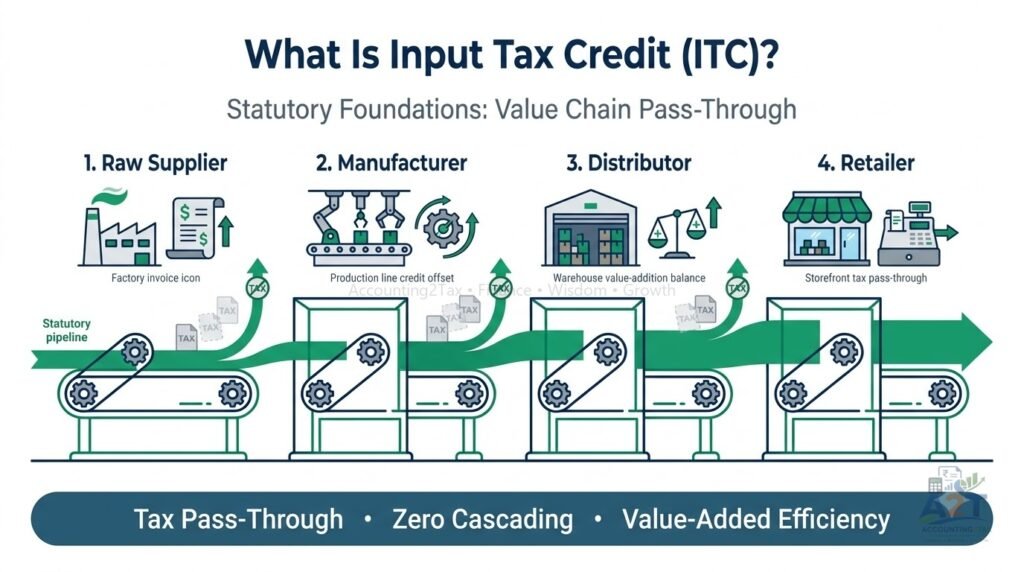
- • What Is Input Tax Credit (ITC)?
- • The 4 Mandatory Conditions to Claim ITC (Section 16(2))
- • Statutory Deadlines and Vendor Rules
- • Apportionment of Credit: Rules 42 and 43
- • Blocked Credits: What Can NEVER Be Claimed (Section 17(5))
Expert Revision Notice — Last Verified: 1 September 2026
Key verification sources: 56th GST Council recommendations, CBIC Tax Information Portal, GSTN advisories (IMS, GSTR-1A), Finance Act amendments.
The core economic engine that makes the Goods and Services Tax (GST) a true value-added tax is the Input Tax Credit (ITC).
In simple terms, ITC allows a registered business to deduct the GST it pays on business purchases (raw materials, office equipment, software subscriptions, professional services) from the GST it collects on outward sales.
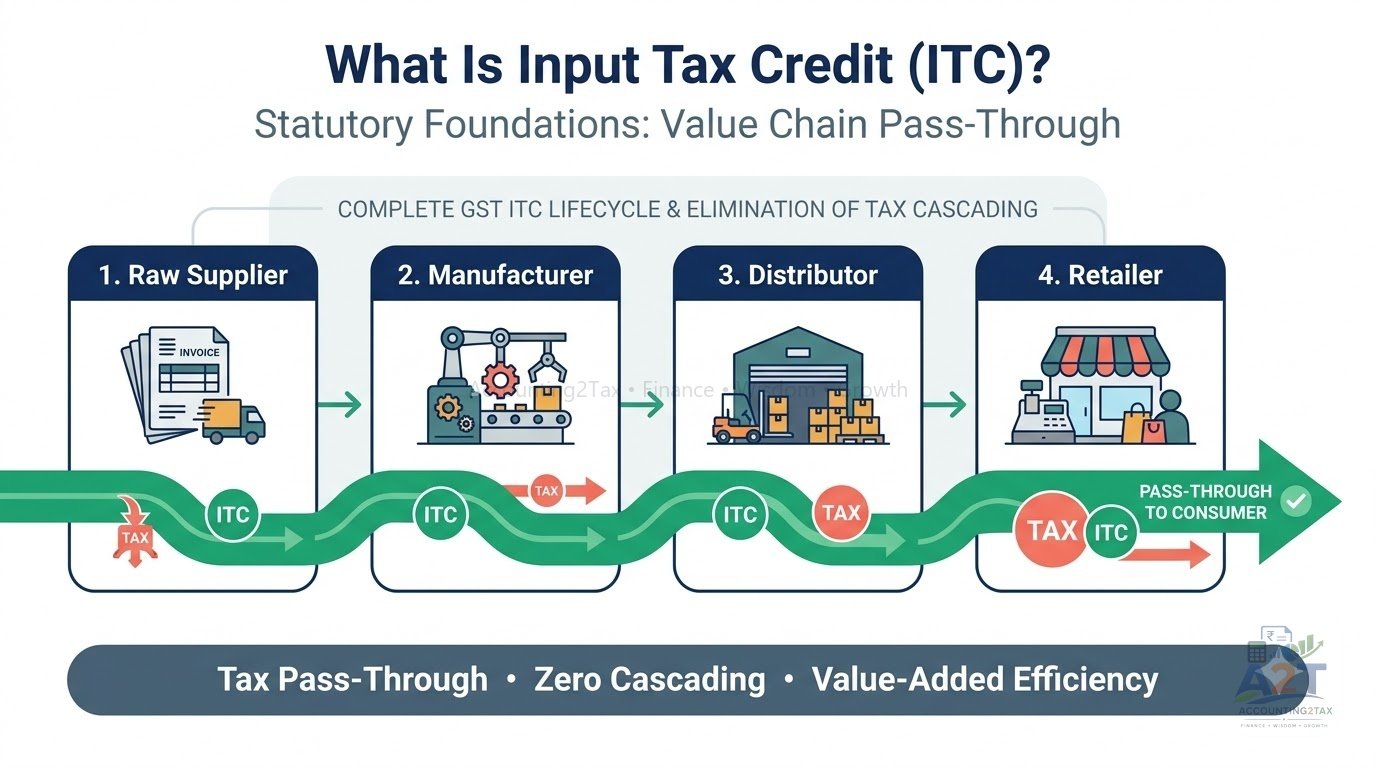
Without Input Tax Credit, businesses would pay tax on the full selling price at every stage of distribution, causing massive “tax cascading” (tax on tax) and making Indian products uncompetitive.
However, claiming ITC is not automatic. Under Indian GST law, claiming credit requires satisfying strict statutory conditions under Section 16, navigating the blocked credit restrictions of Section 17(5), apportioning credits between taxable and exempt supplies under Rules 42 and 43, and complying with the 180-day vendor payment rule.
Claiming ineligible ITC can lead to severe penalties of 100% tax, reversal demands, and 18% penal interest under Section 50(3).
This guide provides a comprehensive breakdown of what Input Tax Credit is, the mandatory conditions to claim it, the rules for apportionment, the complete list of blocked credits, and practical calculation examples.
What Is Input Tax Credit (ITC)?
Input Tax Credit (ITC) is the credit a registered business receives for the GST paid on the purchase of goods and services used in the course or furtherance of business.
 [ GST Paid on Business Purchases (Input Tax) ] : ₹18,000
                               │
                               ▼
 [ GST Collected on Sales (Output Tax) ] : ₹30,000
                               │
                               ▼
 [ Net Tax Payable to Government in Cash (GSTR-3B) ] : ₹12,000 (₹30,000 − ₹18,000)
By utilizing ₹18,000 of ITC, the business avoids double taxation and pays tax only on the ₹12,000 of incremental value it added.
The 4 Mandatory Conditions to Claim ITC (Section 16(2))
Under Section 16(2) of the CGST Act, a registered buyer can claim Input Tax Credit ONLY if all four of the following legal conditions are satisfied simultaneously:
 The 4 Golden Rules of ITC
                                        │
        ┌───────────────────────────────┼───────────────────────────────┐
       ▼                                                               ▼
 1. Valid Tax Invoice               2. Reflected in GSTR-2B & IMS   3. Goods/Services Received
 In possession of tax invoice       Supplier uploaded in GSTR-1,    Buyer has physically received
 or debit note with GSTIN           accepted in IMS, and appears    the goods or services.
                                    in buyer's GSTR-2B.
        │                                                               │
        └───────────────────────────────┬───────────────────────────────┘
                                        ▼
                                4. Tax Paid & Return Filed
                                Supplier deposited tax with Govt.
                                and buyer filed GSTR-3B return.
- Possession of Tax Invoice: You must hold a valid tax invoice or debit note issued by a GST-registered supplier containing your correct GSTIN.
- GSTR-2B and IMS Matching (Section 16(2)(aa)): The supplier must have uploaded the invoice in their GSTR-1, and it must be processed through the Invoice Management System (IMS) to appear in your auto-drafted GSTR-2B.
- Actual Receipt of Goods/Services: You must have actually received the underlying goods or services.
- Tax Paid to Government & Return Filed: The supplier must have paid the tax to the government, and you must file your GSTR-3B return.
Statutory Deadlines and Vendor Rules
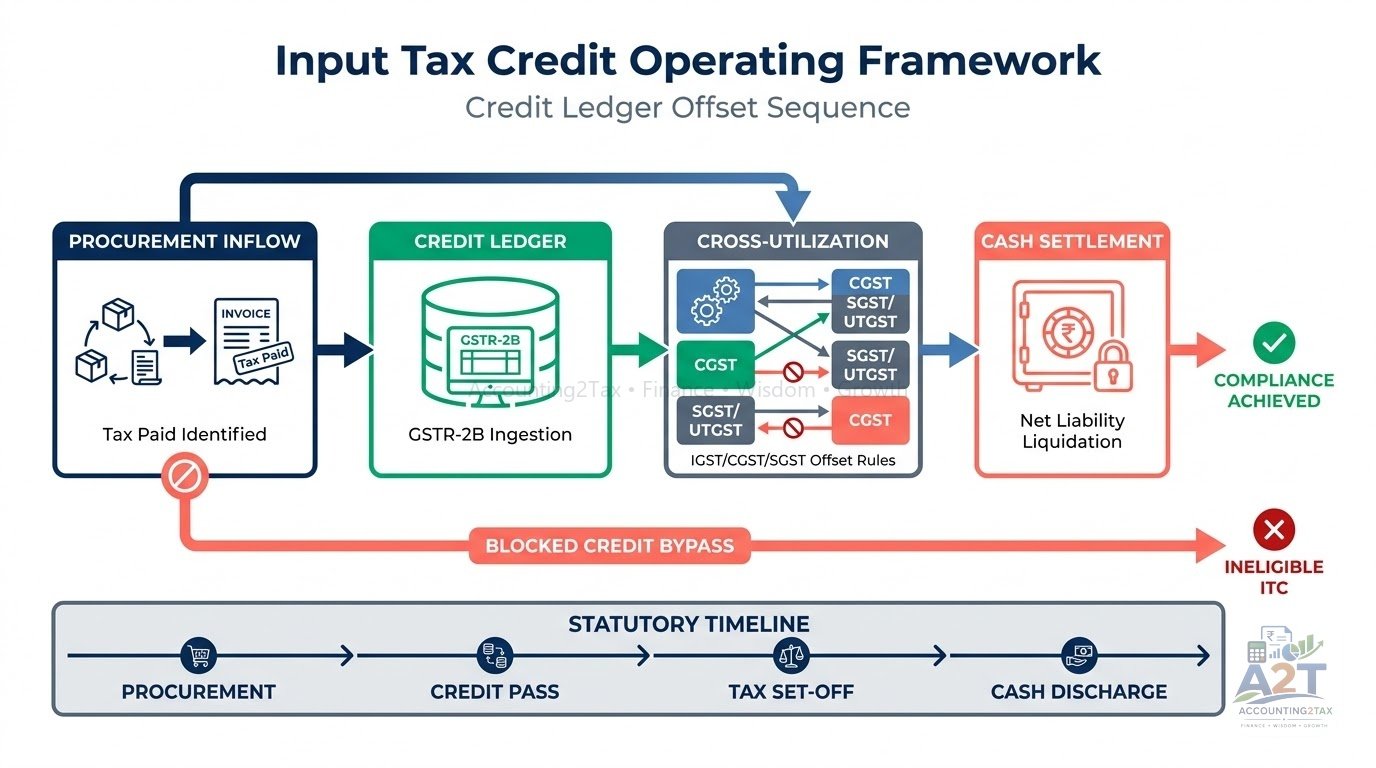
1. The Expiry Deadline (Section 16(4))
You cannot claim ITC indefinitely. Missed ITC for any financial year must be claimed by the earliest of:
– 30th November following the end of the financial year, OR
– The actual date of filing the relevant Annual Return (Form GSTR-9).
After this date, the ITC perishes forever.
2. The 180-Day Vendor Payment Rule (Section 16(2) Second Proviso)
To ensure fair commercial practices, the law mandates that buyers pay their suppliers promptly:
– If you fail to pay the supplier the full invoice value plus GST within 180 days from the invoice date, you must reverse the claimed ITC in GSTR-3B along with 18% interest.
– Re-Claiming Credit: As soon as you eventually pay the supplier, you can immediately reclaim the full ITC without any time restriction.
3. Vendor Non-Filing Reversal (Rule 37A)
If your supplier files GSTR-1 (making the ITC available in your GSTR-2B) but fails to file their GSTR-3B (meaning tax isn’t paid to the government), you must reverse the claimed ITC by 30th November of the following financial year. If the supplier later files GSTR-3B, you can re-claim it.
Apportionment of Credit: Rules 42 and 43
Not all business purchases are used exclusively for making taxable supplies. When goods or services are used for mixed purposes, the ITC must be apportioned:
- Rule 42 (Inputs and Input Services): If you buy a service (like rent) that is used partly for business and partly for personal use, or partly for taxable sales and partly for exempt sales, you must calculate and reverse the proportionate ITC pertaining to the non-business or exempt portion.
- Rule 43 (Capital Goods): A similar apportionment formula applies to capital assets (machinery, computers) used for both taxable and exempt supplies over their prescribed useful life (typically 60 months).
Blocked Credits: What Can NEVER Be Claimed (Section 17(5))
Even if a purchase is made for business purposes and has a valid GST invoice, Section 17(5) of the CGST Act explicitly prohibits claiming ITC on specified categories:
| Category | Ineligible / Blocked Under Section 17(5) | Exceptions (Where ITC IS Allowed) |
|---|---|---|
| Motor Vehicles | Passenger cars, SUVs, and two-wheelers with seating capacity ≤ 13 persons | Allowed if used for commercial passenger transport, driving schools, or further sale of vehicles |
| Food & Beverages / Catering | Office lunches, snacks, business dinner catering, and food delivery | Allowed if employer is under a statutory government mandate (e.g., Factories Act canteen) |
| Health, Club & Fitness | Gym memberships, health club subscriptions, spa, and beauty treatments | None |
| Life & Health Insurance | General health/life insurance policies bought for employees | Allowed ONLY if mandated by the government (e.g., statutory workmen insurance) |
| Employee Travel Perks | Leave Travel Concession (LTC) and vacation holiday packages | None |
| Personal Consumption | Any goods/services used for personal or household use | None |
| Lost, Stolen or Destroyed Goods | Goods lost, stolen, written off, expired, or distributed as free samples/gifts | None (Input tax on raw materials used must also be reversed) |
| Civil Construction of Buildings | Goods/services used for construction of immovable property on own account (e.g., office building) | Allowed ONLY for construction of Plant & Machinery |
Practical Case Study: Input Tax Credit Computation
Case Study: Pune Software & Consulting Firm
In August 2026, a registered consulting firm generates ₹10,00,000 in client billing (GST @ 18% = ₹1,80,000 Output GST).
During the same month, the firm incurred the following business expenses (all with valid GST invoices reflected in GSTR-2B):
1. Office Laptops & Monitors: ₹2,00,000 (GST @ 18% = ₹36,000) $\rightarrow$ Eligible ITC
2. Cloud Server Hosting (AWS): ₹1,00,000 (GST @ 18% = ₹18,000) $\rightarrow$ Eligible ITC
3. Office Commercial Internet: ₹20,000 (GST @ 18% = ₹3,600) $\rightarrow$ Eligible ITC
4. Executive Team Dinner & Drinks: ₹30,000 (GST @ 18% = ₹5,400) $\rightarrow$ Blocked u/s 17(5) (Ineligible)
5. Company Car for Director: ₹8,00,000 (GST @ 28% = ₹2,24,000) $\rightarrow$ Blocked u/s 17(5) (Ineligible)Tax Computation for GSTR-3B:
- Total Output Tax Liability: ₹1,80,000
- Less: Total Eligible ITC Claimed (₹36,000 + ₹18,000 + ₹3,600): ₹57,600
- Net Cash Tax Payable: ₹1,22,400
The firm legitimately saves ₹57,600 in cash outflow while correctly excluding ₹2,29,400 of blocked credits to prevent tax notices.
Frequently Asked Questions (FAQs)
Q1. What happens if I miss the 30th November deadline to claim ITC?
Answer: The ITC expires permanently. Section 16(4) imposes a hard statutory deadline. You cannot claim ITC for a financial year after 30th November of the following year, or the date of filing GSTR-9, whichever is earlier.
Q2. Do I need to reverse ITC if I only paid half the invoice amount within 180 days?
Answer: Yes. You must proportionately reverse the ITC related to the unpaid portion of the invoice, along with 18% interest. You can reclaim it once the remaining balance is paid.
Q3. How do Rules 42 and 43 affect my ITC?
Answer: If you make both taxable and exempt sales, you cannot claim 100% of the ITC on common inputs (like rent or admin expenses). You must use the formulas in Rules 42 (for inputs/services) and 43 (for capital goods) to reverse the portion of ITC attributable to exempt sales.
Q4. Can I claim ITC on laptops given to employees for work-from-home?
Answer: Yes. Laptops are capital goods used in the course of business. Since they do not fall under the Section 17(5) blocked list, you can claim 100% ITC.
Q5. What is Rule 37A?
Answer: It requires you to reverse claimed ITC by 30th November if your vendor successfully filed GSTR-1 (so you got the credit in 2B) but failed to file their GSTR-3B and pay the tax to the government.
Calculate Your GST Invoices and ITC Offsets
Model your input tax credits, check net tax payouts, and structure compliant billing using the Accounting2Tax GST Calculator.
Use the GST Calculator to compute eligible input credits and net tax payable.
Related Financial Wisdom
- GST Explained: Understanding India’s Goods and Services Tax — core indirect tax guide.
- CGST, SGST, IGST and UTGST: Understanding the Different GST Components — tax components.
- ITC Reconciliation: Why GSTR-2B Matters — reconciliation SOP.
- GSTR-1 and GSTR-3B: Understanding Their Different Purposes — monthly filing cycle.
- GST Compliance Checklist: Key Requirements for Registered Businesses (Article 105 — coming soon).
Key Takeaways
- Input Tax Credit (ITC) allows businesses to offset GST paid on purchases against GST collected on sales, eliminating tax cascading.
- To claim ITC under Section 16(2), you must have a tax invoice, it must appear in your GSTR-2B via IMS, goods/services must be received, and tax must be paid.
- You must pay your vendor within 180 days. Otherwise, the claimed ITC must be reversed in GSTR-3B with 18% interest until payment is cleared.
- Section 17(5) blocks credit on personal motor cars, food/catering, health clubs, personal items, and free gifts.
- Reconcile your purchase registers with GSTR-2B every month before filing GSTR-3B to prevent illegal claims.
- The deadline to claim missed ITC is 30th November of the following financial year.
📚 Sources & Official Regulatory References
| Section / Circular | Source | Authority | Checked On | Effective Date |
|---|---|---|---|---|
| Section 16 (Eligibility, Conditions, & Time Limits for Taking ITC) | Central Goods and Services Tax Act, 2017 | Tier 1 | 2026-09-01 | Current |
| Section 17(5) (Statutory List of Blocked / Ineligible Credits) | CGST Act, 2017 / Ministry of Finance | Tier 1 | 2026-09-01 | Current |
| Rules 42 & 43 (Apportionment of ITC) | Central Goods and Services Tax Rules, 2017 | Tier 1 | 2026-09-01 | Current |
| Rules 37 & 37A (Reversal of ITC) | Central Goods and Services Tax Rules, 2017 | Tier 1 | 2026-09-01 | Current |
| Section 50(3) (Penal Interest on Wrongful ITC Claim & Utilization) | CGST Act, 2017 / CBIC Notifications | Tier 1 | 2026-09-01 | Current |
📚 Explore More in ITC (GST)
Taxonomy Series
Discover related guides, taxonomy series, and interactive financial calculators:
This publication is strictly for educational, research, and informational purposes and does not constitute formal financial, investment, tax, or legal advice.
- Data Accuracy & Inadvertent Errors: While every reasonable effort is made to maintain accuracy, all information, interest rates, tax thresholds, formulas, and statutory data are provided on an “as-is” basis. Accounting2Tax makes no express or implied warranties regarding absolute completeness, timeliness, or typographical and computational infallibility. Statutory authorities (Ministry of Finance, RBI, CBDT, CBIC, SEBI, PFRDA) update guidelines periodically. Readers must independently verify current rates and rules on official government portals before executing financial transactions.
- Illustrations, Simulations & Limitations of Liability: Mathematical models, compounding simulations, case studies, and hypothetical return projections are conceptual tools designed solely to demonstrate financial principles. They do not constitute guaranteed returns, profit forecasts, or capital safety commitments. Accounting2Tax and its authors disclaim all liability for any direct, indirect, or consequential financial losses, tax penalties, or investment outcomes arising from inadvertent errors, omissions, calculation discrepancies, or reliance placed on this material.
- Professional Consultation: Readers must independently evaluate their individual financial goals, tax positions, and risk tolerance, and consult a SEBI-registered financial advisor or certified chartered accountant before making financial decisions.
