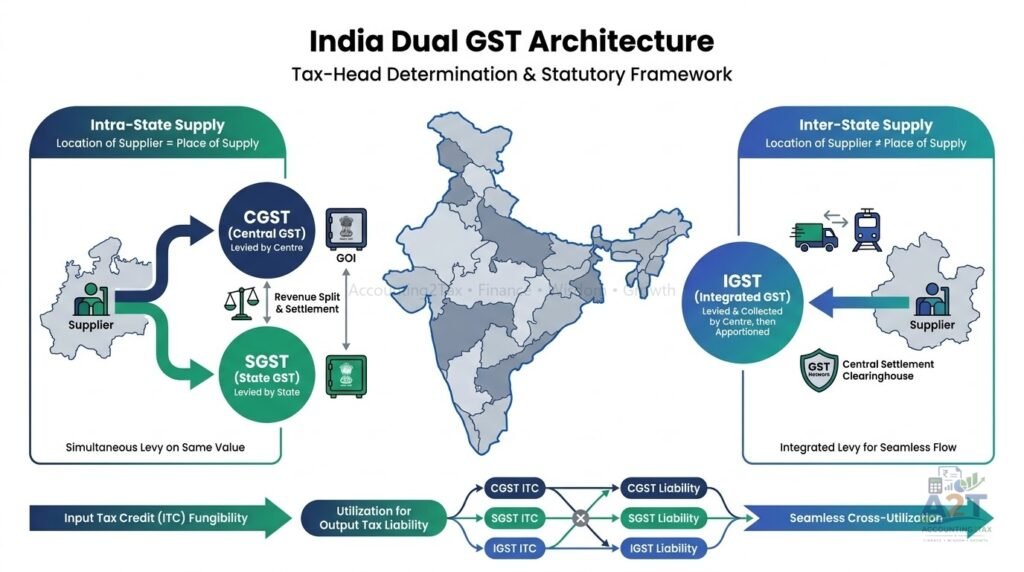
- • Current-Law Position and Tax-Head Determination
- • The 4 Components of GST at a Glance
- • 1. CGST (Central Goods and Services Tax)
- • 2. SGST (State Goods and Services Tax)
- • 3. IGST (Integrated Goods and Services Tax)
Last Verified: 1 September 2026
Sources: 56th GST Council recommendations, CBIC Tax Information Portal, GST Portal advisories.
If you look closely at any tax invoice in India — whether from your local neighborhood store, a restaurant bill, or an e-commerce order shipped from another state — you will notice that the tax is rarely labeled simply as “GST.”
Instead, it is broken down into specific acronyms: CGST, SGST, IGST, or occasionally UTGST.
Why does India have four different types of GST instead of a single uniform tax rate on an invoice? How do you determine whether to charge CGST + SGST or IGST on a sale? And which Union Territories use UTGST instead of SGST?
Understanding these four components is vital for businesses to raise compliant tax invoices. Furthermore, if you accidentally pay tax under the wrong head (e.g., treating an inter-state supply as an intra-state supply), Section 77 of the CGST Act and Section 19 of the IGST Act provide a mechanism for refund of tax wrongly paid under the incorrect head without interest liability.
This guide provides a comprehensive explanation of CGST, SGST, IGST, and UTGST, details the rules governing intra-state vs. inter-state supplies, and explains the statutory Input Tax Credit (ITC) utilization hierarchy.
Current-Law Position and Tax-Head Determination
The primary framework for determining which GST is legally payable follows a controlling sequence:
Nature of Supply → Supplier Location → Recipient Location → Place-of-Supply Rule → Intra-State/Inter-State Result → Correct Tax Head → ITC Utilisation.
Important (Settled Position): A change in the GST rate (such as the September 2025 rate rationalisation) does not convert an intra-State supply into an inter-State supply. The place of supply remains the first substantive classification question.
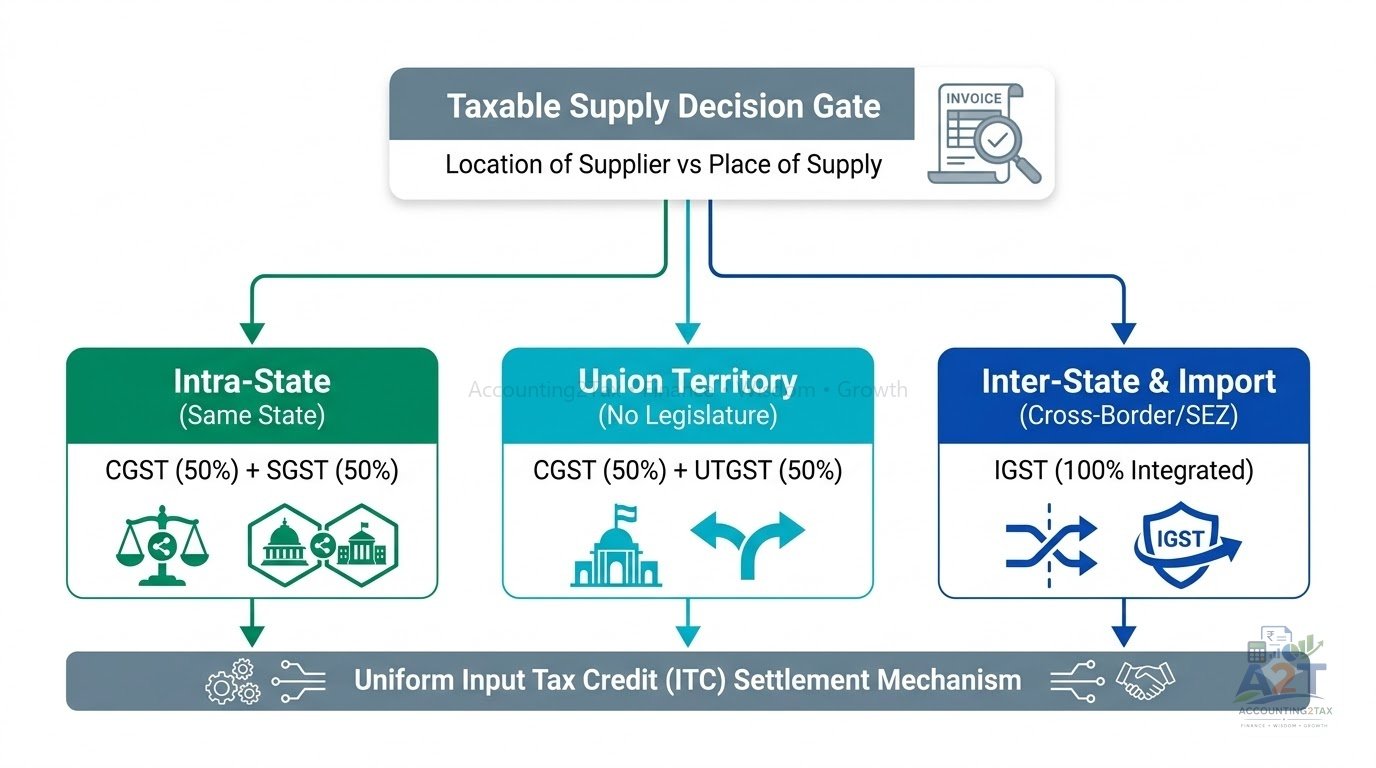
The 4 Components of GST at a Glance
India’s federal indirect tax structure comprises four distinct statutory taxes:
The 4 GST Components in India
                                          │
            ┌─────────────────────────────┼─────────────────────────────┐
          ▼                               ▼                             ▼
   [ CGST + SGST ]                  [ CGST + UTGST ]                 [ IGST ]
Intra-State (Within State)     Intra-UT (No Legislature)       Inter-State / Imports
  • Split equally 50-50          • Split equally 50-50         • Single integrated tax
• e.g. 9% CGST + 9% SGST       • e.g. 9% CGST + 9% UTGST             • e.g. 18% IGST
1. CGST (Central Goods and Services Tax)
- Governing Law: Central Goods and Services Tax Act, 2017.
- Levied By: The Central Government of India.
- Applicability: Levied on intra-state supplies of taxable goods and services (sales made within the same state).
- Revenue Recipient: 100% of CGST collections go directly into the Consolidated Fund of India for Central Government expenditures.
2. SGST (State Goods and Services Tax)
- Governing Law: Respective State Goods and Services Tax Acts (e.g., Maharashtra GST Act, Tamil Nadu GST Act).
- Levied By: The respective State Government.
- Applicability: Levied alongside CGST on intra-state supplies within that specific State.
- Revenue Recipient: 100% of SGST collections remain with that State Government to fund state infrastructure, healthcare, and education.
3. IGST (Integrated Goods and Services Tax)
- Governing Law: Integrated Goods and Services Tax Act, 2017.
- Levied By: The Central Government.
- Applicability: Levied on:
1. Inter-State Supplies: When goods or services move from one State/UT to another State/UT.
2. Imports into India: All goods and services imported into India count as inter-state supplies and attract IGST (along with basic customs duty).
3. Special Economic Zones (SEZ): Supplies to or by SEZ developers/units. - Revenue Mechanism: Collected by the Central Government and subsequently apportioned 50% to the Central Government and 50% to the destination State where the goods/services are consumed.
4. UTGST (Union Territory Goods and Services Tax)
- Governing Law: Union Territory Goods and Services Tax Act, 2017.
- Levied By: The Central Government on behalf of Union Territories.
- Applicability: Levied alongside CGST on intra-UT supplies within Union Territories that do NOT have their own state legislature.
Which Union Territories Use UTGST vs. SGST?
Union Territories with UTGST                 Union Territories with SGST
(No State Legislature — Charges UTGST)       (Have State Legislature — Charges SGST)
────────────────────────────────────────     ────────────────────────────────────────
• Andaman and Nicobar Islands                • National Capital Territory of Delhi
• Chandigarh                                 • Puducherry
• Dadra & Nagar Haveli and Daman & Diu       • Jammu & Kashmir
• Ladakh
• Lakshadweep
Intra-State vs. Inter-State Supply: The Determination Rule
To decide which tax to apply on an invoice, you must compare two statutory factors under the IGST Act:
- Location of the Supplier: The physical place of business from where the supplier is registered and supplying goods/services.
- Place of Supply (PoS): The registered location of the recipient or the place where goods are delivered / services are performed (governed by Sections 10 to 13 of the IGST Act).
Location of Supplier: Maharashtra               Location of Supplier: Karnataka
Place of Supply: Maharashtra                    Place of Supply: Tamil Nadu
─────────────────────────────────               ─────────────────────────────────
      = INTRA-STATE SUPPLY                             = INTER-STATE SUPPLY
   Charge: 9% CGST + 9% SGST                             Charge: 18% IGST
Head-to-Head Comparison Matrix
| Parameter | CGST | SGST | UTGST | IGST |
|---|---|---|---|---|
| Full Form | Central GST | State GST | Union Territory GST | Integrated GST |
| Enacted By | Central Parliament | State Legislatures | Central Parliament | Central Parliament |
| Applicable On | Intra-state sales | Intra-state sales | Intra-UT sales (No legislature) | Inter-state sales & Imports |
| Charged In Tandem With | SGST or UTGST | CGST | CGST | Standalone single rate |
| Revenue Goes To | Central Government | State Government | Central Govt (for UT) | Split 50:50 (Center + Dest. State) |
| Input Tax Credit Usage | Offsets CGST, then IGST | Offsets SGST, then IGST | Offsets UTGST, then IGST | Offsets IGST, then CGST/SGST/UTGST |
The Strict Input Tax Credit (ITC) Utilization Order
One of the most important accounting rules in GST is the statutory order of ITC utilization under Sections 49, 49A, 49B of the CGST Act, and Rule 88A of the CGST Rules:
ITC Set-Off Hierarchy Rules
                                         │
 ┌───────────────────────────────────────┴───────────────────────────────────────┐
 │ RULE 1: IGST Credit MUST be completely exhausted (reduced to ZERO) first      │
 │         against Output IGST ──► Output CGST / Output SGST in ANY PROPORTION   │
 │         and in any order (per Rule 88A).                                      │
 ├───────────────────────────────────────────────────────────────────────────────┤
 │ RULE 2: CGST Credit is used next against Output CGST ──► then Output IGST.    │
 │         (CGST Credit CANNOT be used to pay Output SGST/UTGST).                │
 ├───────────────────────────────────────────────────────────────────────────────┤
 │ RULE 3: SGST/UTGST Credit is used next against Output SGST ──► Output IGST.   │
 │         (SGST Credit CANNOT be used to pay Output CGST).                      │
 └───────────────────────────────────────────────────────────────────────────────┘
The Golden Rule: Cross-utilization between CGST and SGST/UTGST is strictly illegal. Central tax credits cannot pay State tax liabilities, and State tax credits cannot pay Central tax liabilities.
Additionally, under the Invoice Management System (IMS), valid supplier invoices categorized into CGST/SGST/IGST accurately flow from the supplier’s outward supplies into the buyer’s IMS (for Accept/Reject/Pending actions) before appearing in the GSTR-2B. Claiming ITC under the correct head based on GSTR-2B is critical.
Practical Invoicing Illustration
Case Study: Bangalore Electronics Dealer
A registered electronics dealer in Bengaluru, Karnataka sells a laptop (GST Rate: 18%, Base Price: ₹50,000):
Scenario A: Sale to a Customer in Mysuru (Intra-State)
- Base Price: ₹50,000
- Add: CGST @ 9%: ₹4,500
- Add: SGST @ 9%: ₹4,500
- Total Invoice Value: ₹59,000
Scenario B: Sale to a Customer in Hyderabad, Telangana (Inter-State)
- Base Price: ₹50,000
- Add: IGST @ 18%: ₹9,000
- Total Invoice Value: ₹59,000
The total tax paid by the customer is identical (₹9,000). Only the statutory classification and revenue allocation change.
Calculate Your Exact GST Split
Model your intra-state and inter-state GST breakdowns instantly using the Accounting2Tax GST Calculator.
Use the GST Calculator to separate CGST, SGST, and IGST components for any invoice.
Frequently Asked Questions (FAQs)
Q1. What happens if I charge CGST/SGST on an inter-state sale by mistake?
Answer: This is a common error. Under Section 77 of the CGST Act and Section 19 of the IGST Act, you must pay the correct IGST to the government, but you can claim a refund of the wrongly paid CGST/SGST. The law explicitly provides relief from interest liabilities in such bona-fide classification errors.
Q2. Can I use my SGST credit to pay off my CGST liability?
Answer: No. Cross-utilization between CGST and SGST (or UTGST) is strictly prohibited by law. State tax credits cannot offset Central tax liabilities and vice versa.
Q3. How does Rule 88A affect the utilization of IGST credit?
Answer: Rule 88A allows a taxpayer to utilize remaining IGST credit towards the payment of CGST and SGST/UTGST in any proportion and in any order, provided the IGST output liability has been fully paid off first.
Q4. Does the recent change in GST rates to 5%, 18% and 40% affect how CGST, SGST, and IGST are applied?
Answer: No. Rate changes (such as the September 2025 rationalization) do not alter the fundamental principles of determining tax heads. Whether an item is taxed at 5%, 18%, or 40%, the intra-state vs inter-state test (place of supply) dictates if you charge CGST/SGST or IGST.
Q5. How does the Invoice Management System (IMS) impact my CGST/SGST/IGST claims?
Answer: Invoices uploaded by your suppliers flow directly into your IMS portal reflecting their tax head (CGST/SGST/IGST). You must accurately action (Accept/Reject/Pending) these invoices. Only accepted or deemed accepted invoices will populate your GSTR-2B under the respective tax heads for your ITC claim.
Q6. Is IGST an additional tax burden compared to CGST + SGST?
Answer: No, IGST is not an extra tax. It is a single, integrated tax equivalent to the sum of CGST and SGST. For example, an 18% IGST is mathematically equal to 9% CGST + 9% SGST. The tax burden on the final consumer remains identical.
Related Financial Wisdom
- GST Explained: Understanding India’s Goods and Services Tax — comprehensive GST framework.
- GST Registration Explained: Who May Need to Register
- Input Tax Credit Explained: How GST Paid on Purchases Works
- GSTR-1 and GSTR-3B: Understanding Their Different Purposes
- Income Tax in India Explained: A Beginner’s Guide — direct vs indirect taxes.
Key Takeaways
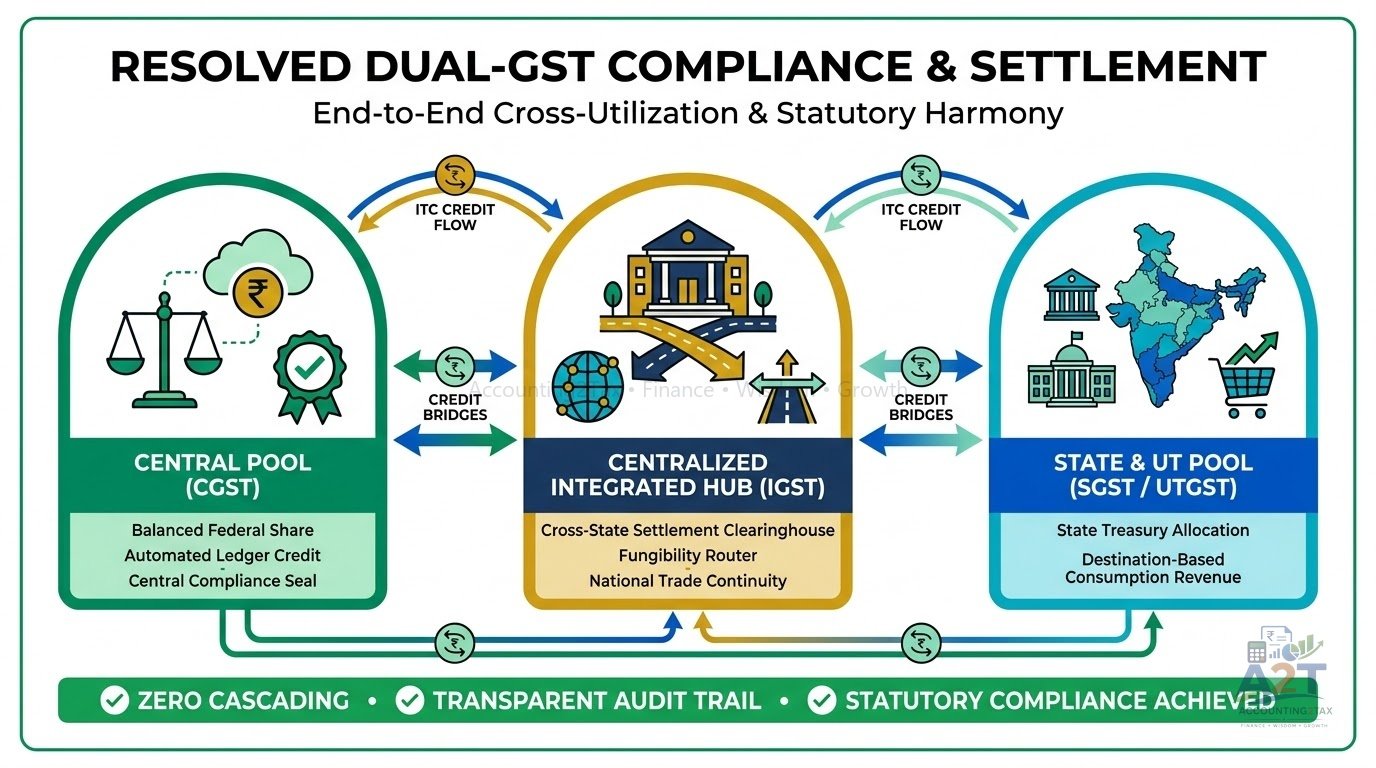
- CGST and SGST/UTGST apply to intra-state/intra-UT transactions, dividing the total GST rate equally (50:50).
- IGST applies to inter-state supplies, imports, and SEZ transactions, collected by the Center and shared with the destination State.
- Delhi, Puducherry, and J&K charge SGST (they have legislatures); other Union Territories charge UTGST.
- IGST credit must be completely exhausted first before utilizing CGST or SGST credits.
- Under Rule 88A, remaining IGST credit can be utilized towards CGST and SGST in any proportion.
- CGST and SGST credits can NEVER cross-utilize to offset each other.
📚 Sources & Official Regulatory References
| Topic / Section | Source | Authority | Checked On | Effective Date |
|---|---|---|---|---|
| Section 7 & 8 (Inter-State and Intra-State Supply Rules) | Integrated Goods and Services Tax (IGST) Act, 2017 | Tier 1 | 2026-09-01 | Current |
| Section 9 (Levy and Collection of CGST) & Section 49 (ITC Payment Order) | Central Goods and Services Tax (CGST) Act, 2017 | Tier 1 | 2026-09-01 | Current |
| Union Territory Goods and Services Tax (UTGST) Act, 2017 | Ministry of Law and Justice | Tier 1 | 2026-09-01 | Current |
| Section 49A & 49B / Rule 88A (Order of Utilization of Input Tax Credit) | CBIC Notifications / GST Rules | Tier 1 | 2026-09-01 | Current |
| Section 77 (CGST) & Section 19 (IGST) (Tax wrongfully collected) | CGST & IGST Acts | Tier 1 | 2026-09-01 | Current |
📚 Explore More in Basics (GST)
Taxonomy Series
Discover related guides, taxonomy series, and interactive financial calculators:
This publication is strictly for educational, research, and informational purposes and does not constitute formal financial, investment, tax, or legal advice.
- Data Accuracy & Inadvertent Errors: While every reasonable effort is made to maintain accuracy, all information, interest rates, tax thresholds, formulas, and statutory data are provided on an “as-is” basis. Accounting2Tax makes no express or implied warranties regarding absolute completeness, timeliness, or typographical and computational infallibility. Statutory authorities (Ministry of Finance, RBI, CBDT, CBIC, SEBI, PFRDA) update guidelines periodically. Readers must independently verify current rates and rules on official government portals before executing financial transactions.
- Illustrations, Simulations & Limitations of Liability: Mathematical models, compounding simulations, case studies, and hypothetical return projections are conceptual tools designed solely to demonstrate financial principles. They do not constitute guaranteed returns, profit forecasts, or capital safety commitments. Accounting2Tax and its authors disclaim all liability for any direct, indirect, or consequential financial losses, tax penalties, or investment outcomes arising from inadvertent errors, omissions, calculation discrepancies, or reliance placed on this material.
- Professional Consultation: Readers must independently evaluate their individual financial goals, tax positions, and risk tolerance, and consult a SEBI-registered financial advisor or certified chartered accountant before making financial decisions.