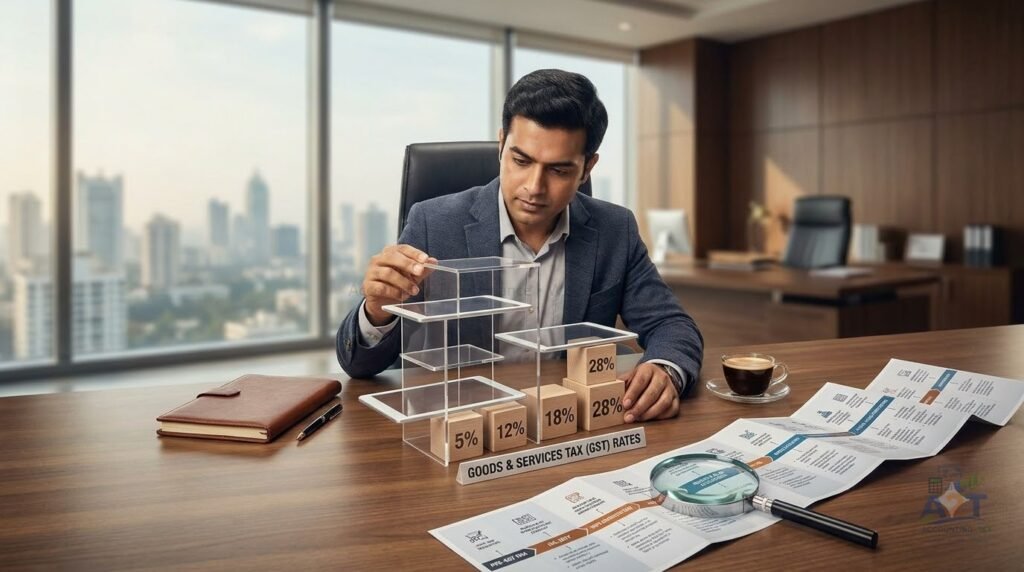
- • The Core Philosophy: Why a Single Flat Rate Fails in India
- • 1. The Post-2025 Framework and Historical Slabs
- • 2. The GST Compensation Cess (The Sin Tax) Transition
- • 3. Special Concessional GST Slabs
- • 4. Nil-Rated vs. Exempt vs. Non-GST vs. Zero-Rated Supplies
Last Verified: 1 September 2026
Sources: 56th GST Council recommendations, CBIC Tax Information Portal, GST Portal advisories.
When the Goods and Services Tax (GST) was introduced in July 2017 under the banner of “One Nation, One Tax”, many citizens expected a single, uniform tax percentage on every purchase.
Instead, when you examine your receipts, you find a diverse spectrum of tax rates:
- Fresh vegetables and milk: 0%
- Life-saving medicines and edible oil: 5%
- Software services, banking, and dining: 18%
- Tobacco and Pan Masala: 40%
- Gold jewelry: 3%
Why does India not use a single flat GST rate like Singapore or New Zealand? How does the Rationalized GST Slab Structure (5%, 18%, 40%) balance government revenue with social equity and inflation control? What is the GST Compensation Cess, and how is it transitioning out for certain goods? What is the critical statutory difference between Nil-Rated, Exempt, Non-GST, and Zero-Rated supplies? And how do HSN and SAC codes determine the exact tax rate for your business?
This comprehensive guide breaks down India’s GST rate architecture, explains the socio-economic rationale behind each slab, and provides an updated master 20-category rate reference table reflecting the September 2025 rationalization.
The Core Philosophy: Why a Single Flat Rate Fails in India
In an economy with wide income disparities, a single flat tax rate (such as 15% on everything) would be deeply regressive:
THE SOCIO-ECONOMIC GST BALANCE
                                 │
     ┌───────────────────────────┴───────────────────────────┐
   ▼                                                         ▼
[ LOW-INCOME PROTECTION ]                       [ PROGRESSIVE TAXATION ]
Taxing basic food grains and                    Taxing luxury cars and demerit
essential medicines at 15% would                sin goods heavily ensures
cripple lower-income households.                the wealthy contribute fairly.
                                 │
                                 ▼
[ THE RATIONALIZED SLAB SOLUTION: 0% / 5% / 18% / 40% + Special Rates ]
1. The Post-2025 Framework and Historical Slabs

Effective 22 September 2025, the 56th GST Council implemented a landmark rate rationalization, shifting away from the original 2017 5-slab system (0%, 5%, 12%, 18%, 28%) to a more streamlined architecture.
Current Rate Architecture (Effective 22 Sep 2025)
THE CURRENT GST RATE STRUCTURE
                                     │
 ┌─────────────────────────────────────────────────────────────────────────────┐
 │  0% (NIL-RATED / EXEMPT)  ──► Unpacked Food Grains, Fresh Milk, Healthcare  │
 ├─────────────────────────────────────────────────────────────────────────────┤
 │  5% (MERIT RATE)          ──► Edible Oil, Tea, Life-Saving Medicines, LPG   │
 ├─────────────────────────────────────────────────────────────────────────────┤
 │  18% (STANDARD RATE)      ──► IT Services, Telecom, Financial, Capital Goods│
 ├─────────────────────────────────────────────────────────────────────────────┤
 │  40% (DE-MERIT RATE)      ──► Tobacco, Pan Masala (Effective 1 Feb 2026)    │
 └─────────────────────────────────────────────────────────────────────────────┘
A. 0% Slab (Nil-Rated & Essential Life Needs)
- Objective: Ensure basic nutrition, healthcare, and education remain 100% tax-free.
- Key Items: Unbranded and unpacked wheat, rice, pulses, fresh fruits, vegetables, fresh milk, curd, eggs, salt, non-AC ordinary passenger transport, basic educational and clinical healthcare services.
B. 5% Slab (Merit Rate / Mass Consumption Essentials)
- Objective: Keep essential processed goods accessible to the middle and working classes.
- Key Items: Branded and pre-packaged food grains/flour, tea, coffee, edible vegetable oils, life-saving drugs and insulin, domestic LPG, renewable energy devices, and economy class air travel.
C. 18% Slab (The Standard Workhorse)
- Objective: The primary revenue generator covering the vast majority of industrial goods, corporate services, and standard consumer items.
- Key Items: Capital goods, industrial machinery, IT and software development services, telecommunication services, banking and financial intermediation, standard hotels, branded restaurants, legal/accounting professional services, hair oil, soaps, toothpaste, apparel, and footwear.
D. 40% Slab (Special De-merit Rate)
- Objective: Discourage demerit consumption and tax high-end luxury/sin goods.
- Key Items: Pan masala and tobacco products. (Effective 1 February 2026, this 40% rate replaces the old 28% + Compensation Cess structure for these specified items).
Historical Context (The 12% and 28% Slabs):
Prior to September 2025, goods were spread across 5%, 12%, 18%, and 28%. The 12% slab (which included processed foods, computers, and originally apparel/footwear before they were flatly rationalized) and the 28% slab (automobiles, cement, air conditioners) have now been largely consolidated into the 18% standard rate and the 40% de-merit rate.
Note on Footwear & Apparel: Historically, thresholds existed (e.g., footwear below ₹1,000 at 5%). This outdated threshold was removed, rationalizing these categories to flat rates (initially 12% across the board) before integrating into the modern structure.
2. The GST Compensation Cess (The Sin Tax) Transition
Under the Goods and Services Tax (Compensation to States) Act, 2017, an additional Compensation Cess was historically levied on specific 28% slab demerit items (like luxury cars and tobacco).
The 2026 Transition:
For specified de-merit items like tobacco and pan masala, the Compensation Cess becomes Nil effective 1 February 2026. Instead of charging 28% GST + Cess, these specified entries are transitioned directly into the new 40% special de-merit rate.
For certain other historical luxury items (like heavy SUVs), check the current HSN notification to verify if Cess applies under the latest rationalized schedules.
3. Special Concessional GST Slabs
For high-value precious commodities where standard rates would invite smuggling and black market evasion, the GST Council maintained special low rates:
 ┌─────────────────────────────────────────────────────────────────────────────┐
 │  3.0% SPECIAL RATE:                                                         │
 │  Gold, Silver, Platinum jewelry, and articles of precious metals.           │
 ├─────────────────────────────────────────────────────────────────────────────┤
 │  0.25% ULTRA-LOW RATE:                                                      │
 │  Rough industrial and unworked precious diamonds and gemstones.             │
 └─────────────────────────────────────────────────────────────────────────────┘
4. Nil-Rated vs. Exempt vs. Non-GST vs. Zero-Rated Supplies
Understanding these four legal classifications is vital for claiming Input Tax Credit (ITC):
The 4 Non-Taxable Classifications
                                       │
        ┌───────────────────┬──────────┴──────────┬───────────────────┐
      ▼                   ▼                       ▼                   ▼
[ NIL-RATED ]      [ EXEMPT SUPPLIES ]     [ NON-GST ITEMS ]    [ ZERO-RATED (EXPORTS) ]
0% tariff rate in  Exempted via Sec 11     Completely outside   Exports & SEZ sales;
GST Schedule       Notification; NO ITC    GST (Petrol/Alcohol) FULL ITC REFUND
- Nil-Rated: Goods with a 0% entry in the GST tariff schedules (e.g., fresh milk, unbranded grains). No ITC can be claimed on input purchases.
- Exempt Supplies: Goods/services exempted by the government through Section 11 notifications (e.g., residential property leasing for dwelling). No ITC allowed.
- Non-GST Supplies: Goods outside the constitutional scope of GST: Petroleum crude, petrol (motor spirit), diesel (HSD), aviation turbine fuel (ATF), natural gas, alcoholic liquor for human consumption (taxed under State VAT and Central Excise).
- Zero-Rated Supplies (Section 16 of IGST Act): Physical exports of goods/services and supplies to Special Economic Zones (SEZ). The export itself carries 0% tax. The exporter is 100% entitled to claim a refund of all Input Tax Credit (ITC) paid on inputs.
Master Reference Matrix: 20 Common Goods and Services
(Note: Rates reflect the post-22 Sep 2025 rationalization. Always verify with current HSN notifications.)
| Category / Item Description | HSN / SAC Chapter | GST Slab Rate | ITC Eligibility for Businesses |
|---|---|---|---|
| Fresh Vegetables & Unpacked Rice | Chapter 07 / 10 | 0% (Nil-Rated) | No ITC on Inputs |
| Healthcare & Basic Education | SAC 9993 / 9992 | 0% (Exempt) | No ITC on Inputs |
| Branded Packaged Atta / Dal | Chapter 11 / 07 | 5% | Full ITC Allowed |
| Life-Saving Medicines (Insulin) | Chapter 30 | 5% | Full ITC Allowed |
| Renewable Solar Panels | Chapter 84 / 85 | 5% | Full ITC Allowed |
| Economy Air Passenger Travel | SAC 9964 | 5% | Business Travel ITC Allowed |
| Computers & Laptops | Chapter 84 | 18% | Full Business ITC Allowed |
| Apparel & Garments (Flat) | Chapter 61 / 62 | 18% | Full ITC Allowed |
| Footwear (Flat) | Chapter 64 | 18% | Full ITC Allowed |
| IT & Software Development Services | SAC 9983 | 18% | Full Business ITC Allowed |
| Telecom & Internet Services | SAC 9984 | 18% | Full Business ITC Allowed |
| Banking & Financial Services | SAC 9971 | 18% | Full Business ITC Allowed |
| Restaurants (Air-Conditioned) | SAC 9963 | 5% (without ITC) | No Input ITC Allowed |
| Commercial Construction Contracts | SAC 9954 | 18% | Subject to Section 17(5) |
| Capital Machinery & Equipment | Chapter 84 / 85 | 18% | Full Business ITC Allowed |
| Air Conditioners & Refrigerators | Chapter 84 | 18% | Commercial Use ITC Allowed |
| Motorcycles (>350cc) | Chapter 87 | 18% | Blocked u/s 17(5) (except transport) |
| Tobacco, Cigarettes & Pan Masala | Chapter 24 | 40% | Full Trading ITC Allowed |
| Gold & Precious Jewelry | Chapter 71 | 3% | Full ITC Allowed |
| Rough Uncut Diamonds | Chapter 71 | 0.25% | Full ITC Allowed |
Calculate Your Exact GST and Output Liability
Calculate CGST, SGST, IGST splits, project Compensation Cess, and model input tax credits across all GST slabs using the Accounting2Tax Financial Tools.
Use the GST Calculator to model your invoice pricing and tax liabilities.
Frequently Asked Questions (FAQs)
Q1. Why are tobacco and pan masala taxed at 40%?
Answer: Effective 1 February 2026, the old system of charging 28% GST plus a heavy Compensation Cess was streamlined into a flat 40% special de-merit rate for these specified goods, ensuring they remain heavily taxed to discourage consumption.
Q2. What happened to the 12% and 28% slabs?
Answer: Following the 56th GST Council meeting on 22 September 2025, the rate structure was rationalized. The 12% and 28% slabs are now largely historical, with most items having been absorbed into the 18% Standard rate or the 40% De-merit rate.
Q3. Can I claim ITC on items taxed at 0%?
Answer: It depends. If the item is Nil-Rated or Exempt, you cannot claim ITC on the inputs used to supply it. However, if the item is Zero-Rated (e.g., physical exports), you can claim a 100% refund of the ITC paid on your inputs.
Q4. Are there different rates for footwear and apparel based on their price?
Answer: No. Historically, there were price-based thresholds (e.g., items below ₹1,000 had a lower rate). These thresholds were rationalized away to provide a flat standard rate (initially 12%, and now aligned with the current structure) across the board to simplify compliance.
Q5. Do HSN and SAC codes really matter for GST rates?
Answer: Yes. The exact GST rate applicable to a product or service is legally determined by its classification under the HSN (for goods) or SAC (for services) code in the official CBIC tariff notifications.
Related Financial Wisdom
- GST Explained: Understanding India’s Indirect Tax — GST fundamentals.
- CGST, SGST, IGST and UTGST: Key Differences — GST components.
- Input Tax Credit Explained: How GST on Purchases Works — ITC mechanics.
- GST Invoice Explained: Mandatory Rules and E-Invoicing — invoicing standards.
- GST Registration for Small Businesses: Rules and Thresholds — registration guide.
Key Takeaways
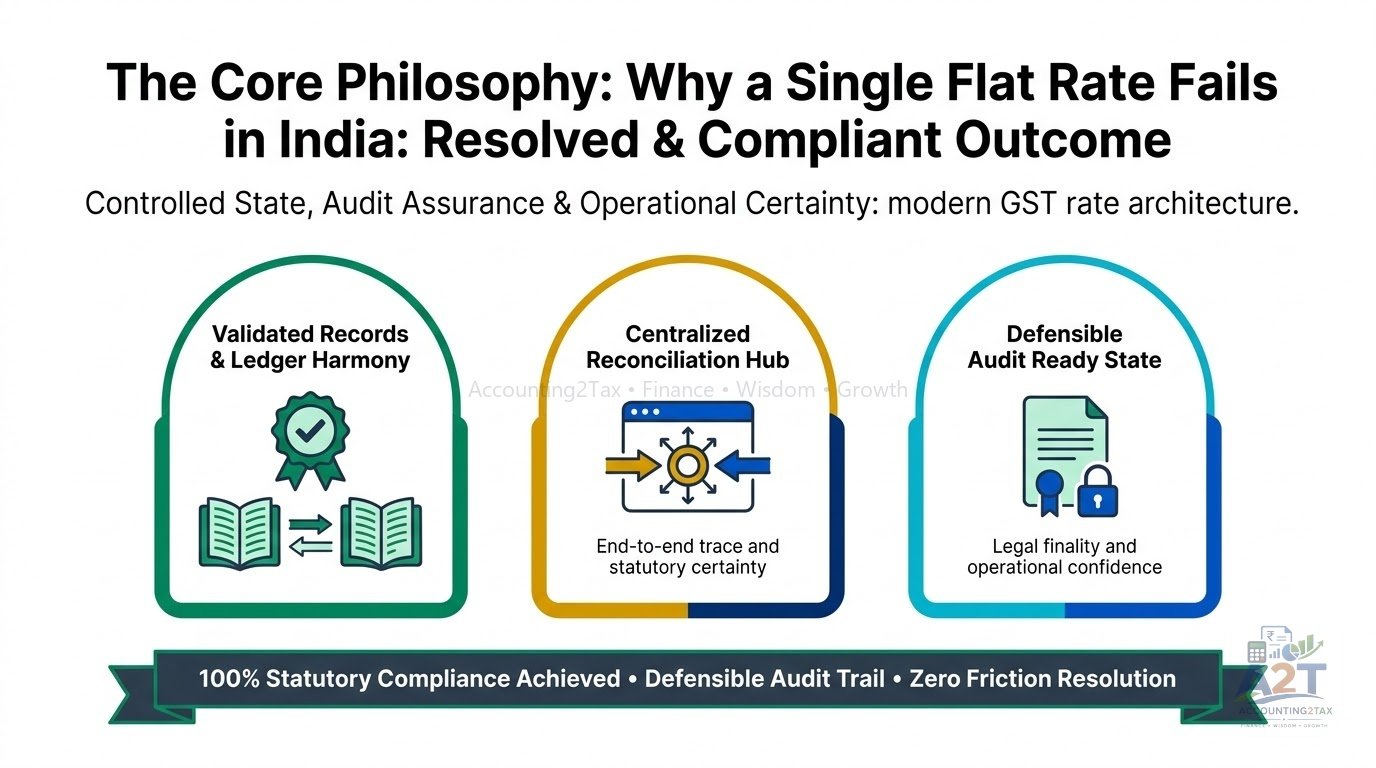
- India uses a rationalized GST slab structure (5%, 18%, 40%) to balance social protection with revenue generation.
- 0% and 5% rates protect mass essentials (food grains, healthcare, edible oil).
- 18% is the default standard workhorse rate covering the majority of industrial goods and corporate services.
- 40% applies as a special de-merit rate (effective 1 Feb 2026) for tobacco and pan masala, replacing the old 28% + Cess structure.
- Special concessional rates apply to Gold (3%) and Rough Diamonds (0.25%).
- Zero-rated supplies (Exports & SEZ) allow a 100% refund of all Input Tax Credit (ITC) paid on inputs.
📚 Sources & Official Regulatory References
| Topic / Statutory Regulation | Source | Authority | Checked On | Effective Date |
|---|---|---|---|---|
| Master GST Rate Schedules & Notifications on Goods and Services | Central Board of Indirect Taxes and Customs (CBIC) | Tier 1 | 2026-09-01 | Current |
| Decisions & Rate Rationalization Recommendations of the GST Council | GST Council Secretariat (gstcouncil.gov.in) |
Tier 1 | 2026-09-01 | Current |
| Section 11 (Power to Grant Exemption from Tax) & Section 16 IGST Act | Central Goods and Services Tax Act, 2017 / IGST Act | Tier 1 | 2026-09-01 | Current |
| Goods and Services Tax (Compensation to States) Act, 2017 | Ministry of Finance, Government of India | Tier 1 | 2026-09-01 | Current |
📚 Explore More in Basics (GST)
Taxonomy Series
Discover related guides, taxonomy series, and interactive financial calculators:
This publication is strictly for educational, research, and informational purposes and does not constitute formal financial, investment, tax, or legal advice.
- Data Accuracy & Inadvertent Errors: While every reasonable effort is made to maintain accuracy, all information, interest rates, tax thresholds, formulas, and statutory data are provided on an “as-is” basis. Accounting2Tax makes no express or implied warranties regarding absolute completeness, timeliness, or typographical and computational infallibility. Statutory authorities update guidelines periodically. Readers must independently verify current rates and rules on official government portals before executing financial transactions.
- Illustrations, Simulations & Limitations of Liability: Mathematical models, compounding simulations, case studies, and hypothetical return projections are conceptual tools designed solely to demonstrate financial principles. They do not constitute guaranteed returns, profit forecasts, or capital safety commitments. Accounting2Tax and its authors disclaim all liability for any direct, indirect, or consequential financial losses, tax penalties, or investment outcomes arising from inadvertent errors, omissions, calculation discrepancies, or reliance placed on this material.
- Professional Consultation: Readers must independently evaluate their individual financial goals, tax positions, and risk tolerance, and consult a SEBI-registered financial advisor or certified chartered accountant before making financial decisions.