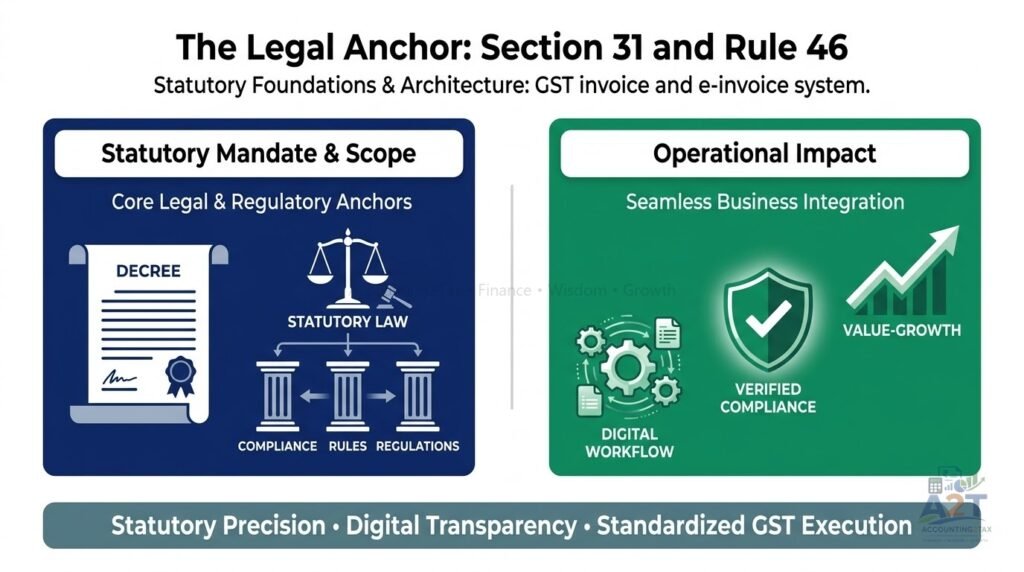
- • The Legal Anchor: Section 31 and Rule 46
- • 1. The 16 Mandatory Invoice Fields Checklist (Rule 46)
- • 2. HSN & SAC Code Rules Based on Turnover
- • 3. Tax Invoice vs. Bill of Supply vs. Delivery Challan
- • 4. E-Invoicing Mandate: IRN and Signed QR Code
Last Verified: 1 September 2026
Sources: 56th GST Council recommendations, CBIC Tax Information Portal, GST Portal advisories.
In commercial trade, an invoice is far more than a simple request for payment.
Under the Goods and Services Tax (GST) regime, a Tax Invoice is a critical statutory legal document that establishes the tax liability of the seller and serves as the primary evidence required by the buyer to claim Input Tax Credit (ITC).
It is a common misconception that if a supplier issues an invoice lacking a mandatory field, the buyer’s ITC is automatically legally extinguished. While a fully compliant invoice is expected, the proviso to Rule 36(2) protects the buyer’s ITC as long as the document contains the core essential details: amount of tax charged, description of goods/services, total value, GSTIN of supplier and recipient, and place of supply. However, defective invoices still trigger reconciliation errors in GSTR-2B and IMS, and expose the supplier to penalties under Section 122 of the CGST Act.
What are the 16 Mandatory Fields that every GST tax invoice must contain under Rule 46 of the CGST Rules? What is the statutory difference between a Tax Invoice, a Bill of Supply, and a Delivery Challan? How many digits of HSN/SAC codes must you print based on your annual turnover? How does the E-Invoicing mandate (with the 30-day reporting restriction) apply to businesses? And how do Credit and Debit Notes (Section 34) rectify invoicing errors?
This comprehensive guide breaks down the legal architecture of GST invoicing, details compliance requirements, and provides an annotated sample invoice structure.
The Legal Anchor: Section 31 and Rule 46
Under Section 31 of the Central Goods and Services Tax (CGST) Act, 2017:
THE DUAL STATUTORY ROLE OF A GST INVOICE
                                          │
        ┌─────────────────────────────────┴─────────────────────────────────┐
      ▼                                                                 ▼
[ FOR THE SELLER / SUPPLIER ]                     [ FOR THE BUYER / RECIPIENT ]
1. Records outward taxable supply                 1. Mandatory statutory document to claim
2. Determines "Time of Supply" liability             Input Tax Credit (ITC) under Section 16
3. Establishes CGST/SGST/IGST charged             2. Validates purchase price and tax paid
1. The 16 Mandatory Invoice Fields Checklist (Rule 46)
Under Rule 46 of the CGST Rules, every tax invoice issued by a registered taxpayer must generally contain the following 16 elements:
THE 16 MANDATORY FIELDS
                                       │
 ┌─────────────────────────────────────────────────────────────────────────────┐
 │  1. SUPPLIER IDENTITY: Legal name, registered business address & GSTIN.     │
 │  2. CONSECUTIVE SERIAL NUMBER: Unique for the FY, max 16 characters.        │
 │  3. DATE OF INVOICE ISSUE: Date on which the invoice is generated.          │
 │  4. RECIPIENT GSTIN / UIN: Mandatory for all B2B transactions.              │
 │  5. RECIPIENT NAME & ADDRESS: Full billing and shipping address.            │
 │  6. B2C UNREGISTERED DETAILS: Address of delivery if value exceeds ₹50,000. │
 │  7. HSN / SAC CODE: 4 or 6 digits depending on turnover and B2B/B2C status. │
 │  8. DESCRIPTION OF GOODS/SERVICES: Clear trade description of item.         │
 │  9. QUANTITY & UNIT: Number of units, kilograms, liters, or meters.         │
 │ 10. TOTAL VALUE: Gross price before tax and trade discounts.                │
 │ 11. TAXABLE VALUE: Net price after deducting eligible trade discounts.      │
 │ 12. RATE OF TAX: Applicable GST rate (5%, 18%, 40%) and Cess.               │
 │ 13. SEPARATE TAX AMOUNTS: Individual columns for CGST, SGST, IGST, and Cess.│
 │ 14. PLACE OF SUPPLY: Name of State and State Code (Crucial for IGST!).      │
 │ 15. REVERSE CHARGE DECLARATION: "Tax payable on Reverse Charge: Yes/No".    │
 │ 16. SIGNATURE / DIGITAL SIGNATURE: Authorized signatory signature or DSC.   │
 └─────────────────────────────────────────────────────────────────────────────┘
2. HSN & SAC Code Rules Based on Turnover
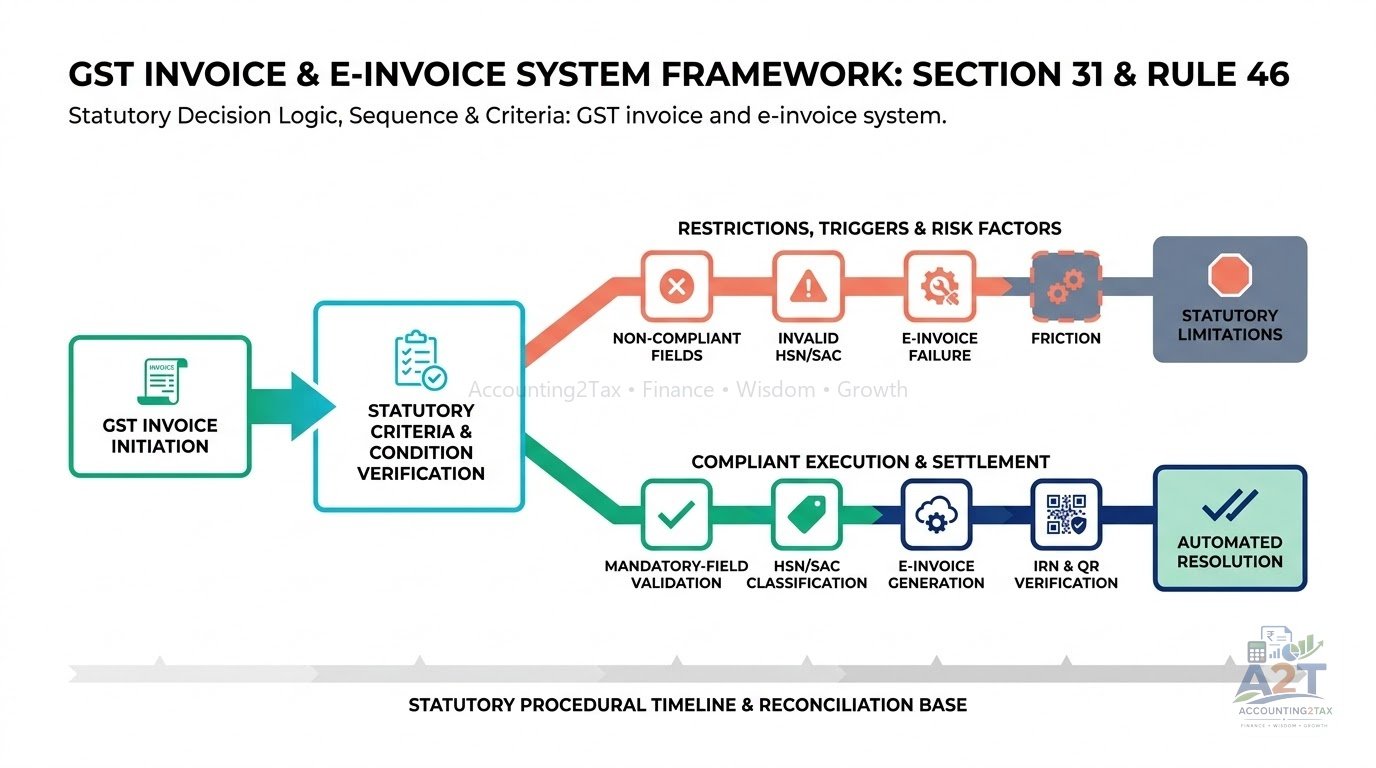
Businesses cannot omit HSN (Harmonized System of Nomenclature) or SAC (Services Accounting Code) codes. However, the requirements vary based on turnover and the nature of the transaction:
HSN Code Digit Requirements
                                        │
        ┌───────────────────────────────┴───────────────────────────────┐
      ▼                                                               ▼
[ TURNOVER UP TO ₹5 CRORE ]                     [ TURNOVER EXCEEDING ₹5 CRORE ]
• B2B Invoices: MINIMUM 4 DIGITS REQUIRED       • B2B Invoices: MINIMUM 6 DIGITS MANDATORY
• B2C Invoices: 4 Digits Optional               • B2C Invoices: 6-digit mandate does NOT
                                                  apply to B2C retail invoices.
3. Tax Invoice vs. Bill of Supply vs. Delivery Challan
Not every commercial movement uses a standard Tax Invoice:
Document Classification
                                      │
        ┌─────────────────────────────┼─────────────────────────────┐
      ▼                               ▼                             ▼
 [ TAX INVOICE ]               [ BILL OF SUPPLY ]            [ DELIVERY CHALLAN ]
Issued by regular GST dealers Issued by Composition dealers Issued for transport
charging GST on sales.        or 100% exempt suppliers.     without sale (job work,
ITC is passed to buyer.       ❌ CANNOT CHARGE GST OR ITC.  exhibitions, demo units).
- Tax Invoice: Issued by normal registered businesses making taxable supplies. Taxes are charged explicitly, allowing the buyer to claim ITC.
- Bill of Supply (Section 31(3)(c)): Issued by Composition Scheme taxpayers (Section 10) or businesses supplying 100% exempt or nil-rated goods/services. Statutory Rule: No tax can be collected from the customer; no ITC can be claimed by the recipient.
- Delivery Challan (Rule 55): Issued when goods are transported without an immediate supply/sale (e.g., sending raw materials for job work, transferring goods between branches, or sending machinery for exhibition).
4. E-Invoicing Mandate: IRN and Signed QR Code
Under Rule 48(4) of the CGST Rules, India has implemented mandatory electronic invoicing (E-Invoicing) for specific taxpayers.
THE E-INVOICING WORKFLOW
                                   │
Step 1: Generate invoice in your accounting ERP (Tally, Zoho, SAP, Busy).
                                   │
Step 2: Upload JSON data to Government Invoice Registration Portal (IRP).
                                   │
Step 3: IRP validates invoice data and generates a unique 64-character
        INVOICE REFERENCE NUMBER (IRN) and digital signature.
                                   │
Step 4: IRP embeds a dynamic SIGNED QR CODE onto the invoice PDF.
Current Threshold & Time Limits:
– E-invoicing is mandatory for all B2B suppliers with Aggregate Annual Turnover (AATO) > ₹5 Crore.
– An invoice without an IRN and QR Code is LEGALLY INVALID for these specified taxpayers.
– 30-Day Reporting Restriction: Taxpayers with an AATO of ₹10 Crore or more are restricted from reporting invoices, credit notes, and debit notes to the IRP that are older than 30 days from the date of reporting.
The Document Lifecycle (IMS Integration):
The modern workflow follows this sequence: Supply → Invoice generation → IRN obtained from IRP (if applicable) → Supplier files GSTR-1 → Invoice flows into Buyer’s Invoice Management System (IMS) → Buyer Accepts/Rejects → Accepted invoice flows to Buyer’s GSTR-2B → Buyer claims ITC in GSTR-3B.
5. Credit Notes & Debit Notes (Section 34)
When an invoice needs to be altered after issuance:
- Credit Note (Section 34(1)): Issued by the seller when:
- The taxable value or tax charged in the original invoice was too high.
- The buyer returns goods due to defect or cancellation.
- The seller provides a post-sale discount.
- Result: Reduces the seller’s output tax liability and necessitates a reversal of the buyer’s ITC.
- Debit Note (Section 34(3)): Issued by the seller when:
- The taxable value or tax charged in the original invoice was too low.
- Extra goods were supplied without billing.
- Result: Increases the seller’s output tax liability and the buyer’s ITC entitlement.
Annotated Sample GST Invoice Structure
========================================================================================
TAX INVOICE
========================================================================================
SUPPLIER DETAILS:                               INVOICE DETAILS:
ABC Technologies Pvt Ltd                        Invoice No: INV/2026-27/0412
402, Cyber Tower, Hinjawadi, Pune, MH - 411057  Invoice Date: 12-May-2026
GSTIN: 27AABCA1234F1Z5                          Place of Supply: 29 - Karnataka (Inter-State)
State Code: 27 (Maharashtra)                    Reverse Charge Applicable: NO
────────────────────────────────────────────────────────────────────────────────────────
BUYER / RECIPIENT DETAILS:                      SHIPPING ADDRESS:
XYZ Enterprises Ltd                             Same as Billing Address
MG Road, Bengaluru, Karnataka - 560001
GSTIN: 29XYZPA9876M1Z2 | State Code: 29
========================================================================================
S.No │ Item Description      │ HSN/SAC │ Qty │ Unit Price (₹) │ Taxable Value (₹) │ IGST Rate │ IGST Amt (₹)
─────┼───────────────────────┼─────────┼─────┼────────────────┼───────────────────┼───────────┼─────────────
  1  │ Cloud Server Hosting  │ 998315  │  1  │    50,000.00   │     50,000.00     │   18.0%   │    9,000.00
  2  │ Network Security Pack │ 998313  │  2  │    20,000.00   │     40,000.00     │   18.0%   │    7,200.00
========================================================================================
TOTAL TAXABLE VALUE: ₹90,000.00
INTEGRATED GST (IGST @ 18%): ₹16,200.00
CENTRAL GST (CGST @ 0%): ₹0.00
STATE GST (SGST @ 0%): ₹0.00
────────────────────────────────────────────────────────────────────────────────────────
TOTAL INVOICE VALUE (In Figures): ₹1,06,200.00
TOTAL INVOICE VALUE (In Words): One Lakh Six Thousand Two Hundred Rupees Only
========================================================================================
[ IRN: (64-character hash provided by the IRP system) ]
*Disclaimer: IRN shown is for illustrative purposes only.*
[ SIGNED QR CODE EMBEDDED ]                     For ABC Technologies Pvt Ltd
                                                Authorized Signatory (Digital Signature)
========================================================================================
Calculate Your Exact GST Breakdown on Invoices
Calculate taxable values, determine correct CGST/SGST vs. IGST splits, and verify invoice totals using the Accounting2Tax Financial Tools.
Use the GST Calculator to model your invoice pricing and tax breakdowns.
Frequently Asked Questions (FAQs)
Q1. If my supplier missed a minor field on the invoice, is my ITC permanently blocked?
Answer: No. While Rule 46 prescribes 16 mandatory fields, the proviso to Rule 36(2) provides relief. Your ITC is legally valid if the invoice contains the core essential details (amount of tax, description, total value, GSTINs, and place of supply), subject to GSTR-2B reconciliation.
Q2. Do retail shop owners need to mention a 6-digit HSN code for walk-in customers?
Answer: No. Even if the retailer’s turnover exceeds ₹5 Crore, the mandatory 6-digit HSN requirement applies to B2B invoices. For B2C retail invoices, the 6-digit HSN mandate is not strictly enforced.
Q3. What is the 30-day rule for E-Invoicing?
Answer: For taxpayers with an Aggregate Annual Turnover of ₹10 Crore or more, there is a strict 30-day reporting restriction. You cannot generate an IRN on the IRP for an invoice, debit note, or credit note that is older than 30 days from the current date.
Q4. What happens if an E-Invoice is generated without an IRN and QR code?
Answer: If you cross the applicable turnover threshold (> ₹5 Crore), an invoice issued without an IRN and signed QR code is legally invalid. Your buyer will not be able to claim ITC, and you may face penalties for non-issuance of a valid tax invoice.
Q5. Can I use a Delivery Challan to bill a customer?
Answer: No. A Delivery Challan is purely for the transportation of goods where no immediate sale or supply is taking place (such as moving goods to a job worker). A tax invoice must be issued when a taxable supply is made.
Related Financial Wisdom
- GST Rates Explained: Current Slab Structure
- CGST, SGST, IGST and UTGST: Key Differences
- Input Tax Credit Explained: How GST on Purchases Works
- GST Registration for Small Businesses: Rules and Thresholds
- GSTR-1 and GSTR-3B Explained
Key Takeaways
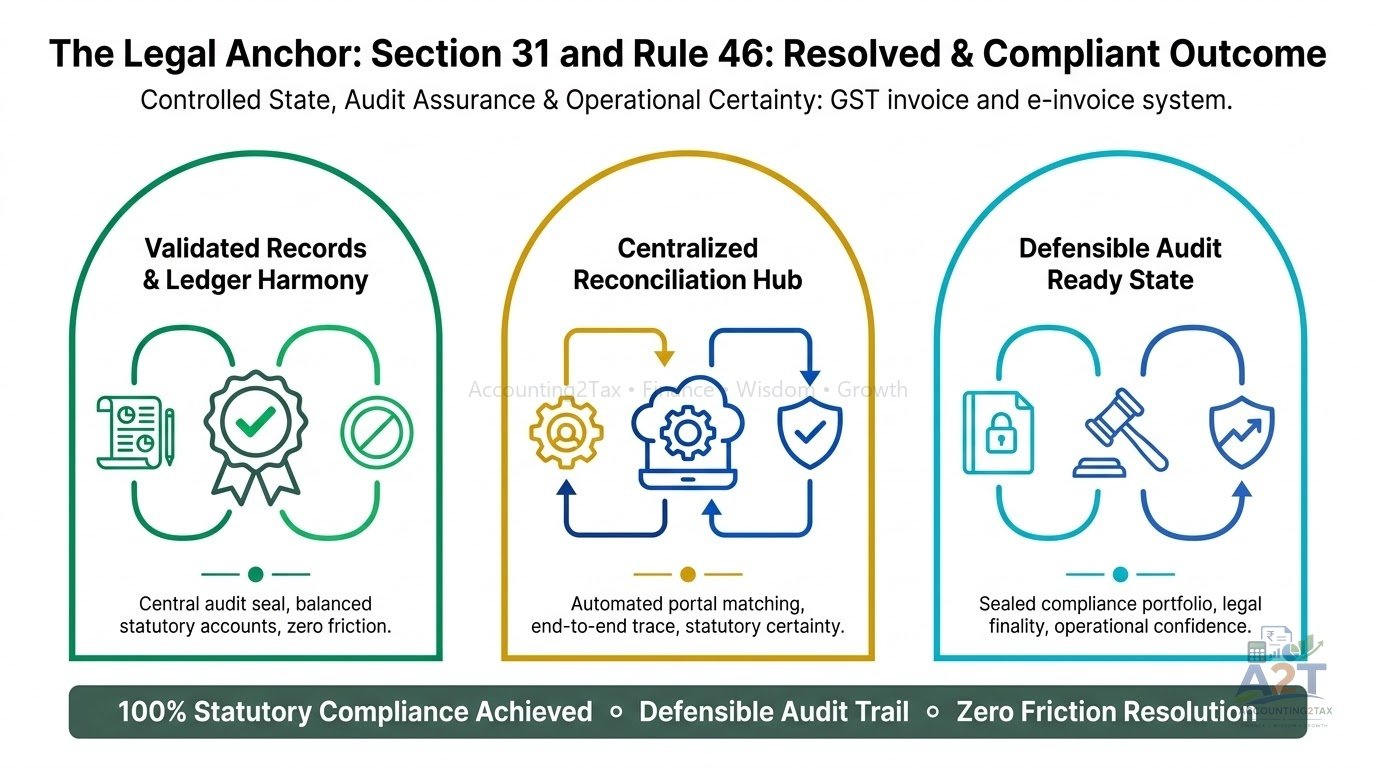
- A GST Tax Invoice is the statutory foundation required for buyers to claim Input Tax Credit (ITC) under Section 16, though Rule 36(2) provides relief for minor omissions.
- Invoices must generally contain all 16 mandatory fields under Rule 46, including unique serial numbers, GSTINs, and place of supply.
- Print 4-digit HSN codes for turnover up to ₹5 Crore and 6-digit HSN codes for B2B invoices for turnover above ₹5 Crore.
- Composition dealers and exempt suppliers must issue a Bill of Supply and cannot charge GST or pass ITC.
- E-Invoicing is mandatory for businesses with turnover > ₹5 Crore, requiring an IRN and signed QR code from the IRP portal. The 30-day reporting restriction applies to those with AATO >= ₹10 Crore.
- Use Credit Notes (Section 34) to adjust price reductions or returns, and Debit Notes for unbilled upward revisions.
📚 Sources & Official Regulatory References
| Topic / Statutory Regulation | Source | Authority | Checked On | Effective Date |
|---|---|---|---|---|
| Section 31 (Tax Invoice) & Rule 46 (Tax Invoice Contents) | Central Goods and Services Tax Act, 2017 & CGST Rules | Tier 1 | 2026-09-01 | Current |
| Rule 48(4) Electronic Invoicing Guidelines & Notifications | Central Board of Indirect Taxes and Customs (CBIC) | Tier 1 | 2026-09-01 | Current |
| Section 34 (Credit and Debit Notes Provisions) | Central Goods and Services Tax Act, 2017 | Tier 1 | 2026-09-01 | Current |
| Master Guidelines on HSN Code Disclosure & E-Invoice System | GST Network (GSTN) / NIC E-Invoice System | Tier 1 | 2026-09-01 | Current |
📚 Explore More in Basics (GST)
Taxonomy Series
Discover related guides, taxonomy series, and interactive financial calculators:
This publication is strictly for educational, research, and informational purposes and does not constitute formal financial, investment, tax, or legal advice.
- Data Accuracy & Inadvertent Errors: While every reasonable effort is made to maintain accuracy, all information, interest rates, tax thresholds, formulas, and statutory data are provided on an “as-is” basis. Accounting2Tax makes no express or implied warranties regarding absolute completeness, timeliness, or typographical and computational infallibility. Statutory authorities update guidelines periodically. Readers must independently verify current rates and rules on official government portals before executing financial transactions.
- Illustrations, Simulations & Limitations of Liability: Mathematical models, compounding simulations, case studies, and hypothetical return projections are conceptual tools designed solely to demonstrate financial principles. They do not constitute guaranteed returns, profit forecasts, or capital safety commitments. Accounting2Tax and its authors disclaim all liability for any direct, indirect, or consequential financial losses, tax penalties, or investment outcomes arising from inadvertent errors, omissions, calculation discrepancies, or reliance placed on this material.
- Professional Consultation: Readers must independently evaluate their individual financial goals, tax positions, and risk tolerance, and consult a SEBI-registered financial advisor or certified chartered accountant before making financial decisions.