- • The Statutory Mandate: Section 28 and Rule 19
- • 1. Core Fields: When Tax Officer Approval Is Mandatory
- • 2. Non-Core Fields: Instant Automated Approval
- • 3. The Inter-State Relocation Trap: Why You Cannot “Amend” Across States
- • 4. Operating from an Unregistered Address: The Compliance Risk
Last Verified: 1 September 2026
Key Verification Sources: GST Council 56th Meeting (Sept 2025), CBIC Tax Information Portal, GSTN Advisories.
A business is dynamic: you might move to a larger office, open a new warehouse, onboard new company directors, change your primary bank account, or expand into new product categories.
Under the Goods and Services Tax (GST) regime, your GST registration certificate (Form GST REG-06) is an active statutory record. Any change in your commercial operations must be legally updated on the GST Portal.
Failing to report changes or operating from an unlisted location carries serious statutory consequences.
“Can I change my registered office address online? What is the difference between a Core and a Non-Core amendment? What happens if I move my business from Mumbai to Bengaluru? Can I simply change the address on my existing GSTIN?”
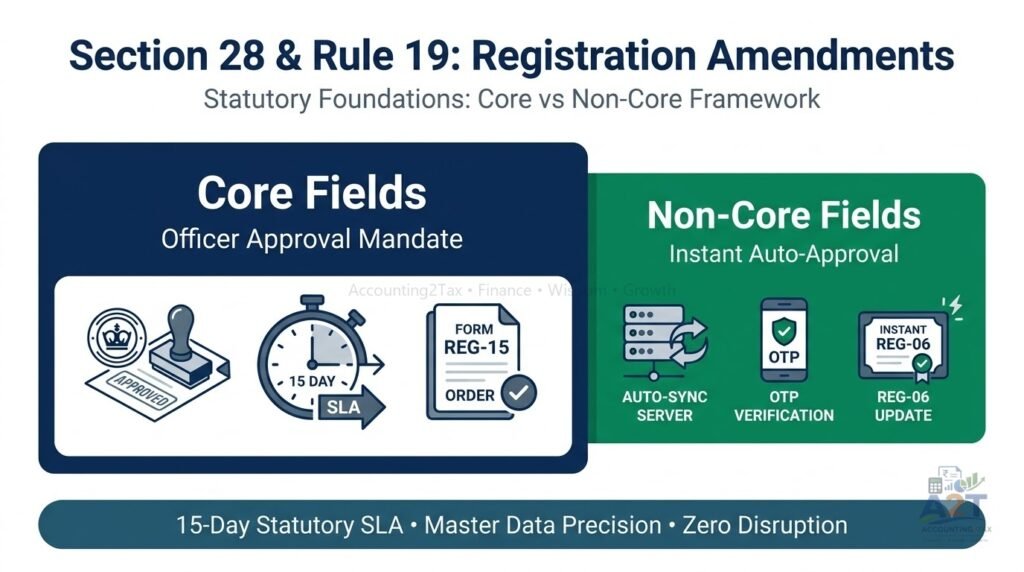
Under Section 28 of the CGST Act and Rule 19 of the CGST Rules, every registered taxpayer is legally obligated to submit an amendment application within 15 days of any business change.
However, the GST portal treats changes very differently depending on whether they touch Core Fields (requiring formal tax officer verification) or Non-Core Fields (processed instantly with automated system approval).
What are the specific fields categorized as Core vs. Non-Core? What is the step-by-step workflow for filing Form GST REG-14? Why can you never transfer a GSTIN across state borders? And what penalties apply if you store goods in an unnotified warehouse?
This comprehensive guide breaks down the amendment architecture, details officer approval timelines, and provides a practical step-by-step compliance SOP.
The Statutory Mandate: Section 28 and Rule 19
Under Section 28 of the CGST Act, 2017:
 THE 15-DAY STATUTORY TIMELINE
                                      │
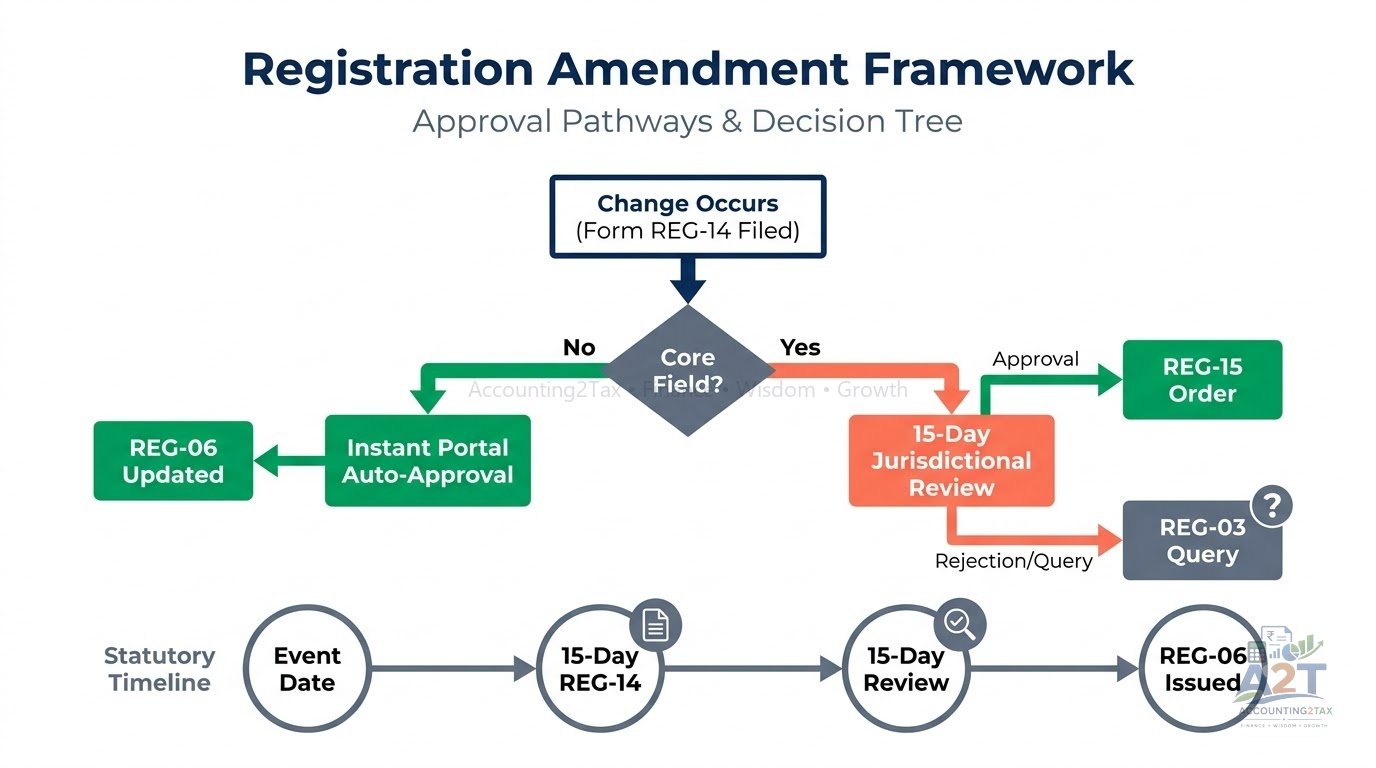
 Every registered person MUST file an application for amendment in FORM GST REG-14
 WITHIN 15 DAYS of any change in business information or legal particulars.
                                      │
        ┌────────────────────────────┴────────────────────────────┐
        ▼                                                         ▼
 [ CORE FIELDS AMENDMENT ]                         [ NON-CORE FIELDS AMENDMENT ]
 Requires mandatory documentary evidence           Automated instant system approval;
 and APPROVAL by the Jurisdictional Tax Officer    NO officer intervention needed.
 (Takes up to 15 working days)                     (Takes under 15 minutes)
1. Core Fields: When Tax Officer Approval Is Mandatory
Core fields represent the foundational identity and jurisdiction of your business. Any modification requires scrutiny and verification by your assigned tax officer:
 THE 3 CORE AMENDMENT CATEGORIES
                                           │
 ┌─────────────────────────────────────────────────────────────────────────────┐
 │  1. LEGAL / TRADE NAME OF BUSINESS:                                         │
 │     Change in the legal name of the entity (without a change in PAN).       │
 │     • Required Proof: Certificate of Incorporation (MCA) / Amended Deed.    │
 ├─────────────────────────────────────────────────────────────────────────────┤
 │  2. PRINCIPAL OR ADDITIONAL PLACE OF BUSINESS:                              │
 │     Moving registered office, opening a new branch, or adding a warehouse   │
 │     within the same state.                                                  │
 │     • Required Proof: Electricity bill, Rent Agreement, Consent Letter, NOC.│
 ├─────────────────────────────────────────────────────────────────────────────┤
 │  3. PROMOTERS, DIRECTORS, PARTNERS & KARTA:                                 │
 │     Addition, deletion, retirement, or resignation of Directors, Partners,   │
 │     or Managing Committee members.                                          │
 │     • Required Proof: DIR-12 (MCA), Resignation letter, Partnership deed.   │
 └─────────────────────────────────────────────────────────────────────────────┘
The Core Approval Workflow:
- Filing: You submit Form GST REG-14 with supporting documents on the GST portal.
- Verification: The Tax Officer has 15 working days to either approve the application or issue a clarification notice (Form GST REG-03).
- Response: If a notice is issued, you must submit your reply (Form GST REG-04) within 7 working days.
- Approval / Rejection: The officer issues an Approval Order (Form GST REG-15) or rejects the application.
2. Non-Core Fields: Instant Automated Approval
Non-Core fields cover operational data that does not alter the fundamental legal identity of the business:
 NON-CORE FIELDS (INSTANT APPROVAL)
                                           │
 ┌─────────────────────────────────────────────────────────────────────────────┐
 │  • Bank Account Details (Addition, deletion, or modification of accounts).  │
 │  • Authorized Signatories (Contact email and mobile numbers via OTP).       │
 │  • Business Description & HSN / SAC Codes (Adding new goods or services).   │
 │  • Website URLs and Social Media identifiers.                               │
 └─────────────────────────────────────────────────────────────────────────────┘
Process: When you submit Form GST REG-14 for non-core amendments, the system validates the data via OTP and updates your profile instantly without any manual officer intervention.
Mandatory Bank Account Rules (Rule 10A)
Under Rule 10A, bank account details must be furnished within 30 days of registration or before filing GSTR-1/IFF, whichever is earlier. Failure to update bank details within this timeline triggers automatic suspension of your GSTIN.
3. The Inter-State Relocation Trap: Why You Cannot “Amend” Across States
One of the most common mistakes entrepreneurs make is attempting to amend their GST address when shifting operations to a different state:
 THE INTER-STATE RELOCATION WORKFLOW
                                        │
 [ THE RULE: The first 2 digits of every GSTIN represent the STATE CODE (e.g. 27 for MH, 29 for KA). ]
 [ You CANNOT change the state code of an existing GSTIN through an amendment. ]
                                        │
                                        ▼
 Step 1: Apply for a FRESH GST REGISTRATION in the new destination state.
                                        │
 Step 2: Transfer ITC. Note that for mere relocation between distinct persons under
 the same PAN, ITC is transferred via tax invoices/cross-charge, ISD, or Rule 41A
 (Form ITC-02A). Form GST ITC-02 (Rule 41) is strictly for business transfers
 like sale, merger, or demerger.
                                        │
 Step 3: File an application for CANCELLATION / SURRENDER of the old GSTIN
 in Form GST REG-16 and submit GSTR-10 (Final Return).
4. Operating from an Unregistered Address: The Compliance Risk
If your business stores goods or operates from a location that has not been formally added as an Additional Place of Business (APoB) in your GST certificate:
- Seizure & Confiscation (Section 129 & 130): Tax authorities can detain and seize all inventory stored at the unnotified premises.
- Input Tax Credit Blockage: Invoices billed to an unlisted location may be challenged during department audits.
- Statutory Penalties: General penalties of up to ₹25,000 under Section 125 of the CGST Act.
Master Comparison: Core vs. Non-Core GST Amendments
| Feature | Core Field Amendment | Non-Core Field Amendment |
|---|---|---|
| Statutory Form | Form GST REG-14 | Form GST REG-14 |
| Filing Deadline | Within 15 days of business change | Within 15 days of business change |
| Tax Officer Approval? | MANDATORY (15 working days) | NOT REQUIRED (Instant Auto-Approval) |
| Examples | Legal Name, Address (PPoB/APoB), Directors | Bank details, Contact info, HSN codes |
| Documentary Evidence | Rent deed, NOC, Electricity bill, DIR-12 | Cancelled cheque, Bank statement, OTP |
| Approval Document | Form GST REG-15 (Amended Certificate) | Instant Application Reference Number (ARN) |
| Query Notice | Form GST REG-03 (if officer seeks clarity) | No query notice issued |
Frequently Asked Questions (FAQs)
Q1. What happens if I forget to update my business address on the GST portal?
Answer: Operating from an unlisted address violates Section 28. Tax authorities may seize goods stored there under Section 129, and you could face general penalties under Section 125 of up to ₹25,000.
Q2. How much time do I have to submit bank account details after getting my GSTIN?
Answer: Under Rule 10A, you must furnish your bank account details within 30 days of registration or before filing GSTR-1/IFF, whichever is earlier, to avoid automatic suspension.
Q3. Can I use Form GST ITC-02 to transfer credit when I relocate my business to another state?
Answer: No. Form GST ITC-02 is strictly for business transfers like mergers or sales. For relocation between distinct persons under the same PAN, you should use cross-charge, ISD, or Form ITC-02A (Rule 41A).
Q4. Does adding a new warehouse in the same state require tax officer approval?
Answer: Yes. Adding an Additional Place of Business (APoB) is a Core Field amendment and requires documentary proof (like a rent agreement or NOC) and mandatory officer approval.
Q5. Can I continue invoicing while my core amendment application is pending?
Answer: Yes, you can continue your regular business operations and invoicing under your existing GSTIN while the amendment is being processed by the officer.
Calculate Your GST Obligations and Business Cash Flows
Calculate output taxes across your principal and additional places of business, model ITC reconciliations, and structure tax liabilities using the Accounting2Tax Financial Tools.
Use the GST Calculator to model your state-wise indirect tax obligations.
Related Financial Wisdom
- GST Registration Explained: Who Must Register — registration basics.
- GST Registration for Small Businesses: Thresholds — threshold rules.
- Voluntary GST Registration: Benefits and Trade-Offs — voluntary options.
- GST Compliance Checklist for Small Businesses — compliance roadmap.
- GST Notices Explained: How to Respond — notice management.
Key Takeaways
- Businesses must file Form GST REG-14 within 15 days of any change in business information.
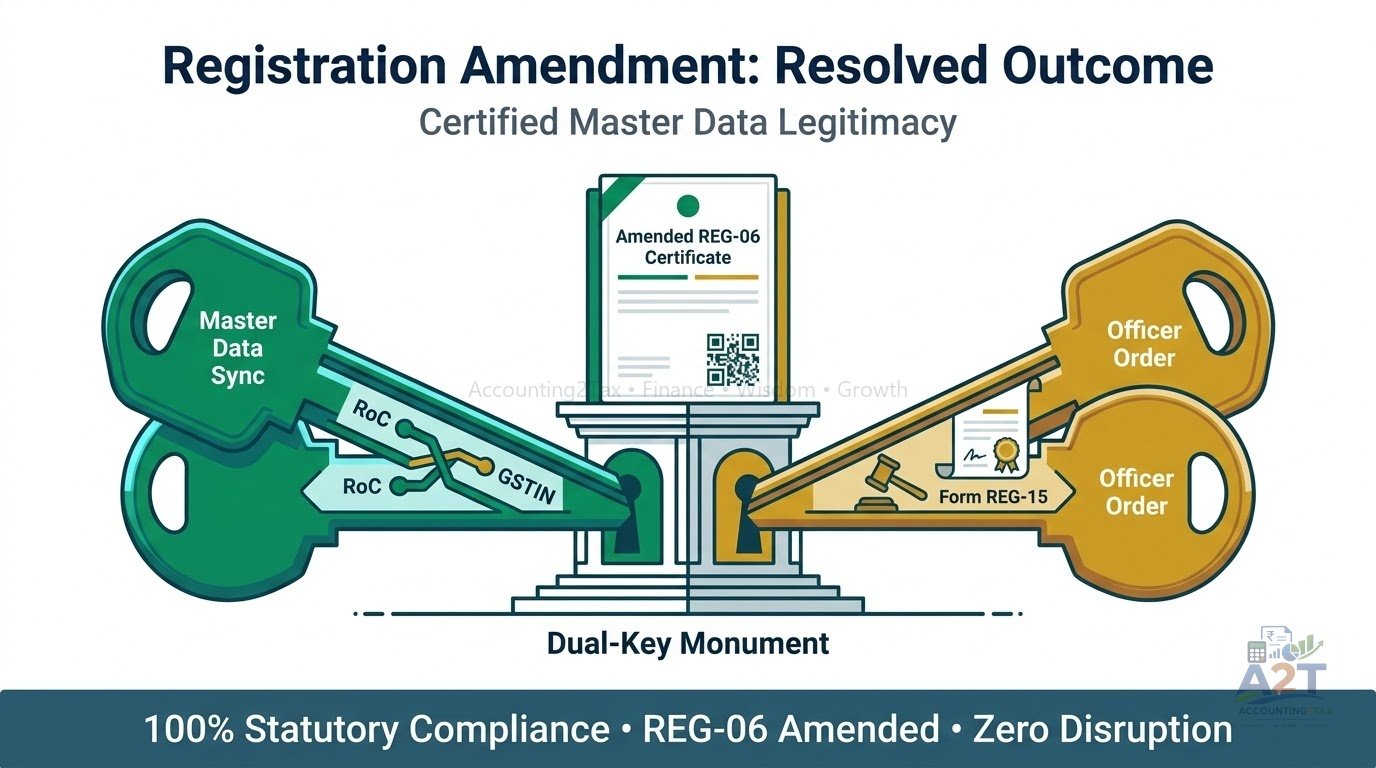
- Core Amendments (Legal name, registered address, adding/removing directors or partners) require formal tax officer approval within 15 working days.
- Non-Core Amendments (Bank accounts, authorized signatory contacts, HSN codes) are auto-approved instantly by the GST portal.
- You cannot transfer a GSTIN across state borders. You must apply for a new GSTIN and cancel the old one.
- Always declare all warehouses, branches, and depots as Additional Places of Business (APoB) to avoid stock seizure under Section 129.
📚 Sources & Official Regulatory References
| Topic / Statutory Regulation | Source | Authority | Checked On | Effective Date |
|---|---|---|---|---|
| Section 28 (Amendment of Registration) & Section 125 (General Penalty) | Central Goods and Services Tax Act, 2017 | Tier 1 | 2026-08-26 | Current |
| Rule 19 (Amendment of Registration Procedure & Form GST REG-14) | Central Goods and Services Tax Rules, 2017 | Tier 1 | 2026-08-26 | Current |
| Guidelines on Principal & Additional Place of Business Verification | Central Board of Indirect Taxes and Customs (CBIC) | Tier 1 | 2026-08-26 | Current |
| Circular on Inter-State Business Transfer & ITC-02 Credit Portability | Goods and Services Tax Network (GSTN) | Tier 1 | 2026-08-26 | Current |
📚 Explore More in Registration (GST)
Taxonomy Series
Discover related guides, taxonomy series, and interactive financial calculators:
This publication is strictly for educational, research, and informational purposes and does not constitute formal financial, investment, tax, or legal advice.
- Data Accuracy & Inadvertent Errors: While every reasonable effort is made to maintain accuracy, all information, interest rates, tax thresholds, formulas, and statutory data are provided on an “as-is” basis. Accounting2Tax makes no express or implied warranties regarding absolute completeness, timeliness, or typographical and computational infallibility. Statutory authorities (Ministry of Finance, RBI, CBDT, CBIC, SEBI, PFRDA) update guidelines periodically. Readers must independently verify current rates and rules on official government portals before executing financial transactions.
- Illustrations, Simulations & Limitations of Liability: Mathematical models, compounding simulations, case studies, and hypothetical return projections are conceptual tools designed solely to demonstrate financial principles. They do not constitute guaranteed returns, profit forecasts, or capital safety commitments. Accounting2Tax and its authors disclaim all liability for any direct, indirect, or consequential financial losses, tax penalties, or investment outcomes arising from inadvertent errors, omissions, calculation discrepancies, or reliance placed on this material.
- Professional Consultation: Readers must independently evaluate their individual financial goals, tax positions, and risk tolerance, and consult a SEBI-registered financial advisor or certified chartered accountant before making financial decisions.