- • The Threshold Architecture: Section 22 of the CGST Act
- • 1. State-Wise Threshold Breakdown
- • 2. How to Calculate “Aggregate Turnover” (PAN-India Basis)
- • 3. Section 24: 8 Mandatory Registration Triggers (Turnover Irrelevant!)
- • 4. Regular Scheme vs. Composition Scheme (Section 10)
Last Verified: 1 September 2026
Key Verification Sources: GST Council 56th Meeting (Sept 2025), CBIC Tax Information Portal, GSTN Advisories.
For millions of micro-entrepreneurs, freelancers, boutique manufacturers, and local shopkeepers in India, the question of GST registration is often accompanied by anxiety:
“My annual revenue is only ₹15 Lakh. Do I have to register for GST? What happens if I sell just one product to a customer in another state? Can I register voluntarily to claim Input Tax Credit on my equipment?”
In the Indian indirect tax framework, obtaining a GST identification number (GSTIN) brings both commercial legitimacy and statutory compliance obligations.
Registering prematurely can burden a tiny micro-business with recurring monthly return filings and compliance fees. On the other hand, failing to register when legally required triggers severe penalties under Section 122 of the CGST Act (100% of the tax amount evaded or ₹10,000, whichever is higher).
How do the turnover thresholds under Section 22 separate goods sellers (₹40 Lakh limit) from service providers (₹20 Lakh limit)? What are the special category state thresholds? Which 8 mandatory cases under Section 24 trigger compulsory GST registration regardless of your turnover? And how does the Composition Scheme (Section 10) offer a simplified compliance track for businesses with turnover up to ₹1.5 Crore?
This comprehensive guide breaks down the statutory rules, explains turnover calculations, and provides a clear decision roadmap for Indian small businesses.
The Threshold Architecture: Section 22 of the CGST Act
Under Section 22 of the CGST Act, 2017, businesses must register for GST only when their Aggregate Annual Turnover crosses specified monetary thresholds:
 SECTION 22 TURNOVER THRESHOLDS (NORMAL STATES)
                                            │
        ┌──────────────────────────────────┴──────────────────────────────────┐
        ▼                                                                     ▼
 [ EXCLUSIVE SUPPLY OF GOODS ]                   [ SERVICE PROVIDERS & MIXED ]
 • Threshold: ₹40 LAKH PER YEAR                  • Threshold: ₹20 LAKH PER YEAR
 • Applies to traders, wholesalers,              • Applies to IT consultants, professionals,
 and physical goods manufacturers.               restaurants, and mixed businesses.
1. State-Wise Threshold Breakdown
To accommodate regional economic variations, the GST Council established tiered thresholds based on geography:
| Category of State | Exclusive Supply of Goods | Services & Mixed Supplies |
|---|---|---|
| Normal States (Maharashtra, Karnataka, Delhi, Gujarat, Tamil Nadu, UP, etc.) | ₹40 Lakh | ₹20 Lakh |
| Special Category States — Group A (Arunachal Pradesh, Meghalaya, Sikkim, Uttarakhand, Puducherry, Telangana) | ₹20 Lakh | ₹20 Lakh |
| Special Category States — Group B (Manipur, Mizoram, Nagaland, Tripura) | ₹10 Lakh | ₹10 Lakh |
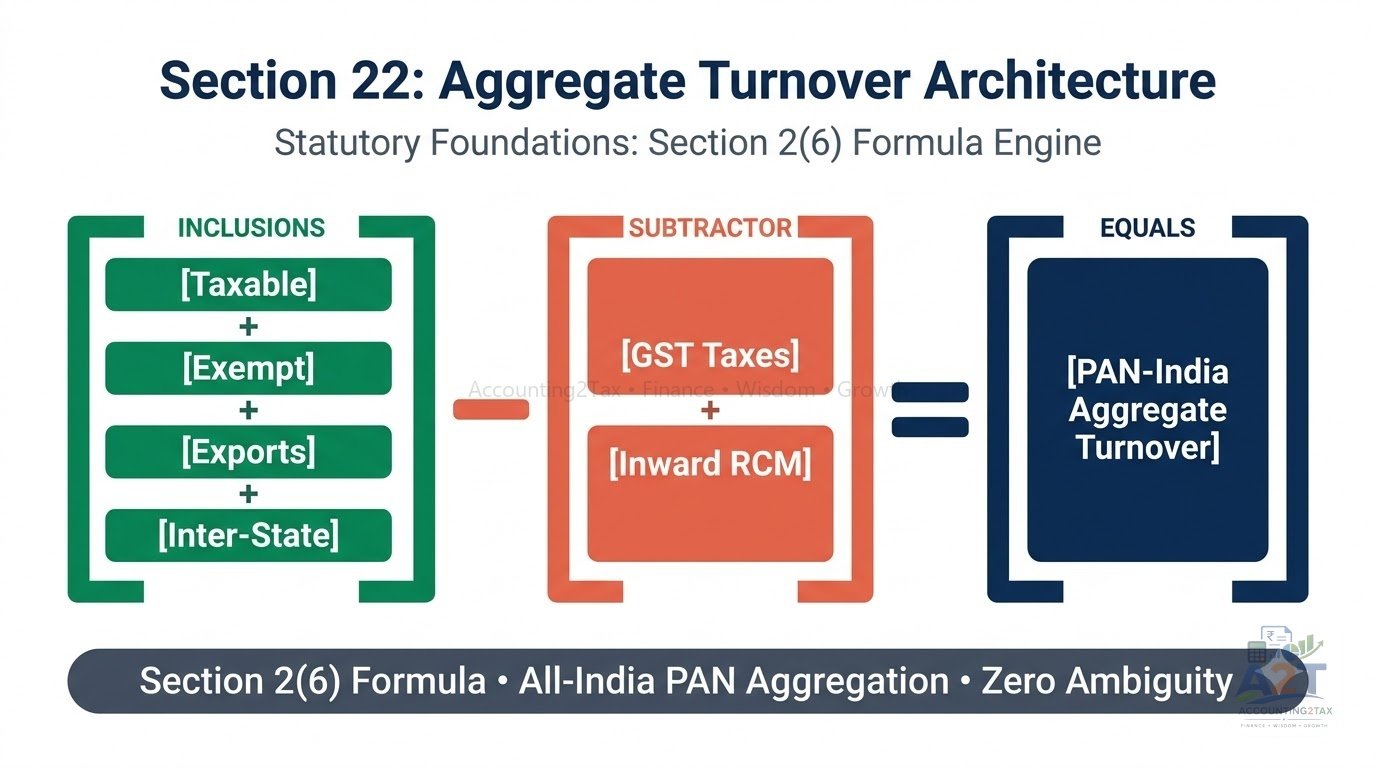
2. How to Calculate “Aggregate Turnover” (PAN-India Basis)
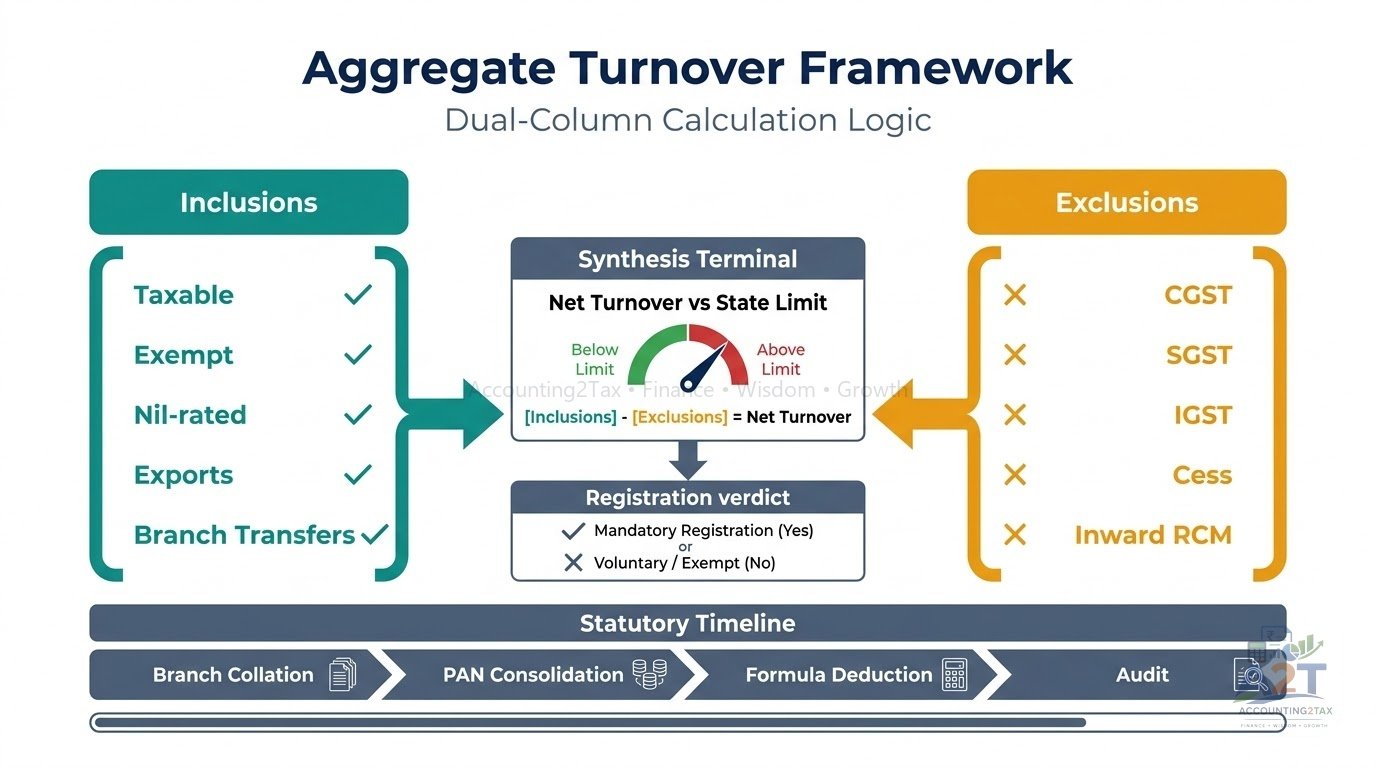
Turnover is not just your taxable local profit. Under Section 2(6) of the CGST Act, Aggregate Turnover accrues on an all-India basis for the same Permanent Account Number (PAN):
 ┌─────────────────────────────────────────────────────────────────────────────┐
 │  WHAT IS EXCLUDED FROM AGGREGATE TURNOVER:                                  │
 │  • Taxes paid under GST (CGST, SGST, IGST, Compensation Cess).              │
 │  • Value of inward supplies on which tax is paid under Reverse Charge (RCM).│
 └─────────────────────────────────────────────────────────────────────────────┘
Example: If a business in Jaipur makes ₹25 Lakh in taxable cloth sales and ₹18 Lakh in exempt unbranded food grain sales, its aggregate turnover is ₹43 Lakh ($\text{₹25L} + \text{₹18L}$). Because it exceeds ₹40 Lakh, GST registration is compulsory.
3. Section 24: 8 Mandatory Registration Triggers (Turnover Irrelevant!)
Under Section 24 of the CGST Act, you must obtain GST registration even if your annual turnover is only ₹1:
 8 MANDATORY GST REGISTRATION TRIGGERS
                                         │
 ┌─────────────────────────────────────────────────────────────────────────────┐
 │  1. INTER-STATE GOODS SUPPLY: Selling physical goods across state borders.  │
 │  2. CASUAL TAXABLE PERSONS (CTP): Operating temporary pop-up stalls.       │
 │  3. REVERSE CHARGE (RCM): Businesses liable to pay tax under Section 9(3).  │
 │  4. NON-RESIDENT TAXABLE PERSONS: Foreign entities making supplies in India.│
 │  5. E-COMMERCE OPERATORS: Platforms liable to collect TCS under Section 52. │
 │  6. E-COMMERCE SELLERS (INTER-STATE): Intra-state goods sellers are EXEMPT.│
 │  7. INPUT SERVICE DISTRIBUTORS (ISD): Office distributing credit to branches.│
 │  8. OIDAR PROVIDERS: Entities providing digital database services from abroad.│
 └─────────────────────────────────────────────────────────────────────────────┘
Important Relief for Service Providers & Micro E-Commerce Sellers:
1. While inter-state supply of goods triggers mandatory registration from Rupee 1, the government issued Notification No. 10/2017 – Integrated Tax, granting service providers an inter-state exemption up to ₹20 Lakh.
2. Effective Oct 1, 2023, small businesses supplying goods through e-commerce operators within a single state (intra-state) are EXEMPT from mandatory registration up to their standard threshold limits (₹40L/₹20L), requiring only a PAN-based enrolment number.
4. Regular Scheme vs. Composition Scheme (Section 10)
If your small business crosses the threshold or registers voluntarily, you must choose between two operating tracks:
 TWO OPERATING TRACKS
                                      │
        ┌────────────────────────────┴────────────────────────────┐
        ▼                                                         ▼
 [ REGULAR GST SCHEME ]                            [ COMPOSITION SCHEME (SEC 10) ]
 • Charge standard GST (5%, 18%, 40%)              • Pay flat low tax (1% or 6%) from pocket.
 • Pass full ITC to B2B buyers                     • Issue Bill of Supply (NO ITC PASSED).
 • File monthly / quarterly GSTR-1 & 3B            • File CMP-08 quarterly & GSTR-4 annually.
 • Full freedom: Inter-state & E-commerce          • Local sales only; turnover limit ₹1.5 Crore.
(Note: The old 5-slab system of 0%, 5%, 12%, 18%, 28% was replaced in September 2025 by the 5%/18%/40% structure, with historical treatment retained for pre-September 2025 transactions).
Master Comparison: Regular vs. Composition Scheme for MSMEs
| Feature | Regular GST Scheme | Composition Scheme (Section 10) |
|---|---|---|
| Turnover Eligibility | No upper ceiling | Up to ₹1.5 Crore (₹75L for NE States; ₹50L for Services) |
| Tax Rates | Current rates (5%, 18%, 40%) | 1% (Traders/Mfrs), 5% (Restaurants), 6% (Services) |
| Can Collect Tax from Buyer? | YES — Charged on Tax Invoice | NO — Paid directly by seller from revenue |
| Input Tax Credit (ITC) | Full ITC Available | NO ITC Available on Purchases |
| Inter-State Sales Allowed? | YES — Unlimited inter-state supply | NO — Strictly restricted to Intra-State trade |
| E-Commerce Selling Allowed? | YES — Full marketplace access | Restricted (except local intra-state goods) |
| Return Compliance | Monthly / Quarterly (GSTR-1 & 3B) | Quarterly Challan (CMP-08) + Annual GSTR-4 |
Frequently Asked Questions (FAQs)
Q1. What is the penalty if I cross the ₹40 Lakh threshold and don’t register?
Answer: Under Section 122(1)(xi) of the CGST Act, failure to obtain registration when required attracts a penalty of 100% of the tax evaded or ₹10,000, whichever is higher.
Q2. Do I need to register for GST if I provide services worth ₹15 Lakh to customers outside my state?
Answer: No. Notification No. 10/2017 – Integrated Tax provides an exemption for inter-state service providers up to a turnover of ₹20 Lakh.
Q3. Can a composition dealer claim Input Tax Credit on purchases?
Answer: No. A taxpayer registered under the Composition Scheme cannot claim any Input Tax Credit (ITC) on inward supplies.
Q4. Does exempt income count towards the ₹40 Lakh threshold limit?
Answer: Yes. “Aggregate Turnover” is calculated on a PAN-India basis and includes taxable supplies, exempt supplies, and exports.
Q5. Can a micro-business selling locally via e-commerce avoid GST registration?
Answer: Yes. Intra-state supply of goods through e-commerce platforms is exempt from mandatory registration up to the standard ₹40L limit. You only need a PAN-based enrolment number.
Calculate Your GST Liabilities and Thresholds
Determine whether your business needs registration, calculate tax burdens under Regular vs Composition tracks, and project cash flows using the Accounting2Tax Financial Tools.
Use the GST Calculator to model your product pricing and tax payouts.
Related Financial Wisdom
- GST Explained: Understanding India’s Indirect Tax — GST overview.
- Voluntary GST Registration: Benefits and Trade-Offs — voluntary guide.
- GST Rates Explained: 0%, 5%, 12%, 18%, 28% Slabs — rate schedules.
- GST Invoice Explained: Mandatory Rules and E-Invoicing — invoicing rules.
- GSTR-1 and GSTR-3B Explained — filing requirements.
Key Takeaways
- Small businesses selling goods exclusively in normal states need GST registration only after crossing ₹40 Lakh annual turnover.
- Service providers and mixed businesses must register at ₹20 Lakh annual turnover.
- Aggregate turnover is computed on a PAN-India basis, combining taxable, exempt, and export sales.
- Under Section 24, inter-state goods trade and e-commerce selling trigger mandatory registration regardless of turnover.
- Service freelancers enjoy a ₹20 Lakh exemption for inter-state services under Notification 10/2017.
- Businesses with turnover up to ₹1.5 Crore can opt for the Composition Scheme to pay a flat 1% tax with simplified quarterly compliance.
📚 Sources & Official Regulatory References
| Topic / Statutory Regulation | Source | Authority | Checked On | Effective Date |
|---|---|---|---|---|
| Section 22 (Persons Liable for Registration) & Section 24 (Compulsory Registration) | Central Goods and Services Tax Act, 2017 | Tier 1 | 2026-08-26 | Current |
| Notification No. 10/2019 – Central Tax (₹40 Lakh Threshold for Goods) | Central Board of Indirect Taxes and Customs (CBIC) | Tier 1 | 2026-08-26 | Current |
| Notification No. 10/2017 – Integrated Tax (Inter-State Services ₹20L Exemption) | Central Board of Indirect Taxes and Customs | Tier 1 | 2026-08-26 | Current |
| Section 10 (Composition Levy) & Notification 02/2019 – Central Tax (Services Composition) | Ministry of Finance, Government of India | Tier 1 | 2026-08-26 | Current |
📚 Explore More in Registration (GST)
Taxonomy Series
Discover related guides, taxonomy series, and interactive financial calculators:
This publication is strictly for educational, research, and informational purposes and does not constitute formal financial, investment, tax, or legal advice.
- Data Accuracy & Inadvertent Errors: While every reasonable effort is made to maintain accuracy, all information, interest rates, tax thresholds, formulas, and statutory data are provided on an “as-is” basis. Accounting2Tax makes no express or implied warranties regarding absolute completeness, timeliness, or typographical and computational infallibility. Statutory authorities (Ministry of Finance, RBI, CBDT, CBIC, SEBI, PFRDA) update guidelines periodically. Readers must independently verify current rates and rules on official government portals before executing financial transactions.
- Illustrations, Simulations & Limitations of Liability: Mathematical models, compounding simulations, case studies, and hypothetical return projections are conceptual tools designed solely to demonstrate financial principles. They do not constitute guaranteed returns, profit forecasts, or capital safety commitments. Accounting2Tax and its authors disclaim all liability for any direct, indirect, or consequential financial losses, tax penalties, or investment outcomes arising from inadvertent errors, omissions, calculation discrepancies, or reliance placed on this material.
- Professional Consultation: Readers must independently evaluate their individual financial goals, tax positions, and risk tolerance, and consult a SEBI-registered financial advisor or certified chartered accountant before making financial decisions.
