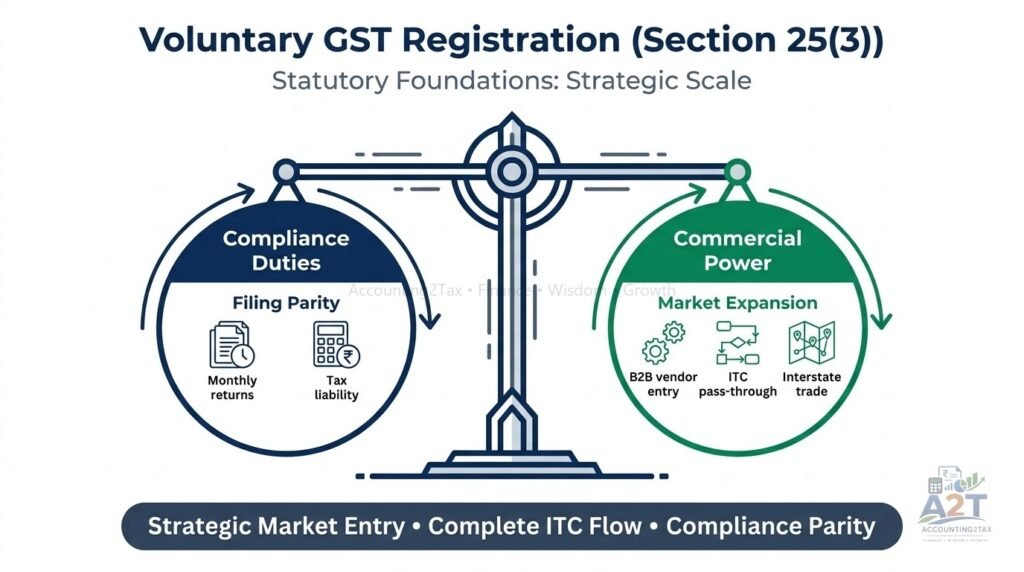
- • What Is Voluntary GST Registration? (Section 25(3))
- • 1. The 4 Major Commercial Advantages
- • 2. The 4 Hidden Costs and Compliance Burdens
- • 3. Strategic Litmus Test: B2B vs. B2C Customer Profile
- • Master 5-Question Decision Filter for Founders
Last Verified: 1 September 2026
Key Verification Sources: GST Council 56th Meeting (Sept 2025), CBIC Tax Information Portal, GSTN Advisories.
When starting a new business or freelance practice in India, one of the earliest strategic decisions is whether to apply for a GST identification number (GSTIN) before crossing the statutory turnover threshold.
If your annual turnover is below the mandatory limit (₹40 Lakh for goods or ₹20 Lakh for services in Normal States), the law does not require you to register.
Yet, thousands of early-stage startups, tech consultants, and boutique manufacturers actively choose Voluntary GST Registration under Section 25(3) of the CGST Act:
“If I don’t have to pay tax yet, why should I voluntarily register? Will having a GSTIN help me win corporate clients? Can I recover the 18% GST paid on my laptops and office setup? What are the hidden compliance costs?”
Voluntary registration is a double-edged sword. On one side, it provides instant commercial credibility and unlocks substantial Input Tax Credit (ITC). On the other, it locks your business into mandatory monthly return filings, accounting costs, and potential price handicaps in retail B2C markets.
What statutory rights and obligations are triggered under Section 25(3)? What are the 4 major commercial advantages for B2B ventures? What are the 4 hidden compliance costs that catch founders off guard? How does your B2B vs. B2C customer mix determine the right move? And what is the 5-question decision filter every startup founder should run?
This comprehensive guide breaks down the economics of voluntary GST registration, weighs the trade-offs, and provides a clear strategic roadmap.
What Is Voluntary GST Registration? (Section 25(3))
Under Section 25(3) of the Central Goods and Services Tax (CGST) Act, 2017:
“A person, though not liable to be registered under Section 22 or Section 24, may get himself registered voluntarily, and all provisions of this Act, as are applicable to a registered person, shall apply to such person.”
 THE GOLDEN RULE OF VOLUNTARY REGISTRATION
                                          │
 ┌─────────────────────────────────────────────────────────────────────────────┐
 │  Once you obtain voluntary GST registration, the law makes ZERO distinction  │
 │  between you and a multi-crore enterprise:                                  │
 │  • You MUST issue statutory Tax Invoices.                                   │
 │  • You MUST collect and deposit GST on all taxable sales.                   │
 │  • You MUST file GSTR-1 and GSTR-3B on time (even if you have ₹0 sales).    │
 │  • You face the exact same late fees and Section 122 penal provisions.      │
 └─────────────────────────────────────────────────────────────────────────────┘
1. The 4 Major Commercial Advantages
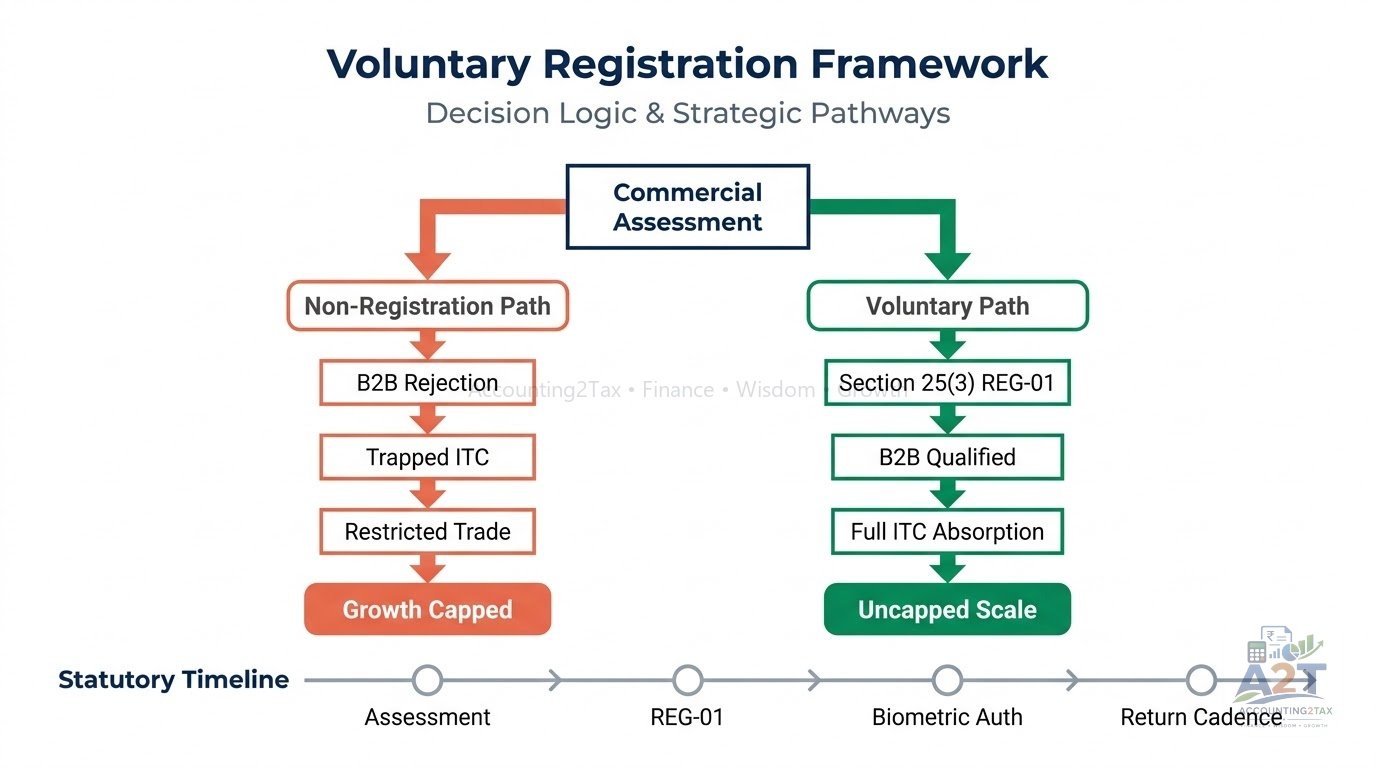
 4 ADVANTAGES OF VOLUNTARY REGISTRATION
                                          │
        ┌───────────────────┬─────────────┴─────────────┬───────────────────┐
        ▼                   ▼                           ▼                   ▼
 [ 1. B2B ONBOARDING ]   [ 2. 18% ITC RECOVERY ]     [ 3. PAN-INDIA SALES ] [ 4. BANK CREDIT ]
 Win corporate clients   Recover GST on laptops,     Sell inter-state and   Official turnover proof
 who demand GST invoices machinery & setup costs     on digital marketplaces for MSME bank loans
Advantage 1: Seamless B2B Corporate Vendor Onboarding
- The Problem: Established companies and enterprise clients operate in a B2B GST ecosystem. When they hire a vendor, they expect to claim Input Tax Credit on the expense.
- The Advantage: If you lack a GSTIN, corporate procurement teams often refuse to onboard you because your invoice represents a “dead cost” (they lose the 18% tax credit). Having a GSTIN instantly establishes institutional trust and levels the playing field with larger competitors.
Advantage 2: Unlocking Input Tax Credit on Setup & Capital Assets
When launching a business, you incur heavy upfront capital expenditures:
– Laptops, servers, and computers (18% GST)
– Software subscriptions (SaaS) and cloud hosting (18% GST)
The Math: If you spend ₹10,00,000 setting up your tech startup, ₹1,80,000 is GST. As an unregistered entity, this ₹1.8 Lakh is an unrecoverable loss. As a voluntarily registered entity, you claim this ₹1.8 Lakh as an electronic ITC credit to offset future output taxes.
Important Caveat: Note that not all setup expenses qualify for 18% ITC. Some expenses may be taxed at different rates, and certain items (e.g., office renovation amounting to immovable property, or food/beverages) have blocked credits under Section 17(5).
Advantage 3: Frictionless Inter-State & E-Commerce Expansion
Unregistered physical goods sellers are strictly barred from shipping products across state boundaries. Voluntary registration eliminates geographic boundaries, allowing you to list products on Amazon, Flipkart, or your own Shopify store and ship across India from Day 1.
Advantage 4: Verified Financial Standing for Bank Credit
Banks and NBFCs require GST returns (GSTR-3B / GSTR-1) as primary documentary proof when evaluating working capital limits, term loans, and business credit cards for MSMEs.
2. The 4 Hidden Costs and Compliance Burdens
 4 HIDDEN COMPLIANCE COSTS
                                       │
        ┌───────────────────┬──────────┴──────────┬───────────────────┐
        ▼                   ▼                     ▼                   ▼
 [ 1. RECURRING FILINGS ] [ 2. ACCOUNTANT FEES ] [ 3. B2C PRICE HIKE ] [ 4. CANCELLATION ]
 Mandatory monthly/qrtrly CA/accountant fees     Charging GST to       Reversing ITC on
 filings even on ₹0 sale  (₹15k–₹30k/year)       retailers hurts margins closing stock u/s 29
- Mandatory Return Filings (The Nil Return Trap): Even if your startup earns ₹0 in revenue during a quarter, you must log in and submit Nil Returns. Missing a deadline triggers automatic late fees (capped at ₹20/day for Nil returns, max ₹500), and can result in bank account attachment.
- Professional Compliance Overhead: Small businesses typically spend ₹15,000 to ₹30,000 per year on bookkeepers or chartered accountants to manage reconciliations and filings.
- The Retail B2C Pricing Handicap: If your customers are everyday retail consumers (who cannot claim ITC), charging GST inflates your retail price compared to unregistered local competitors.
- Complex Deregistration (Section 29): If you decide to cancel your registration later, you must file GSTR-10 (Final Return) and repay any Input Tax Credit claimed on unsold stock and capital goods.
3. Strategic Litmus Test: B2B vs. B2C Customer Profile
Your customer base is the single most important factor determining whether voluntary registration is profitable:
 THE B2B VS B2C DECISION MATRIX
                                          │
        ┌─────────────────────────────────┴─────────────────────────────────┐
        ▼                                                                   ▼
 [ SCENARIO A: B2B FOCUSED (>70% Business Clients) ] [ SCENARIO B: B2C FOCUSED (>70% Retail Buyers) ]
 • Your clients are GST-registered companies.        • Your customers are end consumers.
 • Clients WANT you to charge GST (they claim ITC).  • Customers bear the GST as an out-of-pocket hike.
 • You recover 18% GST on all your startup inputs.   • Unregistered competitors are cheaper than you.
 ─────────────────────────────────────────────────── ───────────────────────────────────────────────────
 VERDICT: VOLUNTARY REGISTRATION IS HIGHLY PROFITABLE. VERDICT: AVOID VOLUNTARY REGISTRATION UNTIL ₹20L/40L.
Master 5-Question Decision Filter for Founders
| # | Strategic Question | If YES | If NO |
|---|---|---|---|
| 1 | Are your primary customers GST-registered businesses (B2B)? | Register Voluntarily | Lean towards waiting |
| 2 | Are you investing heavily in equipment, machinery, or SaaS? | Register to save ITC | ITC benefit is minimal |
| 3 | Do you plan to sell physical goods across state lines or online? | Register Immediately (Mandatory) | Can remain local |
| 4 | Can your business afford ₹15,000–₹30,000/year in compliance? | Proceed safely | Compliance cost may erode margin |
| 5 | Are your competitors winning enterprise deals due to GSTINs? | Register for Credibility | Focus on organic growth |
Frequently Asked Questions (FAQs)
Q1. What is the late fee if I register for GST but have no sales and forget to file a return?
Answer: The late fee for a Nil return is capped at ₹20 per day (₹10 CGST + ₹10 SGST), up to a maximum of ₹500 per return.
Q2. Can I claim ITC on all my business startup costs?
Answer: Not necessarily. While you can claim ITC on laptops and SaaS software, certain expenses like office building renovations (immovable property) or food and beverages are blocked under Section 17(5) of the CGST Act.
Q3. If I voluntarily register and then my business doesn’t work out, can I cancel the GSTIN?
Answer: Yes. You can apply for cancellation under Section 29, but you must file a final return (GSTR-10) and reverse the ITC claimed on any unsold stock and capital goods still held on the date of cancellation.
Q4. Does voluntary registration change my threshold limit?
Answer: No. Once voluntarily registered, you are treated as a registered person from Day 1 and must comply with all provisions, rendering the ₹20L/₹40L threshold effectively irrelevant to you.
Q5. Can I opt for the Composition Scheme if I register voluntarily?
Answer: Yes. If your aggregate turnover remains within the prescribed limit (₹1.5 Crore for goods, ₹50 Lakh for services), you can opt for the Composition Scheme to pay a flat tax rate, though you will not be able to claim ITC.
Calculate Your GST Payouts and ITC Savings
Model your input tax savings on startup equipment, calculate invoice output tax, and evaluate the cash-flow impact of voluntary registration using the Accounting2Tax Financial Tools.
Use the GST Calculator to model your pricing and input tax credits.
Related Financial Wisdom
- GST Registration Explained: Who Must Register — registration basics.
- GST Registration for Small Businesses: Thresholds — threshold rules.
- Input Tax Credit Explained: How GST on Purchases Works — ITC mechanics.
- GST Invoice Explained: Mandatory Rules and E-Invoicing — invoicing rules.
- GST Compliance Checklist for Small Businesses — compliance roadmap.
Key Takeaways
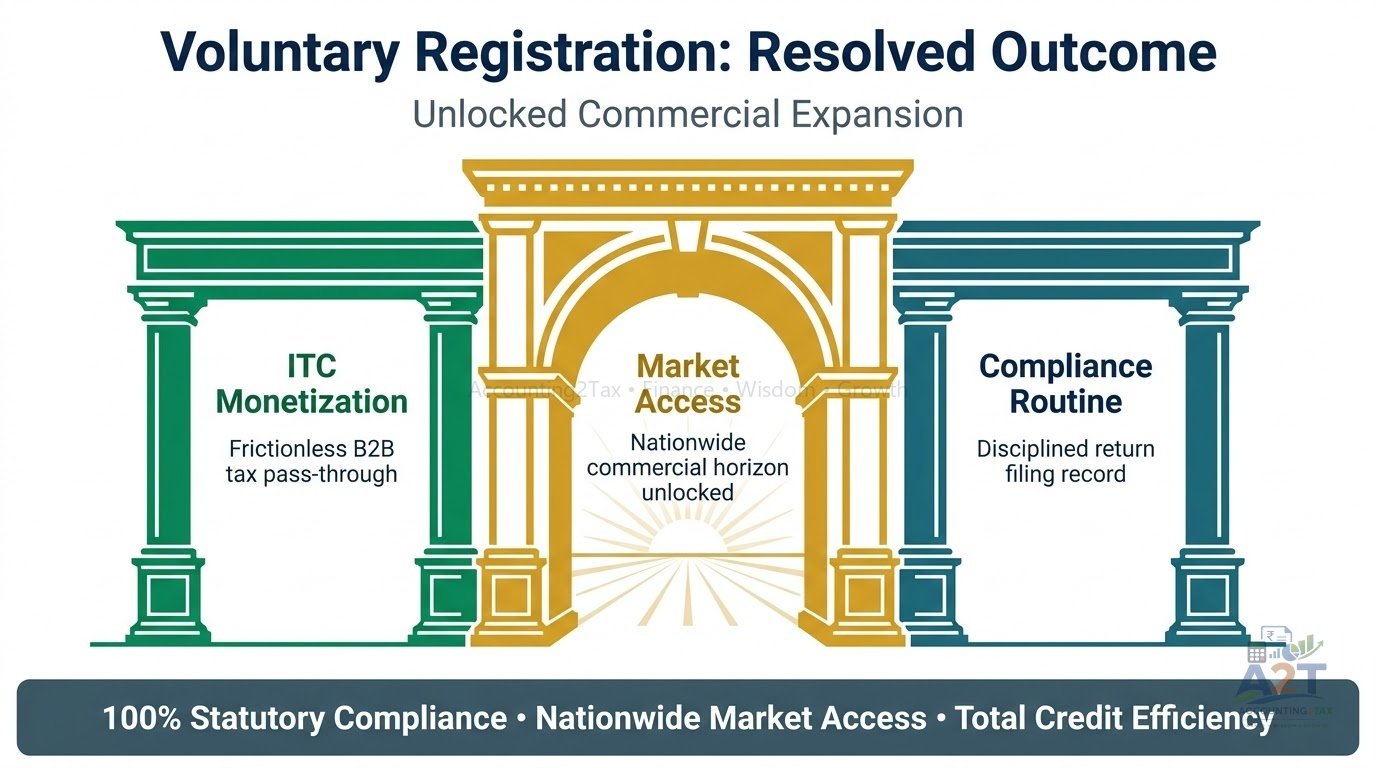
- Voluntary GST registration under Section 25(3) is legally permitted for any business below the turnover thresholds.
- Once registered voluntarily, you are subject to the exact same return filing deadlines and penalties as large corporations.
- For B2B ventures, voluntary registration is an immense advantage: it unlocks enterprise vendor onboarding and saves tax on capital setup costs.
- For retail B2C ventures, voluntary registration creates a price disadvantage against unregistered competitors.
- Always weigh the ₹15,000–₹30,000 annual accounting overhead against your projected Input Tax Credit savings before applying.
📚 Sources & Official Regulatory References
| Topic / Statutory Regulation | Source | Authority | Checked On | Effective Date |
|---|---|---|---|---|
| Section 25(3) (Voluntary Registration Provisions) | Central Goods and Services Tax Act, 2017 | Tier 1 | 2026-08-26 | Current |
| Section 16 (Eligibility and Conditions for Taking ITC) & Section 18 | Central Goods and Services Tax Act, 2017 | Tier 1 | 2026-08-26 | Current |
| Section 29 (Cancellation of Registration) & Rule 20 of CGST Rules | Central Board of Indirect Taxes and Customs (CBIC) | Tier 1 | 2026-08-26 | Current |
| MSME Operating Guidelines on GST Onboarding & Credit Access | Ministry of Micro, Small and Medium Enterprises (MSME) | Tier 1 | 2026-08-26 | Current |
📚 Explore More in Registration (GST)
Taxonomy Series
Discover related guides, taxonomy series, and interactive financial calculators:
This publication is strictly for educational, research, and informational purposes and does not constitute formal financial, investment, tax, or legal advice.
- Data Accuracy & Inadvertent Errors: While every reasonable effort is made to maintain accuracy, all information, interest rates, tax thresholds, formulas, and statutory data are provided on an “as-is” basis. Accounting2Tax makes no express or implied warranties regarding absolute completeness, timeliness, or typographical and computational infallibility. Statutory authorities (Ministry of Finance, RBI, CBDT, CBIC, SEBI, PFRDA) update guidelines periodically. Readers must independently verify current rates and rules on official government portals before executing financial transactions.
- Illustrations, Simulations & Limitations of Liability: Mathematical models, compounding simulations, case studies, and hypothetical return projections are conceptual tools designed solely to demonstrate financial principles. They do not constitute guaranteed returns, profit forecasts, or capital safety commitments. Accounting2Tax and its authors disclaim all liability for any direct, indirect, or consequential financial losses, tax penalties, or investment outcomes arising from inadvertent errors, omissions, calculation discrepancies, or reliance placed on this material.
- Professional Consultation: Readers must independently evaluate their individual financial goals, tax positions, and risk tolerance, and consult a SEBI-registered financial advisor or certified chartered accountant before making financial decisions.