- • Why Are GST Notices Issued? The 4 Core Triggers
- • Major Legislative Shift: Section 73/74 vs Section 74A
- • Master Table of Common GST Notices & Forms
- • Deep Dive into Critical GST Notice Types
- • Mandatory Check: Document Identification Number (DIN)
Last Verified: 1 September 2026
Key verification sources: Finance (No. 2) Act 2024 (Section 74A), CBIC Tax Information Portal, GSTN advisories (DRC-03A).
Receiving an official email or SMS from the GST portal with the subject line “Intimation / Notice under the Goods and Services Tax Act” is an experience that causes immediate anxiety for any business owner.
With artificial intelligence, automated data cross-referencing, and continuous surveillance across the GST Network (GSTN), the tax department today issues thousands of system-generated notices every month.
However, receiving a GST notice does not mean your business is under criminal investigation or that your bank accounts are about to be frozen. In the vast majority of cases, a GST notice is simply an automated inquiry regarding a clerical mismatch between your sales returns and purchase credits, a delay in return filing, or a request for clarification under scrutiny rules.
Understanding the specific section under which the notice was issued, verifying its legal authenticity, and filing a precise online reply within statutory deadlines is essential to resolving disputes without financial penalties.
This comprehensive guide explains the most common types of GST notices, breaks down their governing forms and response timelines, details the Section 74A unified framework, covers Document Identification Number (DIN) verification, and provides a step-by-step protocol for responding online.
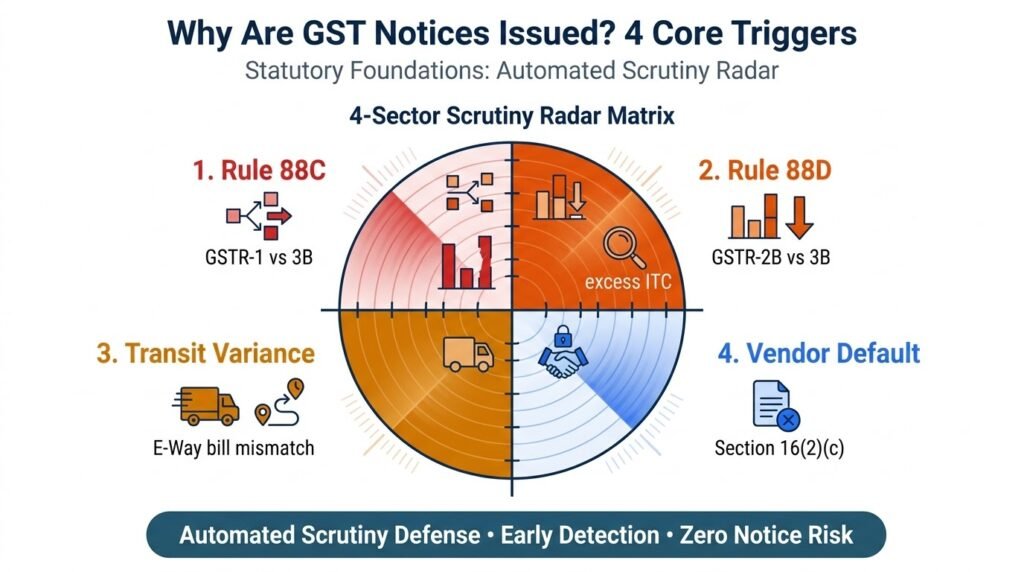
Why Are GST Notices Issued? The 4 Core Triggers
Almost all GST notices originate from one of four primary compliance discrepancies:
CORE TRIGGERS FOR GST NOTICES
                                          │
            ┌─────────────────────────────┼─────────────────────────────┐
            ▼                             ▼                             ▼
    [ SALES MISMATCH ]            [ ITC MISMATCH ]              [ NON-FILING ]
 GSTR-1 sales exceed           GSTR-3B ITC claimed         Failed to file monthly
 GSTR-3B tax paid              exceeds GSTR-2B credit      returns on time.
 (Form DRC-01B / Rule 88C)     (Form DRC-01C / Rule 88D)   (Form GSTR-3A / Sec 46)
- Tax Liability Discrepancies: The Output Tax declared in your sales ledger (GSTR-1) does not match the actual cash/credit tax paid in your summary return (GSTR-3B).
- Excess Input Tax Credit Claims: The ITC claimed in GSTR-3B exceeds the eligible credit appearing in your auto-drafted GSTR-2B.
- Non-Filing of Returns: Missing statutory deadlines for monthly GSTR-3B, quarterly CMP-08, or annual GSTR-9.
- Third-Party Data Mismatches: Significant variance between income tax filings (AIS/ITR), e-way bills generated, e-invoicing data, and your declared GST turnover.
Major Legislative Shift: Section 73/74 vs Section 74A
A major transition occurred regarding demand and adjudication notices. Depending on the financial year involved, different rules apply:
| Tax Period | Main Demand Framework |
|---|---|
| Up to FY 2023-24 | Section 73 applies for non-fraud cases; Section 74 applies for fraud, wilful misstatement, or suppression cases. |
| FY 2024-25 onward | Section 74A (Unified Procedure) applies to all cases (fraud and non-fraud) for tax not paid, short paid, erroneous refunds, and wrongly availed/utilised ITC. |
Master Table of Common GST Notices & Forms
| Notice Form | Governing Law | Primary Trigger / Purpose | Response Form | Statutory Response Window |
|---|---|---|---|---|
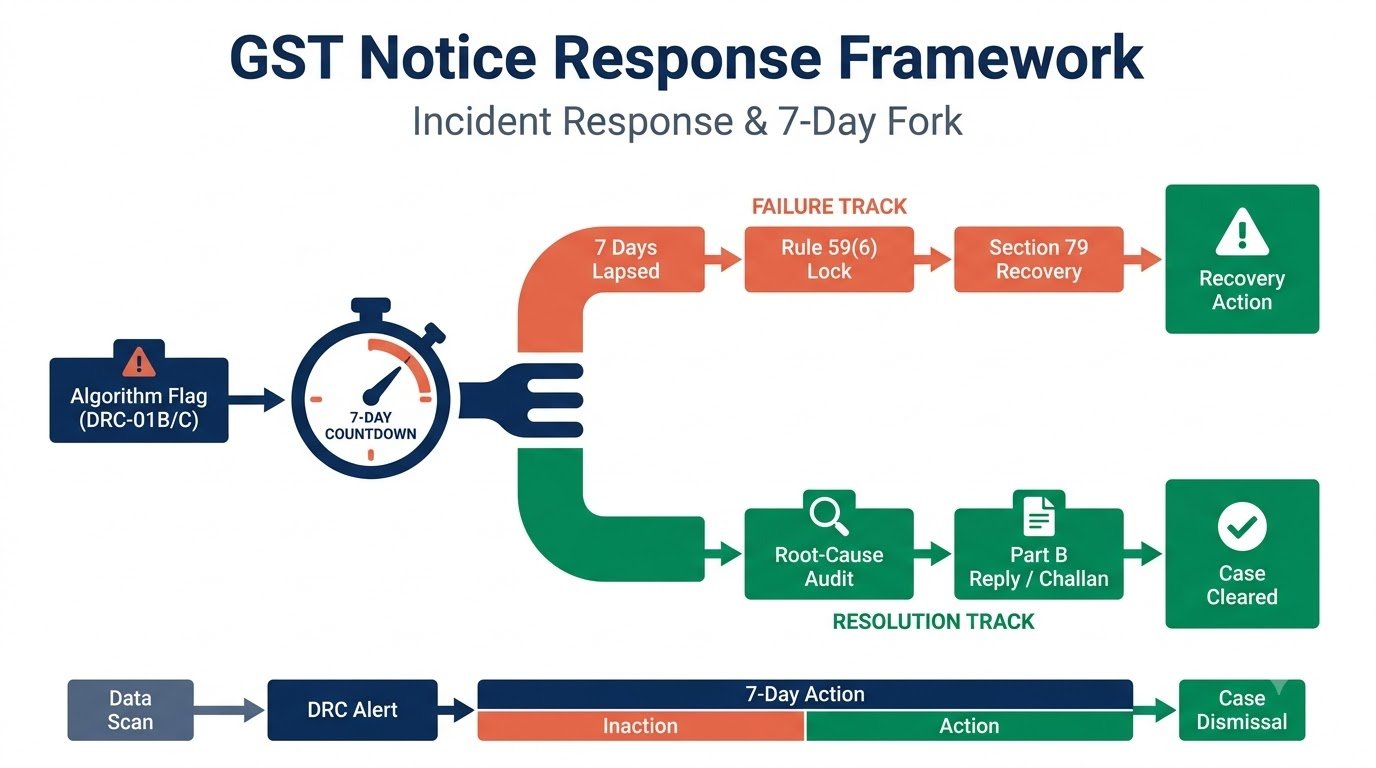
| Form DRC-01B | Rule 88C | Mismatch between tax declared in GSTR-1 and tax paid in GSTR-3B | Part B of Form DRC-01B | 7 Calendar Days |
| Form DRC-01C | Rule 88D | Mismatch between ITC available in GSTR-2B and ITC claimed in GSTR-3B | Part B of Form DRC-01C | 7 Calendar Days |
| Form GSTR-3A | Section 46 | Default notice to non-filers of monthly/quarterly returns | File pending returns | 15 Days |
| Form ASMT-10 | Section 61 | Scrutiny of return pointing out specific discrepancies | Form ASMT-11 | 30 Days (or time granted) |
| Form DRC-01A | Sec 73/74/74A | Pre-show cause notice intimation of tax ascertained | Form DRC-01A (Part B) | As specified in notice |
| Form DRC-01 | Sec 73/74/74A | Formal Show Cause Notice (SCN) for demand of tax, interest & penalty | Form DRC-06 | 30 Days |
| Form REG-17 | Section 29 | Show cause notice for cancellation or suspension of GST registration | Form REG-18 | 7 Working Days |
Deep Dive into Critical GST Notice Types
1. Form DRC-01B (Rule 88C — Sales Tax Mismatch)
- The Issue: Output tax reported in GSTR-1 exceeds GSTR-3B.
- Your Options:
- Pay the short-paid tax with 18% Section 50 interest via Form DRC-03; OR
- Submit reasons in Part B of DRC-01B (e.g., entered incorrect invoice in GSTR-1 amended in subsequent month, clerical typo, or timing difference).
- Warning: Failure to respond in 7 days blocks the filing of your subsequent GSTR-1.
2. Form DRC-01C (Rule 88D — Excess ITC Claim Mismatch)
- The Issue: ITC claimed in Table 4(A) of GSTR-3B is higher than the eligible credit in GSTR-2B.
- Your Options:
- Reverse the excess ITC along with interest via Form DRC-03; OR
- Submit explanation in Part B (e.g., reclaiming valid ITC reversed in prior periods under Rule 37).
3. Section 74A (Unified Demand Framework for FY 24-25 Onward)
Replaces the old Section 73/74 duality for periods starting April 1, 2024.
– Unified Procedure: Handles both fraud and non-fraud cases under one section with a common time limit (42 months from due date of Annual Return to issue SCN, 54 months for order).
– Penalty Structure:
– If paid within the specified period: reduced penalty applies.
– Fraud cases: 100% penalty if not settled before SCN.
– Non-fraud: proportional penalty based on the timing of payment.
4. DRC-01A (Pre-SCN Intimation)
Before serving a formal Show Cause Notice (DRC-01) under Section 73, 74, or 74A, the officer communicates the details of tax, interest, and penalty ascertained in Part A of Form DRC-01A. If you agree, you can pay and file Part B to conclude proceedings before an SCN is issued.
Mandatory Check: Document Identification Number (DIN)
Under CBIC guidelines, every communication, notice, summons, or order issued by central tax officers MUST contain a computer-generated Document Identification Number (DIN):
Notice Received ──► Check for 20-Digit Alphanumeric DIN
                                            │
                                            ▼
           Verify on CBIC Portal: cbic.gov.in ──► "Verify CBIC-DIN"
                                            │
        ┌───────────────────────────────────┴───────────────────────────────────┐
        ▼                                                                     ▼
   [ VALID DIN ]                                                         [ NO DIN ]
 Authentic notice; proceed                                          LEGALLY INVALID & VOID
 with online reply                                                  (Deemed never issued)
5-Step Action Protocol to Respond to a GST Notice
If your business receives a GST notice, follow this disciplined standard operating procedure:
- Step 1: Verify Authenticity: Check the DIN on
cbic.gov.inand confirm the notice appears under your dashboard ongst.gov.in. - Step 2: Note the Statutory Response Deadline: Calculate calendar days immediately (e.g., 7 days for DRC-01B/C, 15 days for GSTR-3A, 30 days for ASMT-10). Never let the deadline expire without action.
- Step 3: Conduct Root-Cause Reconciliation: Match the period’s Purchase Register, Sales Register, GSTR-1, GSTR-2B, and GSTR-3B to identify the exact transactional difference.
- Step 4: Prepare Evidence-Backed Reply:
– If the tax demand is correct: Pay via Form DRC-03 to minimize interest and penalties. (Use DRC-03A to map voluntary payments to existing demands).
– If the demand is incorrect: Draft a point-by-point factual reply citing relevant circulars, statutory provisions, and attaching invoices/reconciliation sheets. - Step 5: Submit Online via GST Portal:
– Log in togst.gov.in$\rightarrow$ Services $\rightarrow$ User Services $\rightarrow$ View Additional Notices/Orders.
– Select the notice reference $\rightarrow$ Click “Reply” $\rightarrow$ Enter response text and upload supporting PDF attachments $\rightarrow$ Sign using DSC/EVC.
What NEVER to Do When You Receive a GST Notice
- ❌ Never Ignore the Notice: Inaction leads to ex-parte orders, attachment of bank accounts under Section 79, and portal return blocking.
- ❌ Never Panic or Pay Blindly: Many automated notices are simple timing differences that can be dropped with a 1-page reconciliation statement. Use DRC-03A if you have already paid.
- ❌ Never Submit Unverified Explanations: Inaccurate statements submitted in formal replies can be used against you during appellate proceedings.
Frequently Asked Questions (FAQs)
Q1. What is the difference between Section 73/74 and Section 74A?
Answer: Sections 73 and 74 apply to financial years up to 2023-24 (separating non-fraud and fraud cases). Section 74A is the unified demand framework applicable from FY 2024-25 onward, combining both fraud and non-fraud cases into one procedural timeline.
Q2. How can I map a payment I made via DRC-03 to a newly issued demand order?
Answer: The GST portal provides Form DRC-03A, allowing taxpayers to adjust/map their voluntary DRC-03 payments directly against corresponding demand orders.
Q3. What happens if I receive a notice without a DIN?
Answer: As per CBIC circulars, any notice from central tax officers without a valid computer-generated Document Identification Number (DIN) is treated as legally invalid and deemed to have never been issued.
Q4. How should I reply to a GST scrutiny notice (ASMT-10)?
Answer: You must reply using Form ASMT-11 within 30 days. Attach a clear reconciliation (e.g., explaining why income tax turnover differs from GST turnover).
Q5. Can my GST registration be suspended without notice?
Answer: Under specific high-risk conditions (like massive ITC mismatches or non-filing for continuous periods), your registration can be suspended, followed by a show cause notice (REG-17) for cancellation.
Calculate Your GST Invoice Breakdowns
Verify tax calculations, model differential liability payouts, and calculate accurate interest under Section 50 using the Accounting2Tax GST Calculator.
Use the GST Calculator to reconcile figures before submitting notice responses.
Related Financial Wisdom
- GST Returns Explained: Understanding the GST Filing System
- GSTR-1 and GSTR-3B: Understanding Their Different Purposes
- ITC Reconciliation: Why GSTR-2B Matters
- GST Compliance Checklist: Key Daily, Monthly and Annual Requirements
Key Takeaways
- Common notice triggers include GSTR-1 vs 3B mismatches (DRC-01B), GSTR-2B vs 3B ITC mismatches (DRC-01C), and non-filing (GSTR-3A).
- Rule 88C (DRC-01B) and Rule 88D (DRC-01C) notices carry a strict 7-day response window. Failure to reply blocks subsequent return filings.
- Always verify the Document Identification Number (DIN) on the CBIC portal to ensure legal validity.
- For notices relating to FY 2024-25 onward, the unified Section 74A applies. Map pre-payments using DRC-03A.
- Submit all replies online through Services $\rightarrow$ User Services $\rightarrow$ View Additional Notices/Orders on the GST portal.
📚 Sources & Official Regulatory References
| Notice / Provision | Source | Authority | Checked On | Effective Date |
|---|---|---|---|---|
| Section 61 (ASMT-10) & Section 74A | CGST Act, 2017 | Tier 1 | 2026-09-01 | Current |
| Rule 88C (DRC-01B) & Rule 88D (DRC-01C) | CGST Rules, 2017 | Tier 1 | 2026-09-01 | Current |
| Mandatory DIN Generation on Notices | CBIC Circulars | Tier 1 | 2026-09-01 | Current |
📚 Explore More in Notices (GST)
Taxonomy Series
Discover related guides, taxonomy series, and interactive financial calculators:
This publication is strictly for educational, research, and informational purposes and does not constitute formal financial, investment, tax, or legal advice.
