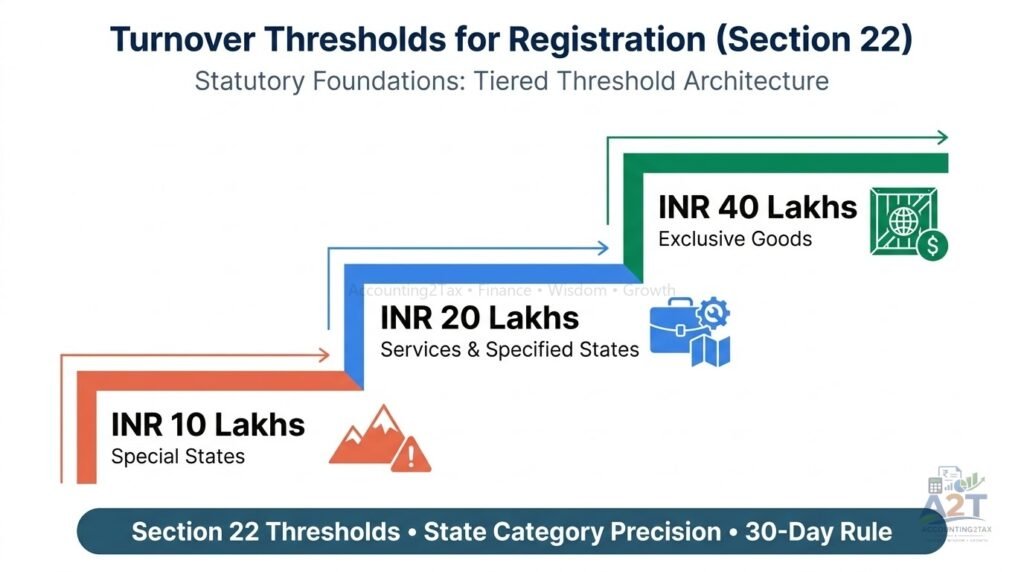
- • Turnover Thresholds for GST Registration (Section 22)
- • State-Wise Threshold Breakdown
- • Mandatory GST Registration Regardless of Turnover (Section 24)
- • Deconstructing the 15-Digit GSTIN Format
- • Voluntary Registration: Should You Register Before Hitting the Limit?
Last Verified: 1 September 2026
Key Verification Sources: GST Council 56th Meeting (Sept 2025), CBIC Tax Information Portal, GSTN Advisories.
When starting or scaling a business in India, one of the most critical legal milestones is obtaining a Goods and Services Tax Identification Number (GSTIN).
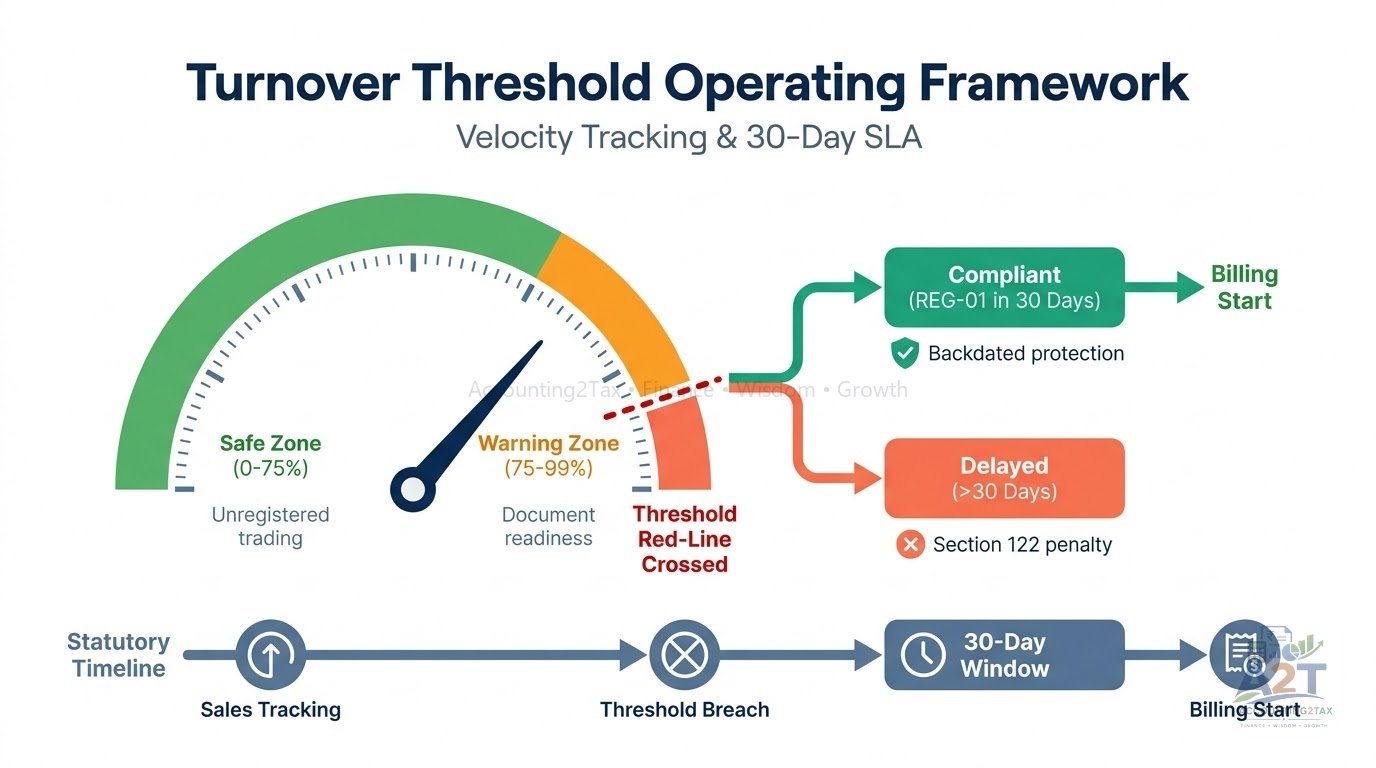
Operating a business without GST registration when legally required is a punishable offense under Section 122 of the CGST Act, attracting a penalty of 100% of the tax due or ₹10,000 (whichever is higher).
Conversely, registering for GST prematurely can impose unnecessary monthly filing burdens and compliance costs on a micro-enterprise.
How do you determine if your business is legally required to register? What is the difference between the ₹40 Lakh goods threshold and the ₹20 Lakh service threshold? What are the Section 24 mandatory triggers that require GST registration even if your turnover is zero? And when does Voluntary Registration make commercial sense?
This guide breaks down all statutory turnover limits, compulsory registration triggers, the anatomy of your 15-digit GSTIN, and the step-by-step registration workflow on the official GST portal.
Turnover Thresholds for GST Registration (Section 22)
Under Section 22 of the CGST Act, liability to register for GST is triggered when your Aggregate Annual Turnover exceeds specified monetary thresholds:
 GST Registration Thresholds (Section 22)
                                          │
            ┌─────────────────────────────┴─────────────────────────────┐
            ▼                                                           ▼
 SUPPLIERS OF GOODS                                          SUPPLIERS OF SERVICES
 (Exclusive physical goods trade)                            (or Mixed Goods + Services)
            │                                                           │
 • Normal States: ₹40 Lakh                                   • Normal States: ₹20 Lakh
 • Special Category: ₹20L / ₹10L                             • Special Category: ₹20L / ₹10L
State-Wise Threshold Breakdown
| Business Nature | Standard Normal States (e.g., MH, KA, DL, TN, UP, GJ) | Special Category States Group A (Uttarakhand, Meghalaya, Sikkim, Arunachal, Puducherry, Telangana) | Special Category States Group B (Manipur, Mizoram, Nagaland, Tripura) |
|---|---|---|---|
| Exclusive Supply of Goods | ₹40,00,000 | ₹20,00,000 | ₹10,00,000 |
| Supply of Services / Mixed | ₹20,00,000 | ₹20,00,000 | ₹10,00,000 |
| Composition Scheme Eligibility | Up to ₹1.50 Crore (Goods) | Up to ₹75 Lakh | Up to ₹75 Lakh |
What Counts in Aggregate Turnover?
Aggregate turnover includes all taxable supplies, exempt supplies, exports of goods/services, and inter-state supplies of persons having the same PAN across all branches in India (excluding inward supplies taxable under RCM and GST taxes).
Mandatory GST Registration Regardless of Turnover (Section 24)
Under Section 24 of the CGST Act, certain businesses MUST register for GST from Day 1, even if their annual turnover is just ₹1:
 Section 24 Mandatory Triggers
                                       │
        ┌──────────────────────────────┼──────────────────────────────┐
        ▼                              ▼                              ▼
 Inter-State Goods Sellers       Reverse Charge (RCM)           E-Commerce & OIDAR
 Supplying goods across state    Entities liable to pay tax     E-commerce marketplaces,
 borders (e.g. MH to KA)         on purchases under RCM         ISDs & foreign digital services
The 6 Key Compulsory Categories:
- Inter-State Taxable Suppliers of Goods: Any business selling physical goods to customers located in another State. (Note: Service providers enjoy a general exemption up to ₹20L for inter-state service supplies).
- Persons Liable to Reverse Charge (RCM): If your business receives supplies where the recipient must pay GST (e.g., Goods Transport Agency services, legal services from advocates).
- E-Commerce Sellers: Suppliers selling physical goods through digital marketplaces (like Amazon or Flipkart), subject to recent intra-state micro-enterprise exemptions.
- Casual Taxable Persons: Individuals setting up temporary exhibition stalls or seasonal pop-up shops in a state where they have no fixed place of business.
- Non-Resident Taxable Persons: Overseas entities supplying goods or services into taxable territories in India.
- Input Service Distributors (ISD): Corporate offices distributing shared vendor ITC across manufacturing or retail units.
Deconstructing the 15-Digit GSTIN Format
Every registered taxpayer receives a unique 15-character alpha-numeric identifier structured as follows:
 Example GSTIN: 27 AAAAA 0000 A 1 Z 5
                            │   │     │    │ │ │ │
 ┌──────────────────────────┘   │     │    │ │ │ │
 ▼                              │     │    │ │ │ │
 [ 27 ] : 2-Digit State Code    │     │    │ │ │ │
 (e.g., 27 = Maharashtra, 29 = Karnataka, 07 = Delhi)
                                │     │    │ │ │ │
 ┌──────────────────────────────┘     │    │ │ │ │
 ▼                                    │    │ │ │ │
 [ AAAAA0000A ] : 10-Digit PAN of the Business Owner / Corporate Entity
                                           │ │ │ │
 ┌─────────────────────────────────────────┘ │ │ │
 ▼                                           │ │ │
 [ 1 ] : Entity Number (1st registration in that State for that PAN)
                                             │ │ │
 ┌───────────────────────────────────────────┘ │ │
 ▼                                             │ │
 [ Z ] : Default Alphabet (Reserved character) │ │
                                               │ │
 ┌─────────────────────────────────────────────┘ │
 ▼                                               ▼
 [ 5 ] : 1-Digit Check Code (Algorithm-generated validation character)
Voluntary Registration: Should You Register Before Hitting the Limit?
You have the legal right to apply for GST registration voluntarily even if your turnover is below ₹20L/₹40L:
 PROS of Voluntary Registration             CONS of Voluntary Registration
 ──────────────────────────────────         ──────────────────────────────────
 • Claim Input Tax Credit on purchases      • Mandatory monthly return filings
 • Sell to B2B corporate clients seamlessly • Penalties for late filing (GSTR-3B)
 • Expand into inter-state commerce         • Must collect GST from retail customers
 • Higher business trust & credibility      • Bookkeeping and accounting overhead
- When to Opt for Voluntary Registration: If your primary clients are GST-registered corporate businesses (who demand GST invoices to claim ITC) or if you purchase substantial equipment/capital goods and want to recover the GST paid.
- When to Avoid: If you sell low-ticket consumer goods/services directly to retail end-consumers who cannot claim ITC, as adding 18% GST makes your prices uncompetitive.
Step-by-Step GST Registration Process
Registration is 100% paperless and free on the government portal (gst.gov.in):
 Step 1: Generate Temporary Reference Number (TRN)
 ► Enter PAN, Mobile Number, and Email on gst.gov.in. Verify via OTP.
         │
         ▼
 Step 2: Complete Form GST REG-01 (Part B)
 ► Fill in business trade name, constitution, principal place of business,
 bank account details, and HSN/SAC codes for your top 5 products/services.
         │
         ▼
 Step 3: Upload Mandatory Documents
 ► PAN Card, Proof of Business Address (Electricity bill + Rent Agreement / NOC),
 Bank Proof (Cancelled cheque / statement), and Director/Proprietor Photo.
         │
         ▼
 Step 4: Aadhaar Authentication & Verification
 ► Complete instant biometric/Aadhaar OTP authentication for authorized signatory.
 Note: When Aadhaar authentication fails or biometric/site verification is initiated under Rule 9, the approval timeline extends up to 30 days.
         │
         ▼
 Step 5: Issuance of GST Registration Certificate (Form GST REG-06)
 ► Approved within 3 to 7 working days (or 30 days if physically verified); download your official certificate with GSTIN.
Frequently Asked Questions (FAQs)
Q1. What is the GST registration threshold for a service provider in Maharashtra?
Answer: The threshold for a service provider in Maharashtra (a normal state) is ₹20 Lakh in aggregate annual turnover.
Q2. Is the ₹40 Lakh threshold applicable to everyone?
Answer: No. The ₹40 Lakh limit applies exclusively to suppliers of goods in Normal States. Service providers, mixed suppliers, and businesses in certain Special Category States have lower thresholds (₹20 Lakh or ₹10 Lakh).
Q3. Do I need GST registration if my turnover is below ₹20 Lakh but I sell goods on Amazon?
Answer: Following recent amendments, intra-state sellers on e-commerce platforms can operate without GST registration up to the standard threshold, requiring only a PAN-based enrolment number. However, if you sell goods inter-state on the platform, registration is mandatory regardless of turnover.
Q4. What happens if I fail to register for GST when my turnover exceeds the limit?
Answer: Under Section 122 of the CGST Act, failure to register attracts a penalty of ₹10,000 or the tax amount evaded (100%), whichever is higher.
Q5. Will my registration be delayed if Aadhaar authentication fails?
Answer: Yes. If Aadhaar authentication fails, or if the officer opts for biometric/site verification under Rule 9, the timeline for processing your application extends up to 30 days.
Calculate Your GST Invoices
Model your sales pricing, calculate forward GST, and structure tax invoices using the Accounting2Tax GST Calculator.
Use the GST Calculator to compute accurate CGST, SGST, and IGST for your new business.
Related Financial Wisdom
- GST Explained: Understanding India’s Goods and Services Tax — core GST guide.
- CGST, SGST, IGST and UTGST: Understanding the Different GST Components — tax components.
- GST Returns Explained: Understanding the GST Filing System (Article 97 — coming soon).
- Input Tax Credit Explained: How GST Paid on Purchases Works (Article 101 — coming soon).
- Income Tax in India Explained: A Beginner’s Guide — business tax rules.
Key Takeaways
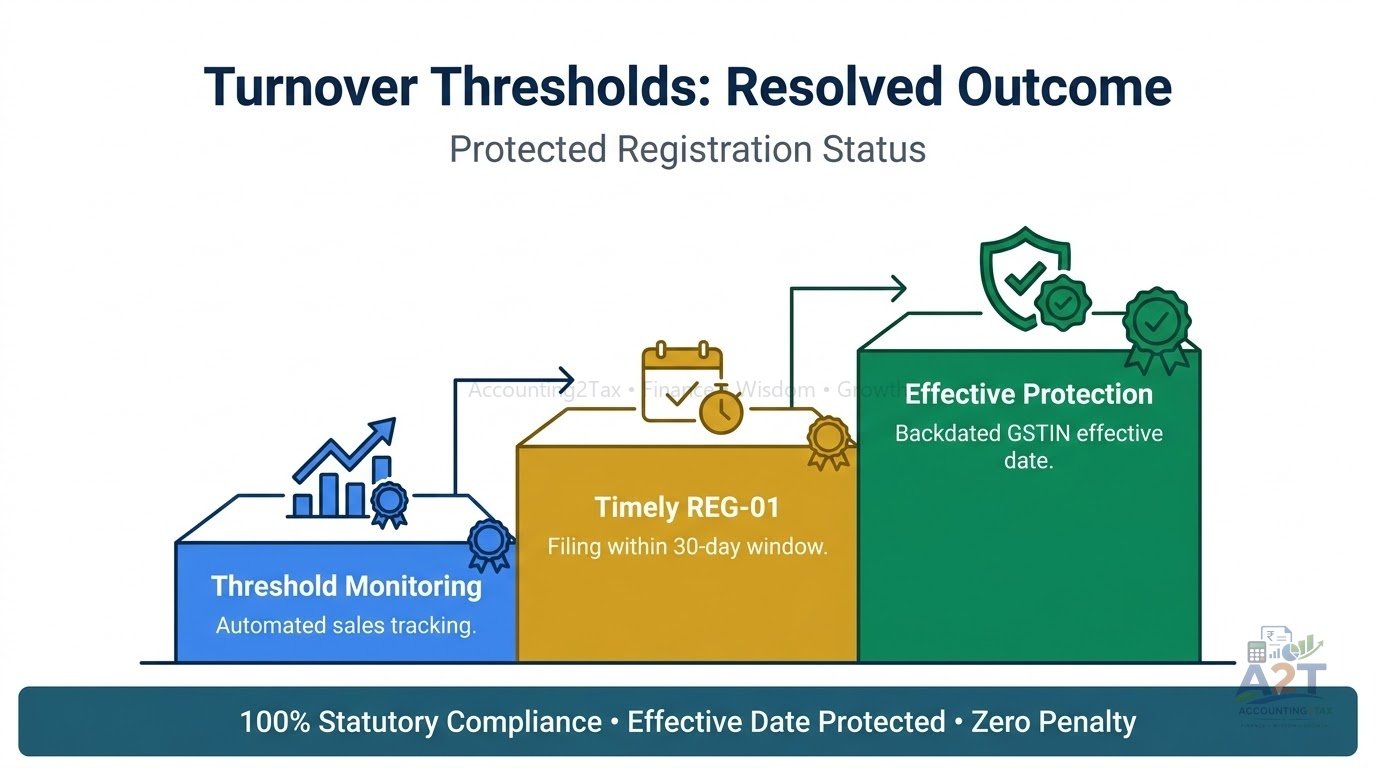
- Standard GST registration turnover threshold is ₹40 Lakh for exclusive goods suppliers and ₹20 Lakh for service providers (₹10L/₹20L in Special Category States).
- Section 24 mandates registration regardless of turnover for inter-state goods sellers, and RCM recipients.
- The 15-digit GSTIN embeds the state code, business PAN, entity count, and check digit.
- Voluntary registration unlocks B2B corporate contracts and ITC benefits, but introduces mandatory return compliance.
- Registration on
gst.gov.inis completely digital and paperless. Typically approved within 3 to 7 working days, but can extend to 30 days if physical/biometric verification is required.
📚 Sources & Official Regulatory References
| Topic / Section | Source | Authority | Checked On | Effective Date |
|---|---|---|---|---|
| Section 22 (Persons Liable for Registration) & Threshold Notifications | Central Goods and Services Tax Act, 2017 / CBIC | Tier 1 | 2026-08-26 | Current |
| Section 24 (Compulsory Registration in Certain Cases) | CGST Act, 2017 / Ministry of Finance | Tier 1 | 2026-08-26 | Current |
| Rule 8 & Form GST REG-01 (Application for Registration & Aadhaar Auth) | Central Goods and Services Tax Rules, 2017 | Tier 1 | 2026-08-26 | Current |
| Section 122 (Penalties for Failure to Register) | CBIC GST Compliance Master Circular | Tier 1 | 2026-08-26 | Current |
📚 Explore More in Registration (GST)
Taxonomy Series
Discover related guides, taxonomy series, and interactive financial calculators:
This publication is strictly for educational, research, and informational purposes and does not constitute formal financial, investment, tax, or legal advice.
- Data Accuracy & Inadvertent Errors: While every reasonable effort is made to maintain accuracy, all information, interest rates, tax thresholds, formulas, and statutory data are provided on an “as-is” basis. Accounting2Tax makes no express or implied warranties regarding absolute completeness, timeliness, or typographical and computational infallibility. Statutory authorities (Ministry of Finance, RBI, CBDT, CBIC, SEBI, PFRDA) update guidelines periodically. Readers must independently verify current rates and rules on official government portals before executing financial transactions.
- Illustrations, Simulations & Limitations of Liability: Mathematical models, compounding simulations, case studies, and hypothetical return projections are conceptual tools designed solely to demonstrate financial principles. They do not constitute guaranteed returns, profit forecasts, or capital safety commitments. Accounting2Tax and its authors disclaim all liability for any direct, indirect, or consequential financial losses, tax penalties, or investment outcomes arising from inadvertent errors, omissions, calculation discrepancies, or reliance placed on this material.
- Professional Consultation: Readers must independently evaluate their individual financial goals, tax positions, and risk tolerance, and consult a SEBI-registered financial advisor or certified chartered accountant before making financial decisions.