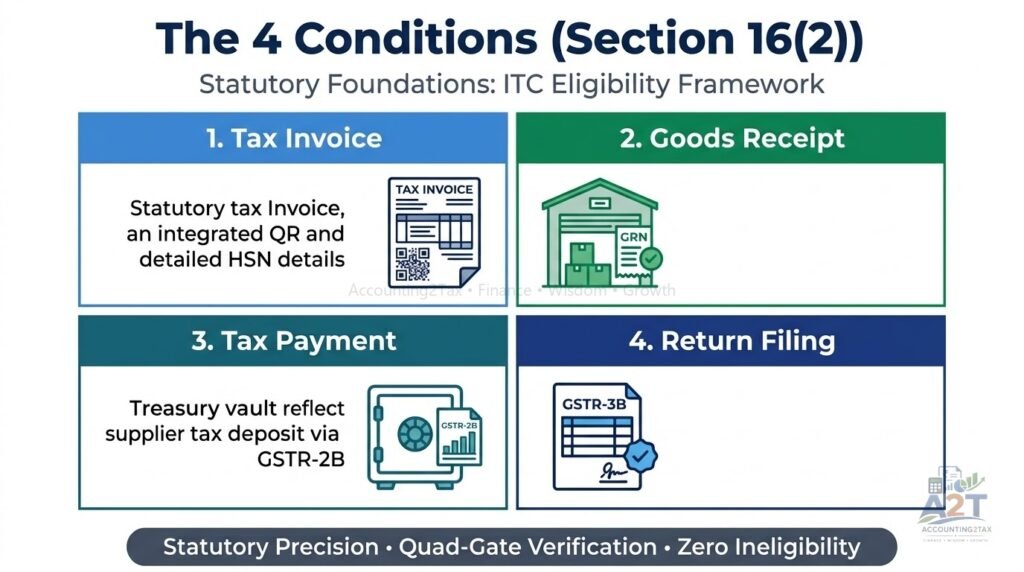
- • The 4 Non-Negotiable Statutory Conditions (Section 16(2))
- • 1. The GSTR-2B and IMS Mandate: The End of Provisional ITC
- • 2. The 180-Day Supplier Payment Rule (Section 16(2) Proviso)
- • 3. Capital Goods & The Double-Dipping Ban (Section 16(3))
- • 4. Statutory Time Limit to Claim Missed ITC
Expert Revision Notice — Last Verified: 1 September 2026
Key verification sources: 56th GST Council recommendations, CBIC Tax Information Portal, Finance (No. 2) Act 2024, GSTN advisories (IMS, GSTR-1A, DRC-03A).
In the Goods and Services Tax (GST) ecosystem, Input Tax Credit (ITC) is the economic engine that prevents the cascading “tax on tax” effect.
By allowing businesses to set off the GST paid on purchases against the GST collected on sales, ITC ensures that tax is levied only on the net value added at each stage of the supply chain.
However, many taxpayers mistakenly view ITC as an unconditional entitlement.
Under Indian jurisprudence and Supreme Court rulings, Input Tax Credit is a statutory concession granted by the legislature, subject to strict statutory preconditions:
- If your supplier fails to upload the invoice to GSTR-1, your credit is legally blocked under Section 16(2)(aa).
- If you fail to pay your vendor within 180 days, you must reverse the claimed credit with 18% penal interest.
- If you claim income tax depreciation on the GST component of a machine, your entire GST credit is forfeited under Section 16(3).
What are the 4 Non-Negotiable Statutory Conditions required to claim ITC under Section 16(2)? How does the Invoice Management System (IMS) and GSTR-2B auto-populated statement govern credit availability? How does the 180-day supplier payment rule operate? Why does Section 16(3) strictly ban “double-dipping” on capital goods? What is the hard deadline (30th November) for claiming missed credits, and what retrospective relief was provided under Sections 16(5) and 16(6)?
This comprehensive guide breaks down the statutory rules governing ITC eligibility, details legal conditions, and provides an actionable compliance checklist.
The 4 Non-Negotiable Statutory Conditions (Section 16(2))
Under Section 16(2) of the Central Goods and Services Tax (CGST) Act, 2017, a registered business can claim Input Tax Credit only if all four of the following conditions are simultaneously satisfied:
 THE 4 PILLARS OF ITC ELIGIBILITY (SEC 16(2))
                                          │
 ┌─────────────────────────────────────────────────────────────────────────────┐
 │  CONDITION 1: POSSESSION OF TAX INVOICE [Sec 16(2)(a)]                      │
 │  You must hold a valid Tax Invoice, Debit Note, or Bill of Entry issued by  │
 │  a registered supplier containing all 16 mandatory Rule 46 fields.          │
 ├─────────────────────────────────────────────────────────────────────────────┤
 │  CONDITION 2: MANDATORY GSTR-2B REFLECTION [Sec 16(2)(aa)]                  │
 │  The invoice details MUST be uploaded by the supplier in their GSTR-1,      │
 │  processed via the IMS, and communicated to you in your GSTR-2B statement.  │
 ├─────────────────────────────────────────────────────────────────────────────┤
 │  CONDITION 3: ACTUAL RECEIPT OF GOODS / SERVICES [Sec 16(2)(b)]             │
 │  You must have physically received the goods or consumed the services.      │
 │  (Includes "Bill to Ship to" deemed delivery to third parties).             │
 ├─────────────────────────────────────────────────────────────────────────────┤
 │  CONDITION 4: TAX ACTUALLY PAID & RETURN FILED [Sec 16(2)(c) & (d)]         │
 │  The tax charged on the supply must be paid to the government, and you must │
 │  have filed your statutory Form GSTR-3B return under Section 39.            │
 └─────────────────────────────────────────────────────────────────────────────┘
1. The GSTR-2B and IMS Mandate: The End of Provisional ITC
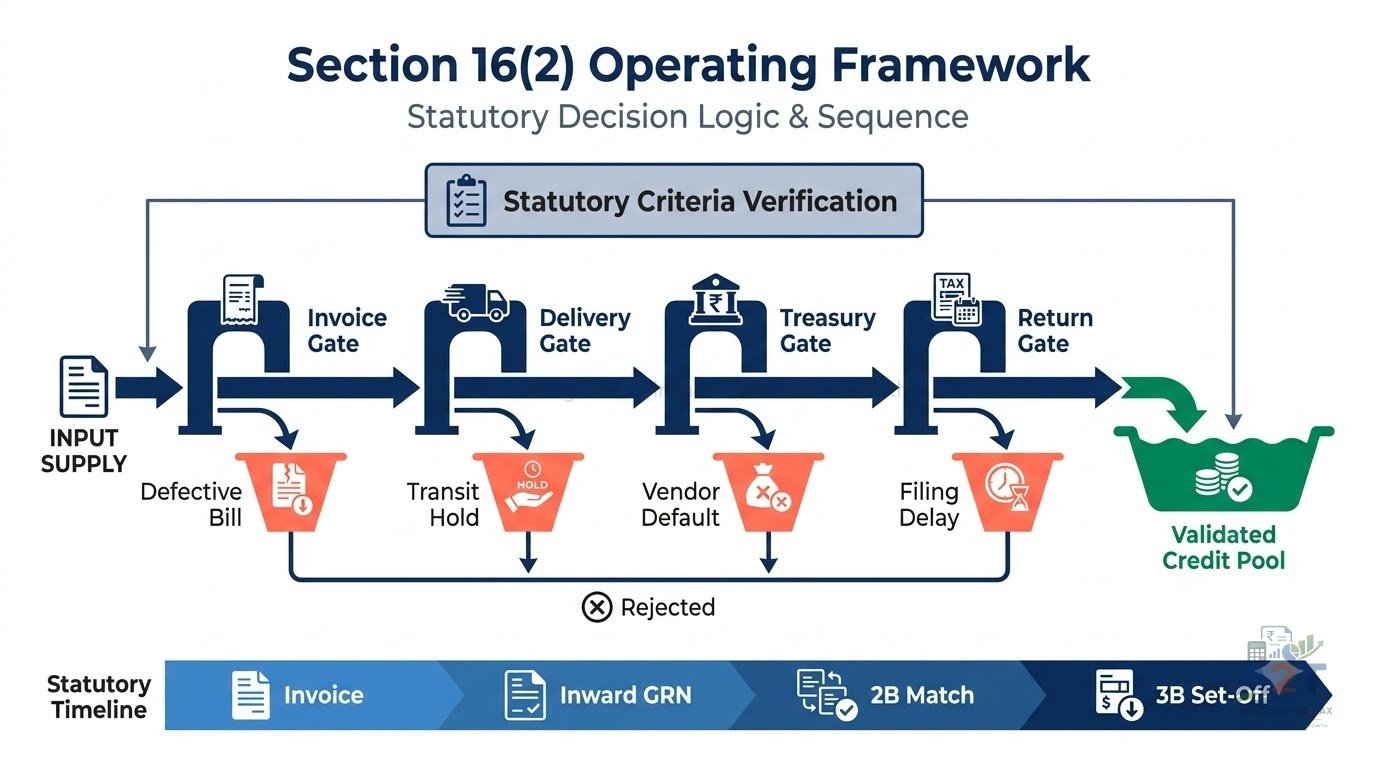
Prior to recent statutory amendments, businesses could claim provisional ITC up to 5% or 10% above vendor uploads. Today, under Section 16(2)(aa) and Rule 36(4), provisional ITC is completely eliminated:
The Invoice Management System (IMS) Workflow
Operational since October 2024, the reconciliation process has evolved into a structured workflow:
Books → IMS Accept/Reject/Pending → GSTR-2B → GSTR-3B
Invoices uploaded by suppliers now populate the IMS dashboard, where buyers must take action before GSTR-2B generation:
– Accept: The invoice is approved, and ITC flows into GSTR-2B.
– Reject: The invoice is rejected (e.g., mismatch or not belonging to the taxpayer), and ITC does not flow to GSTR-2B.
– Pending: Action is deferred to a future month, keeping the ITC parked.
– No Action: Treated as deemed accepted.
 ┌─────────────────────────────────────────────────────────────────────────────┐
 │  THE IMS & GSTR-2B RULE:                                                    │
 │  GSTR-2B is generated based on your actions in IMS. If an invoice is not    │
 │  visible in GSTR-2B, you CANNOT claim ITC in that month's GSTR-3B.          │
 │  You must wait until your vendor files their GSTR-1 and the credit appears  │
 │  in a subsequent month's GSTR-2B.                                           │
 └─────────────────────────────────────────────────────────────────────────────┘
Note: GSTR-2B is not the source of the legal entitlement to ITC; Section 16 and the Rules are. However, IMS and GSTR-2B are critical compliance controls.
2. The 180-Day Supplier Payment Rule (Section 16(2) Proviso)
Under the second proviso to Section 16(2):
- The Requirement: The buyer must pay the full invoice value including the GST amount to the supplier within 180 days from the invoice date.
- The Reversal for Non-Payment: If payment is not made within 180 days, the buyer must reverse the claimed Input Tax Credit in Form GSTR-3B for the month immediately following the 180 days, along with 18% per annum interest under Section 50.
- The Re-Claim Mechanism: Once the supplier is eventually paid, the buyer can re-claim the full ITC in any subsequent return without any time limit restriction.
Rule 37A: Vendor Non-Filing Reversal
Introduced via Notification 26/2022-CT, Rule 37A states that if your supplier files GSTR-1 (so the ITC appears in your GSTR-2B) but fails to file their GSTR-3B (meaning they haven’t paid the tax to the government), you must reverse the ITC by 30th November of the following financial year. If you reverse it by this deadline, no interest is applicable. If the supplier later files their GSTR-3B, you can re-claim the ITC.
3. Capital Goods & The Double-Dipping Ban (Section 16(3))
When a business purchases capital assets (machinery, factory equipment, commercial computers, servers):
 THE CAPITAL ASSET ITC DILEMMA
                                      │
     ┌────────────────────────────────┴────────────────────────────────┐
    ▼                                                                 ▼
 [ OPTION A: CLAIM FULL GST ITC ]       [ OPTION B: CLAIM INCOME TAX DEPRECIATION ]
 Claim 18% GST credit in GSTR-3B.       Capitalize GST into asset cost and claim
 Claim income tax depreciation ONLY on  15%/30% depreciation under Section 32 of
 the basic equipment cost.              the Income-tax Act, 1961.
                                      │
                                      ▼
 [ THE PROHIBITION: SECTION 16(3) BANS DOING BOTH ]
 If you claim depreciation on the GST component, YOUR GST ITC IS FORFEITED.
 Option A is generally mathematically superior: it provides immediate cash-flow recovery.
4. Statutory Time Limit to Claim Missed ITC
If your accountant missed claiming an eligible purchase invoice during the financial year, you cannot claim it indefinitely.
 THE STATUTORY ITC EXPIRY DEADLINE
                                      │
 Under Section 16(4), missed ITC for any Financial Year must be claimed EARLIEST OF:
 1. 30th November following the end of the Financial Year; OR
 2. The actual date of filing the Annual Return (Form GSTR-9).
 After 30th November, unutilized ITC for the preceding FY PERISHES FOREVER.
Landmark Relief: Sections 16(5) and 16(6)
Introduced by the Finance (No. 2) Act, 2024, these sub-sections provided retrospective relief for taxpayers who claimed ITC late during the initial years of GST. For the Financial Years 2017-18, 2018-19, 2019-20, and 2020-21, the deadline to claim ITC under Section 16(4) was extended retrospectively to 30th November 2021. This landmark amendment resolved massive ongoing litigation for millions of taxpayers.
Master 5-Step Pre-Claim ITC Audit Matrix
| Step | Compliance Audit Checkpoint | Verification Document | Statutory Basis |
|---|---|---|---|
| 1. Document Check | Is a valid Tax Invoice with all 16 Rule 46 fields in hand? | Original Supplier Invoice | Section 16(2)(a) |
| 2. GSTR-2B & IMS | Is the invoice accepted in IMS and active in GSTR-2B? | IMS Dashboard / GSTR-2B | Section 16(2)(aa) |
| 3. Physical Delivery | Have goods entered factory / services been consumed? | Goods Receipt Note (GRN) | Section 16(2)(b) |
| 4. Blocked Check | Is the expense outside the Section 17(5) blocked list? | Purchase Nature Ledger | Section 17(5) |
| 5. 180-Day Aging | Is the vendor invoice less than 180 days old? | Accounts Payable Aging | Section 16(2) Proviso |
Frequently Asked Questions (FAQs)
Q1. What happens if an invoice is in my GSTR-2B but I haven’t received the goods yet?
Answer: You cannot claim the ITC yet. Section 16(2)(b) requires actual receipt of goods. You must leave the invoice in a ‘Pending’ state in IMS or avoid claiming it until the goods are received.
Q2. My vendor uploaded the invoice, but filed GSTR-3B late. Can I claim ITC?
Answer: Yes, provided the invoice reflects in your GSTR-2B. However, under Rule 37A, if the vendor fails to file their GSTR-3B by September of the following financial year, you must reverse the ITC by 30th November.
Q3. Can I claim ITC if I pay the principal amount but not the GST amount to my supplier within 180 days?
Answer: No. The second proviso to Section 16(2) mandates payment of the “value of supply along with tax payable thereon.” If you haven’t paid the full amount including GST, a proportionate reversal of ITC with 18% interest is required.
Q4. Does the 30th November deadline apply if I filed my GSTR-9 in October?
Answer: The deadline is the earliest of 30th November or the actual date of filing GSTR-9. If you filed GSTR-9 on 15th October, your deadline to claim missed ITC for that financial year was 15th October.
Q5. What is the status of Section 16(4) notices for FY 2018-19?
Answer: Section 16(5), inserted by Finance (No. 2) Act, 2024, grants retrospective relief extending the Section 16(4) deadline for FY 2017-18 to 2020-21 up to 30th November 2021. If you claimed ITC for FY 2018-19 before 30 November 2021, it is regularized.
Calculate Your Eligible ITC and Tax Liabilities
Reconcile your purchase registers against auto-populated GSTR-2B statements, model capital goods ITC benefits, and verify tax liability offsets using the Accounting2Tax Financial Tools.
Use the GST Calculator to model your input tax credit balances and output liabilities.
Related Financial Wisdom
- Input Tax Credit Explained: How GST Purchases Work — ITC fundamentals.
- Common ITC Mistakes and Blocked Credits (Section 17(5)) — blocked credit list.
- ITC Reconciliation: Matching Purchase Records with GSTR-2B — reconciliation SOP.
- GST Invoice Explained: Mandatory Rules and E-Invoicing — invoicing rules.
- GST Returns Explained: Understanding the Filing System — returns overview.
Key Takeaways
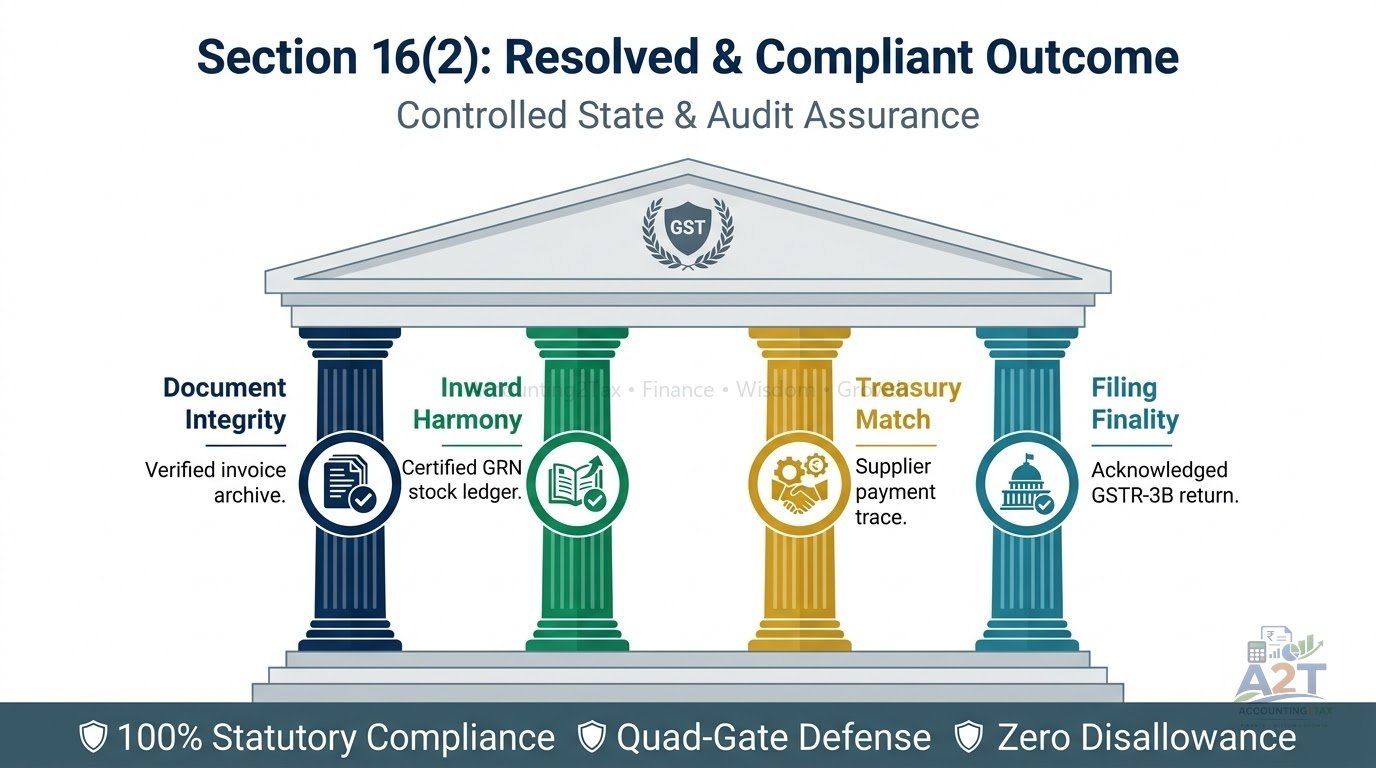
- Input Tax Credit is a statutory concession governed by the 4 strict pillars of Section 16(2).
- Under Section 16(2)(aa), 100% GSTR-2B reflection is mandatory; provisional un-uploaded ITC claims are illegal.
- The Invoice Management System (IMS) requires taxpayers to Accept, Reject, or keep Pending invoices before GSTR-2B generation.
- If you fail to pay a supplier within 180 days, you must reverse claimed ITC with 18% interest.
- Under Rule 37A, ITC must be reversed by 30th November if a vendor files GSTR-1 but defaults on GSTR-3B.
- Under Section 16(3), never claim income tax depreciation on the GST component of capital goods if claiming GST ITC.
- Missed ITC for any financial year expires on 30th November of the following year (or GSTR-9 filing date, whichever is earlier).
- Retrospective relief under Sections 16(5) and 16(6) regularized claims up to 30 November 2021 for FYs 2017-18 through 2020-21.
📚 Sources & Official Regulatory References
| Topic / Statutory Regulation | Source | Authority | Checked On | Effective Date |
|---|---|---|---|---|
| Section 16 (Eligibility & Conditions for Taking ITC) & Section 17 | Central Goods and Services Tax Act, 2017 | Tier 1 | 2026-09-01 | Current |
| Section 16(2)(aa) & Rule 36(4) (Mandatory GSTR-2B Credit Reflection) | Central Board of Indirect Taxes and Customs (CBIC) | Tier 1 | 2026-09-01 | Current |
| Invoice Management System (IMS) Workflow | GSTN Advisories & System Updates | Tier 1 | 2026-09-01 | Oct 2024 |
| Sections 16(5) and 16(6) (Retrospective Relief) | Finance (No. 2) Act, 2024 | Tier 1 | 2026-09-01 | Aug 2024 |
| Rule 37A (Vendor Non-Filing Reversal) | Notification 26/2022-CT | Tier 1 | 2026-09-01 | Dec 2022 |
| Section 16(3) & Income-tax Act Depreciation Double-Dipping Directives | Ministry of Finance, Government of India | Tier 1 | 2026-09-01 | Current |
📚 Explore More in ITC (GST)
Taxonomy Series
Discover related guides, taxonomy series, and interactive financial calculators:
This publication is strictly for educational, research, and informational purposes and does not constitute formal financial, investment, tax, or legal advice.
- Data Accuracy & Inadvertent Errors: While every reasonable effort is made to maintain accuracy, all information, interest rates, tax thresholds, formulas, and statutory data are provided on an “as-is” basis. Accounting2Tax makes no express or implied warranties regarding absolute completeness, timeliness, or typographical and computational infallibility. Statutory authorities (Ministry of Finance, RBI, CBDT, CBIC, SEBI, PFRDA) update guidelines periodically. Readers must independently verify current rates and rules on official government portals before executing financial transactions.
- Illustrations, Simulations & Limitations of Liability: Mathematical models, compounding simulations, case studies, and hypothetical return projections are conceptual tools designed solely to demonstrate financial principles. They do not constitute guaranteed returns, profit forecasts, or capital safety commitments. Accounting2Tax and its authors disclaim all liability for any direct, indirect, or consequential financial losses, tax penalties, or investment outcomes arising from inadvertent errors, omissions, calculation discrepancies, or reliance placed on this material.
- Professional Consultation: Readers must independently evaluate their individual financial goals, tax positions, and risk tolerance, and consult a SEBI-registered financial advisor or certified chartered accountant before making financial decisions.