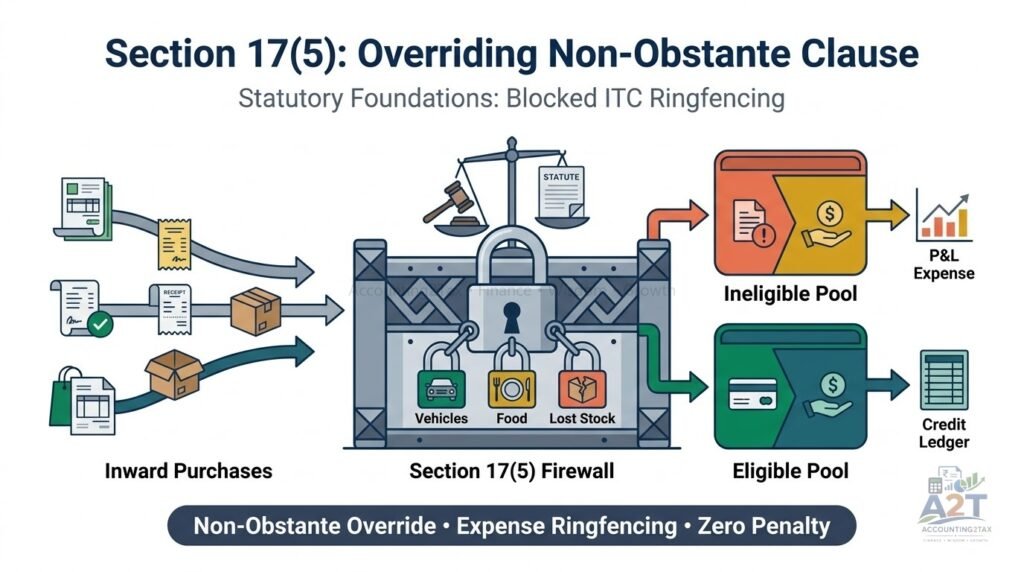
- • The Supremacy of Section 17(5): The Overriding Non-Obstante Clause
- • 1. Clause-by-Clause Breakdown of Section 17(5) Blocked Credits
- • 2. How to Report Blocked Credits in Form GSTR-3B
- • Master Blocked vs. Eligible ITC Reference Table
- • Frequently Asked Questions (FAQs)
Expert Revision Notice — Last Verified: 1 September 2026
Key verification sources: 56th GST Council recommendations, CBIC Tax Information Portal, Finance Act 2023, Safari Retreats Judgment (Oct 2024), GSTN advisories.
A common misconception among business owners is that any expense paid through a corporate bank account and supported by a GST invoice automatically qualifies for Input Tax Credit (ITC).
“We bought a company car for client visits, catered dinner for the annual team party, and renovated our corporate office. Can we claim the 18% and 28% GST on all these expenses?”
Under Indian Goods and Services Tax law, the answer is a definitive NO.
Even if an expense is incurred 100% for legitimate business purposes, Section 17(5) of the CGST Act overrides Section 16. It creates an explicit statutory “negative list” of blocked credits for which no Input Tax Credit can ever be claimed.
Claiming blocked credits is one of the primary triggers for departmental audit notices:
- The tax department’s automated algorithms flag blocked HSN/SAC codes (such as passenger cars, restaurant catering, or civil construction) claimed in Form GSTR-3B.
- Businesses are forced to reverse the credit, pay 18% penal interest under Section 50, and face penalties of up to 100% under Section 122.
Which specific expenses are blocked under Section 17(5) Clauses (a) through (i)? What are the narrow statutory exceptions where ITC is legally permitted? How must ineligible credits be reported in Table 4(B) of Form GSTR-3B?
This comprehensive guide breaks down the statutory mechanics of Section 17(5), analyzes common pitfalls, and provides a clear classification framework.
The Supremacy of Section 17(5): The Overriding Non-Obstante Clause
Under Section 17(5) of the Central Goods and Services Tax (CGST) Act, 2017:
“Notwithstanding anything contained in sub-section (1) of section 16 and sub-section (1) of section 18, input tax credit shall not be available in respect of the following…”
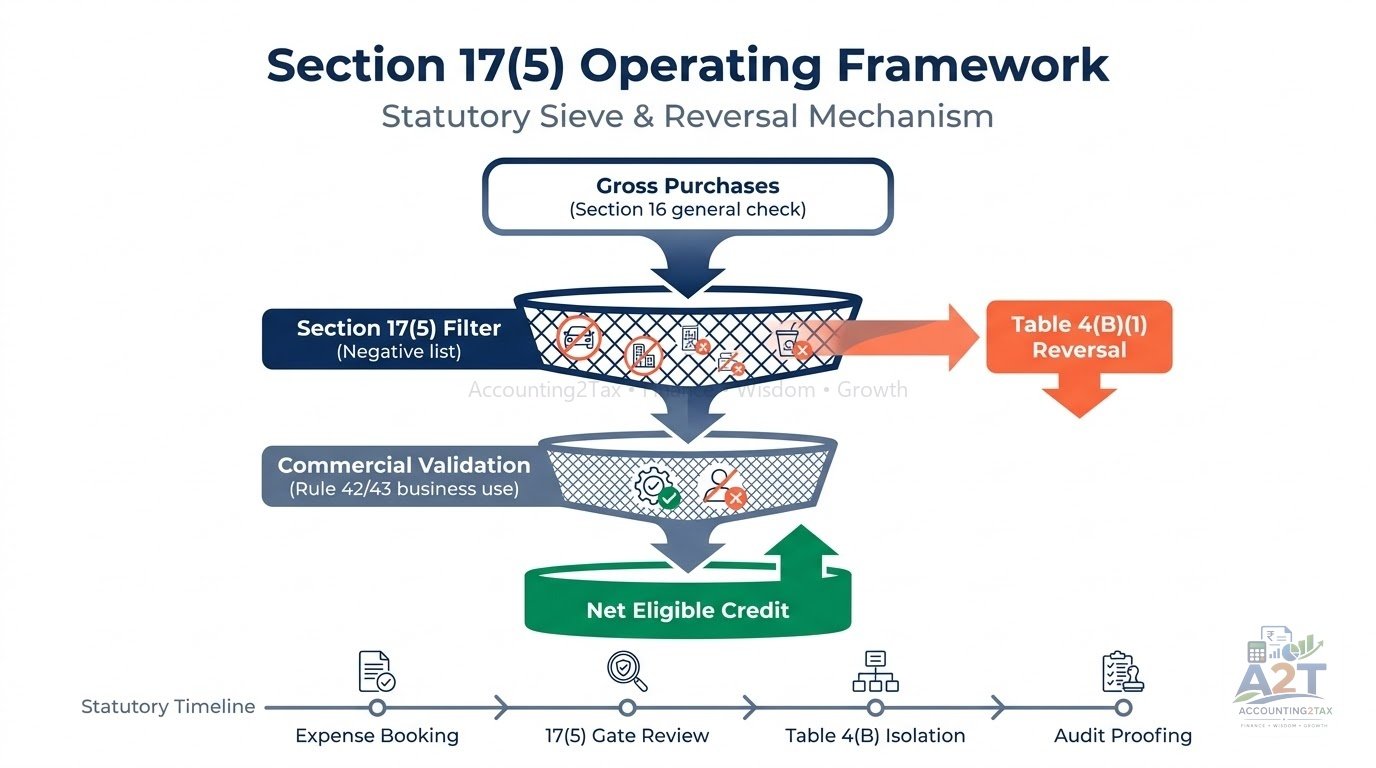
 THE STATUTORY FILTER HIERARCHY
                                       │
 Step 1: Does the expense satisfy Section 16(2) conditions? (Invoice, GSTR-2B, Delivery)
                                       │
                                       ▼
 Step 2: DOES IT FALL UNDER THE SECTION 17(5) BLOCKED LIST?
                                       │
        ┌──────────────────────────────┴──────────────────────────────┐
       ▼                                                              ▼
    [ YES ]                                                        [ NO ]
 ITC IS STATUTORILY BLOCKED. ❌                               ITC IS ELIGIBLE. ✅
 Claiming it triggers Section 122 penalties.                  Claim safely in Table 4(A)(5).
1. Clause-by-Clause Breakdown of Section 17(5) Blocked Credits
 SECTION 17(5) BLOCKED CATEGORIES
                                         │
 ┌─────────────────────────────────────────────────────────────────────────────┐
 │  Clause (a) & (ab) ──► Motor Vehicles, Vessels & Aircraft (Seating ≤ 13)    │
 ├─────────────────────────────────────────────────────────────────────────────┤
 │  Clause (b)        ──► Food, Beverages, Catering, Health Insurance, Clubs   │
 ├─────────────────────────────────────────────────────────────────────────────┤
 │  Clause (c) & (d)  ──► Works Contract & Immovable Property Construction     │
 ├─────────────────────────────────────────────────────────────────────────────┤
 │  Clause (e) & (f)  ──► Composition Scheme Dealers & Non-Resident Persons    │
 ├─────────────────────────────────────────────────────────────────────────────┤
 │  Clause (fa)       ──► Corporate Social Responsibility (CSR) Expenses       │
 ├─────────────────────────────────────────────────────────────────────────────┤
 │  Clause (g)        ──► Goods / Services Used for Personal Consumption       │
 ├─────────────────────────────────────────────────────────────────────────────┤
 │  Clause (h)        ──► Goods Lost, Stolen, Destroyed, Written Off, or Gifts │
 ├─────────────────────────────────────────────────────────────────────────────┤
 │  Clause (i)        ──► Taxes Paid under Fraud / Confiscation Sections       │
 └─────────────────────────────────────────────────────────────────────────────┘
A. Motor Vehicles, Aircraft and Vessels [Clause (a) & (ab)]
(Legislative Note: In February 2019, clauses (a) and (b) were restructured to introduce the exact ≤13 seating capacity distinction for motor vehicles.)
- Blocked: Motor vehicles for transportation of persons having a seating capacity of up to 13 persons (including the driver). Also blocks insurance, servicing, and repair expenses for such vehicles.
- Statutory Exceptions (ITC IS ALLOWED):
1. If the vehicle is used for making further taxable supply of such vehicles (Car dealerships).
2. If used for transportation of passengers (Commercial taxi operators, bus services).
3. If used for imparting training on driving such vehicles (Motor driving schools).
4. Commercial goods transport vehicles (trucks, tempos, delivery vans) always qualify for 100% ITC.
B. Food, Beverages, Outdoor Catering & Health Insurance [Clause (b)]
- Blocked: Food and beverages, outdoor catering, beauty treatment, health services, cosmetic/plastic surgery, life insurance, health insurance, and club/gym memberships.
- Statutory Exceptions (ITC IS ALLOWED):
1. Sub-contracting / Inward Supply: When used to make an outward taxable supply of the same category (e.g., an event management company hiring an outdoor caterer for a client event).
2. Statutory Employer Obligation: When it is obligatory for an employer to provide such services to its employees under any active law (e.g., mandatory factory canteens under the Factories Act, 1948).
C. Works Contract & Immovable Property Construction [Clause (c) & (d)]
- Blocked: Works contract services and goods/services used for the construction of an immovable property on own account (e.g., building an office, factory shed, or warehouse), even when capitalized.
- Statutory Exception: Plant & Machinery. ITC is permitted on apparatus, equipment, and machinery fixed to earth, including structural foundation supports specifically designed for such machinery.
- Landmark Case Law – Safari Retreats Judgment (October 2024): The Supreme Court provided a significant interpretation regarding Section 17(5)(d), ruling that commercial buildings constructed specifically for leasing (like shopping malls) may qualify under the “plant or machinery” exception, subject to functionality tests. Note: This remains a highly litigation-sensitive area; fact-dependent classification is crucial.
D. CSR Expenses, Non-Residents, and Tax Frauds [Clauses (f), (fa), (i)]
- Clause (f): Goods or services received by a non-resident taxable person (except on imported goods) are blocked.
- Clause (fa): Introduced by the Finance Act 2023, ITC on goods or services used to fulfill Corporate Social Responsibility (CSR) obligations under Section 135 of the Companies Act, 2013, is completely blocked.
- Clause (i): Any tax paid due to fraud, suppression, or confiscation under Sections 74 (or the new unified Section 74A effective FY 24-25), 129, or 130 is strictly blocked.
E. Goods Lost, Stolen, Destroyed, Written Off, or Given as Gifts [Clause (h)]
- Blocked / Mandatory Reversal: If inventory or raw materials are lost, stolen, destroyed (e.g., in fire or flood), written off as obsolete, or given away as free marketing samples or festival gifts.
- Process vs. Unaccounted Loss: It is critical to distinguish between normal manufacturing/process loss (where ITC reversal is generally not required, as it is an inherent part of the production cycle) and unaccounted loss/theft/destruction (which squarely hits Clause (h) and mandates reversal).
2. How to Report Blocked Credits in Form GSTR-3B
To maintain transparent accounting records, blocked credits must be handled correctly in your monthly returns:
 ┌─────────────────────────────────────────────────────────────────────────────┐
 │  HOW TO REPORT IN GSTR-3B (TABLE 4):                                        │
 │  1. Auto-Populated Total: All vendor invoices flow into Table 4(A) via      │
 │     GSTR-2B and IMS (including blocked items).                              │
 │  2. Mandatory Reversal in Table 4(B)(1): Enter all Section 17(5) blocked    │
 │     credits under "ITC Reversed - As per Rule 38, 42, 43 and Section 17(5)".│
 │  3. Net Eligible ITC (Table 4(C)): Table 4(A) minus Table 4(B) determines   │
 │     the exact eligible credit credited to your Electronic Credit Ledger.    │
 └─────────────────────────────────────────────────────────────────────────────┘
Master Blocked vs. Eligible ITC Reference Table
| Commercial Expense Description | Section 17(5) Clause | ITC Eligibility Status | Statutory Rationale / Exception |
|---|---|---|---|
| Office Laptops & Desktop Computers | None | ELIGIBLE (100% ITC) ✅ | Capital goods for business use |
| Sedan Car for Managing Director | Clause (a) | BLOCKED (0% ITC) ❌ | Passenger vehicle seating ≤ 13 |
| Delivery Van for Product Logistics | Clause (a) | ELIGIBLE (100% ITC) ✅ | Commercial goods transport vehicle |
| Team Annual Dinner / Catering | Clause (b) | BLOCKED (0% ITC) ❌ | Food & beverages consumption |
| Factory Canteen (Mandated by Law) | Clause (b) | ELIGIBLE (100% ITC) ✅ | Statutory employer obligation |
| Commercial Office Building Construction | Clause (d) | BLOCKED (0% ITC) ❌ | Construction of immovable property |
| Factory Production CNC Machine | Clause (d) | ELIGIBLE (100% ITC) ✅ | Plant and machinery exception |
| CSR Activities (School Construction) | Clause (fa) | BLOCKED (0% ITC) ❌ | CSR obligations explicitly blocked |
| Festival Sweets & Client Diwali Gifts | Clause (h) | BLOCKED (0% ITC) ❌ | Disposed of as gifts / free samples |
| Normal Evaporation Loss in Chem Plant | Clause (h) | ELIGIBLE (100% ITC) ✅ | Normal process loss, not unaccounted |
| Inventory Destroyed in Factory Fire | Clause (h) | REVERSAL REQUIRED ❌ | Goods destroyed / written off |
Frequently Asked Questions (FAQs)
Q1. Are employee travel and hotel accommodation expenses blocked under Section 17(5)?
Answer: No, standard business travel and hotel stays are not explicitly blocked under Section 17(5). However, place of supply rules often restrict CGST/SGST claims if the hotel is in a different state.
Q2. We distributed free samples of our new product. Do we need to reverse ITC on the raw materials used?
Answer: Yes. Under Section 17(5)(h), goods disposed of by way of gift or free samples are ineligible for ITC. You must reverse the proportionate ITC on the inputs used to manufacture those samples.
Q3. Is ITC available on renting a motor vehicle for employees?
Answer: Renting or hiring of motor vehicles with seating capacity ≤13 is blocked under Clause (b), unless it is a statutory obligation for the employer to provide such transport under an active law.
Q4. What does the Safari Retreats judgment change about construction ITC?
Answer: The October 2024 Supreme Court judgment held that commercial properties (like malls) constructed explicitly for letting out might pass the functionality test as “plant or machinery,” thus escaping the 17(5)(d) block. This is highly fact-dependent and subject to strict legal interpretation.
Q5. We paid a tax demand along with a penalty under Section 74A. Can we claim ITC on the tax portion?
Answer: No. Section 17(5)(i) strictly blocks ITC on any tax paid under the fraud, suppression, or confiscation provisions, including the unified Section 74A.
Calculate Your Eligible Input Tax Credit and Liability
Segregate ineligible blocked expenses, calculate net claimable ITC under Table 4(C), and verify output tax offsets using the Accounting2Tax Financial Tools.
Use the GST Calculator to model your eligible input tax credits.
Related Financial Wisdom
- Input Tax Credit Explained: How GST Purchases Work — ITC fundamentals.
- ITC Eligibility: Section 16 Mandatory Conditions — Section 16 guide.
- ITC Reconciliation: Matching Purchase Records with GSTR-2B — reconciliation SOP.
- GST Return Filing Mistakes and Penalty Prevention — filing errors.
- GST Compliance Checklist for Small Businesses — compliance checklist.
Key Takeaways
- Section 17(5) overrides Section 16, permanently blocking ITC on specific categories regardless of business utility.
- Passenger motor vehicles (seating ≤ 13) are statutorily blocked, unless used for driving schools, car dealerships, or commercial transport.
- Food, beverages, catering, and health insurance are blocked unless mandated by law as an employer obligation.
- Construction of immovable property (buildings, offices) is blocked, but Plant & Machinery qualifies for 100% ITC, subject to the Safari Retreats interpretation for leased commercial buildings.
- Goods lost, stolen, destroyed, written off, or distributed as free gifts require mandatory ITC reversal, whereas normal process loss does not.
- CSR expenses [17(5)(fa)] and taxes paid under fraud demands [17(5)(i)] are entirely blocked.
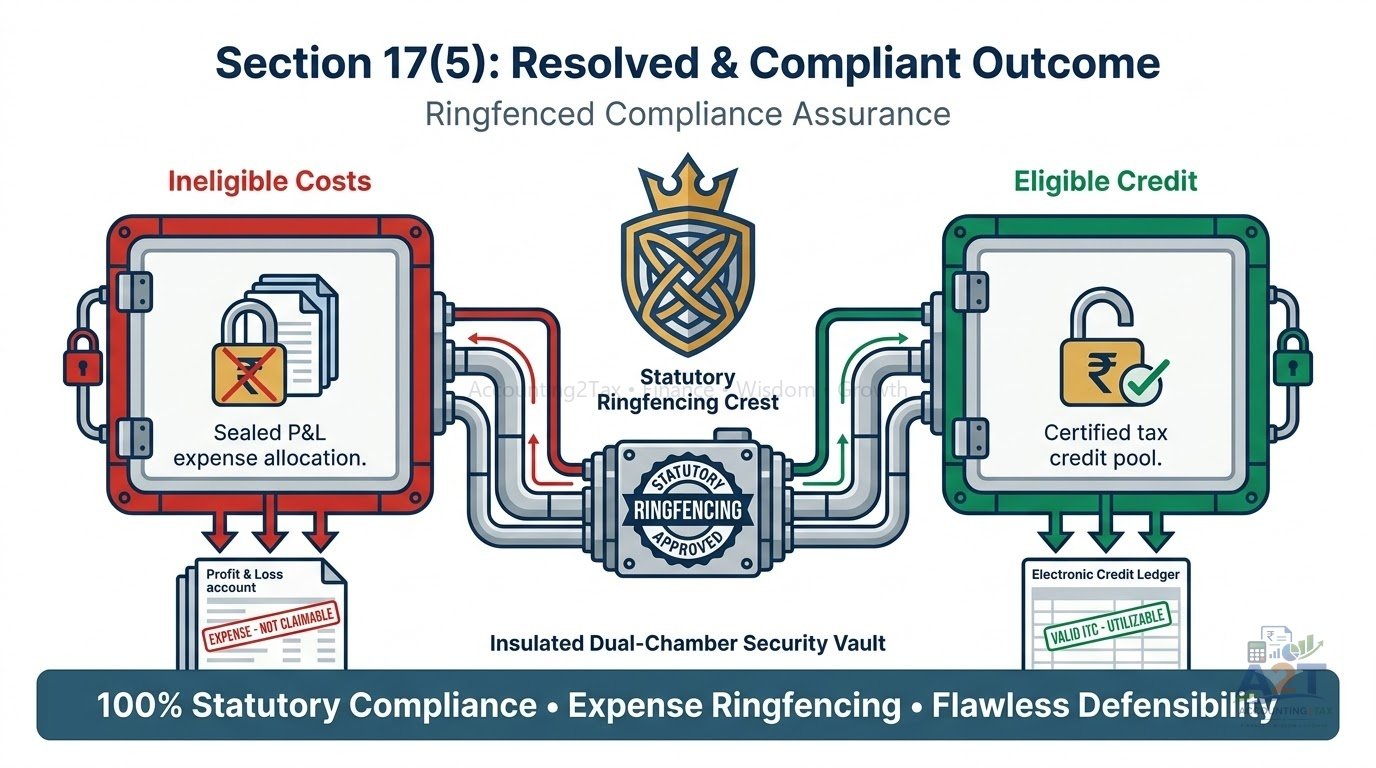
- Always reverse blocked credits under Table 4(B)(1) of Form GSTR-3B to prevent 100% penalties under Section 122.
📚 Sources & Official Regulatory References
| Topic / Statutory Regulation | Source | Authority | Checked On | Effective Date |
|---|---|---|---|---|
| Section 17(5) (Ineligible / Blocked ITC Provisions) | Central Goods and Services Tax Act, 2017 | Tier 1 | 2026-09-01 | Current |
| Section 17(5)(fa) – Blockage of CSR Expenses | Finance Act, 2023 | Tier 1 | 2026-09-01 | Oct 2023 |
| Safari Retreats Judgment on Plant & Machinery | Supreme Court of India | Tier 1 | 2026-09-01 | Oct 2024 |
| Section 122 (Penalties for Fraudulent & Ineligible ITC Claims) | Central Goods and Services Tax Act, 2017 | Tier 1 | 2026-09-01 | Current |
📚 Explore More in ITC (GST)
Taxonomy Series
Discover related guides, taxonomy series, and interactive financial calculators:
This publication is strictly for educational, research, and informational purposes and does not constitute formal financial, investment, tax, or legal advice.
- Data Accuracy & Inadvertent Errors: While every reasonable effort is made to maintain accuracy, all information, interest rates, tax thresholds, formulas, and statutory data are provided on an “as-is” basis. Accounting2Tax makes no express or implied warranties regarding absolute completeness, timeliness, or typographical and computational infallibility. Statutory authorities (Ministry of Finance, RBI, CBDT, CBIC, SEBI, PFRDA) update guidelines periodically. Readers must independently verify current rates and rules on official government portals before executing financial transactions.
- Illustrations, Simulations & Limitations of Liability: Mathematical models, compounding simulations, case studies, and hypothetical return projections are conceptual tools designed solely to demonstrate financial principles. They do not constitute guaranteed returns, profit forecasts, or capital safety commitments. Accounting2Tax and its authors disclaim all liability for any direct, indirect, or consequential financial losses, tax penalties, or investment outcomes arising from inadvertent errors, omissions, calculation discrepancies, or reliance placed on this material.
- Professional Consultation: Readers must independently evaluate their individual financial goals, tax positions, and risk tolerance, and consult a SEBI-registered financial advisor or certified chartered accountant before making financial decisions.