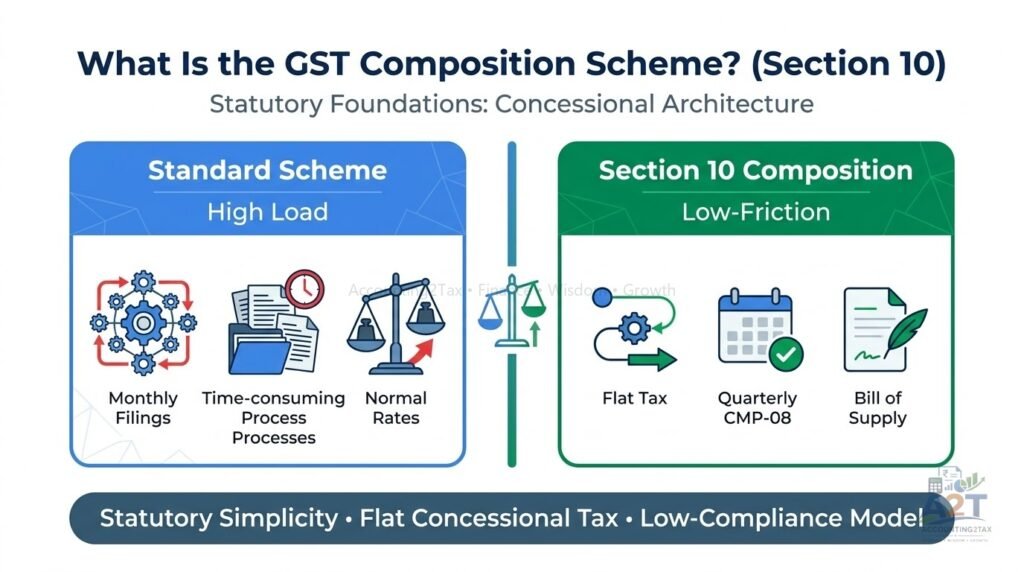
- • What Is the GST Composition Scheme? (Section 10)
- • Turnover Eligibility Limits for Composition Scheme
- • Concessional Composition Tax Rates
- • The 5 Major Restrictions of the Composition Scheme
- • Modern GST Mechanisms and Compliance
Last Verified: 1 September 2026. Key verification sources: GST Council 56th Meeting (Sept 2025), CBIC Tax Information Portal, GSTN/GST Portal advisories.
For small shopkeepers, local manufacturers, neighborhood restaurants, and independent service providers, managing monthly GST invoices and Input Tax Credit (ITC) reconciliations can feel like a full-time accounting job.
Recognizing that small enterprises have limited administrative resources, the Indian Government introduced a simplified, hassle-free alternative under Section 10 of the CGST Act: the GST Composition Scheme.
Under the Composition Scheme, eligible small businesses pay a flat, low percentage of their turnover as tax (as low as 1%), file a simple quarterly payment challan (Form CMP-08), and are exempt from maintaining detailed invoice-by-invoice sales ledgers.
However, this simplicity comes with significant legal trade-offs: Composition dealers cannot collect GST from their customers, cannot claim Input Tax Credit on purchases, and cannot sell goods across state borders.
Choosing between the Composition Scheme and the Regular GST Scheme is one of the most critical decisions for small business profitability.
This guide provides a comprehensive breakdown of the Composition Scheme, turnover eligibility limits, concessional tax rates, core restrictions, and a direct comparative framework to help you choose the right model.
What Is the GST Composition Scheme? (Section 10)
The GST Composition Scheme is an optional tax mechanism designed for small taxpayers to pay tax at a concessional flat rate based on their turnover, with minimal record-keeping and simplified quarterly compliance.
COMPOSITION VS. REGULAR SCHEME
                                          │
            ┌─────────────────────────────┴─────────────────────────────┐
▼ ▼
[ COMPOSITION SCHEME ] [ REGULAR SCHEME ]
• Flat 1% / 5% / 6% turnover tax • Standard 5%, 18%, 40% rates.
• Simple quarterly CMP-08 challan • Monthly GSTR-1 & GSTR-3B filings.
• CANNOT collect GST from buyers • Collects GST from customers.
• CANNOT claim Input Tax Credit • Claims 100% Input Tax Credit.
• Best for local B2C retailers/restaurants • Best for B2B & inter-state businesses.
Turnover Eligibility Limits for Composition Scheme
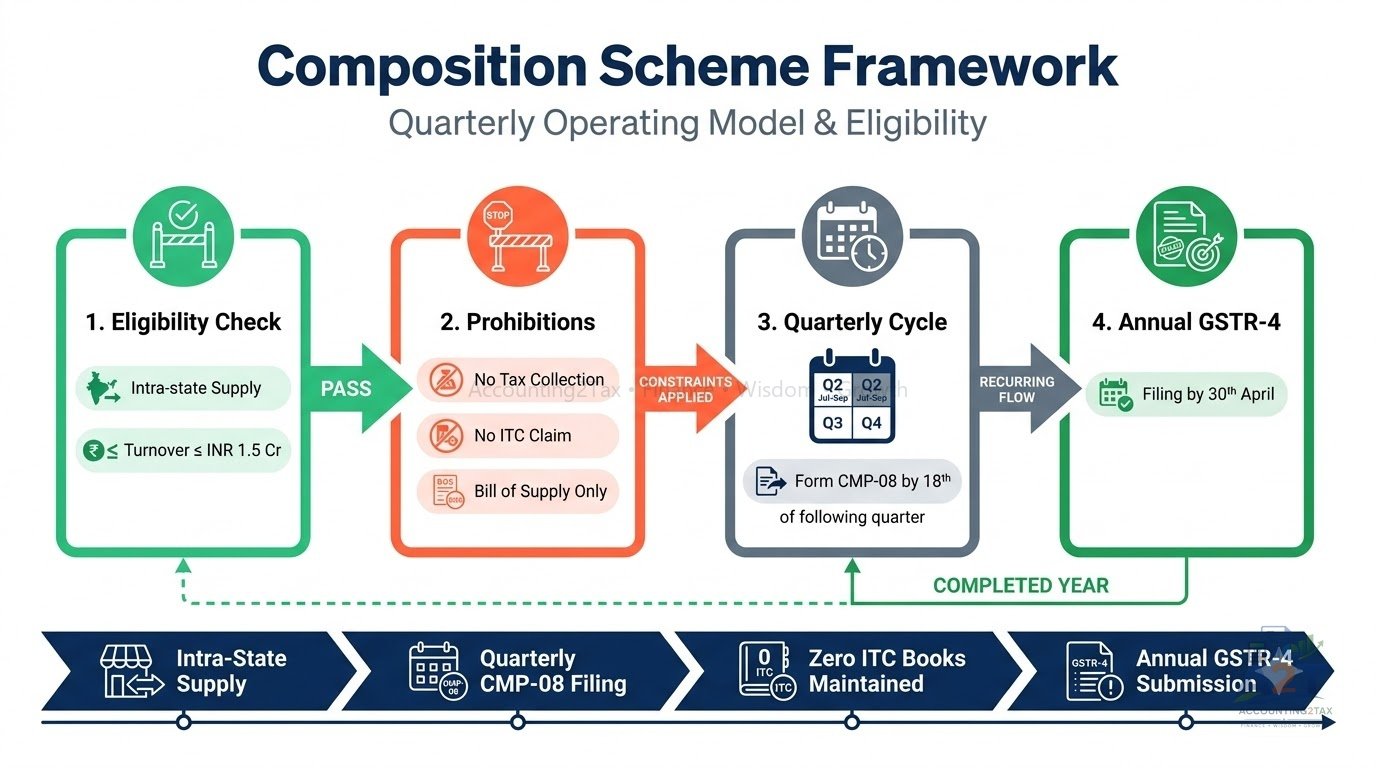
To opt for the Composition Scheme, your Aggregate Annual Turnover in the preceding financial year must be within the statutory thresholds:
| Category of Business | Standard States (e.g., MH, KA, DL, TN, UP, GJ) | Special Category States (Uttarakhand, NE States) |
|---|---|---|
| Manufacturers of Goods | Up to ₹1.50 Crore | Up to ₹75 Lakh |
| Traders of Goods (Retailers/Wholesalers) | Up to ₹1.50 Crore | Up to ₹75 Lakh |
| Restaurant Services (Not serving alcohol) | Up to ₹1.50 Crore | Up to ₹75 Lakh |
| Service Providers & Mixed Suppliers (Sec 10(2A)) | Up to ₹50 Lakh | Up to ₹50 Lakh |
The Marginal Services Window
A goods manufacturer or trader registered under the ₹1.5 Crore Composition Scheme might occasionally provide small services. Under the second proviso to Section 10(1), they are permitted to supply services up to 10% of their turnover in the preceding FY or ₹5,00,000, whichever is higher, without losing their composition eligibility.
Concessional Composition Tax Rates
Composition dealers pay a fixed percentage of their turnover directly from their revenue:
COMPOSITION TAX RATE SLABS
                                     │
         ┌───────────────────────────┼───────────────────────────┐
▼ ▼ ▼
[ 1% FLAT ] [ 5% FLAT ] [ 6% FLAT ]
Manufacturers & Traders Restaurant Services Other Service Providers
(0.5% CGST + 0.5% SGST) (2.5% CGST + 2.5% SGST) (3.0% CGST + 3.0% SGST)
- Traders of Goods: 1% of taxable turnover (0.5% CGST + 0.5% SGST).
- Manufacturers of Goods: 1% of total turnover (0.5% CGST + 0.5% SGST).
- Restaurants (No Alcohol): 5% of total turnover (2.5% CGST + 2.5% SGST).
- Service Providers (Section 10(2A)): 6% of total turnover (3.0% CGST + 3.0% SGST).
The 5 Major Restrictions of the Composition Scheme
While the tax rates are low and compliance is light, Section 10 imposes strict legal limitations:
KEY COMPOSITION RESTRICTIONS
                                         │
        ┌────────────────────────────────┼────────────────────────────────┐
▼ ▼ ▼
NO GST Collection NO Input Tax Credit NO Inter-State Sales
Cannot charge GST to customers Cannot claim credit on Cannot sell physical goods
or issue tax invoices raw materials / stock purchases across state lines
- Cannot Collect GST from Customers: You cannot add GST to your bills. You must issue a “Bill of Supply” (instead of a Tax Invoice) containing the mandatory header: “Composition taxable person, not eligible to collect tax on supplies.” The 1% or 5% tax is paid out of your own gross profit.
- Zero Input Tax Credit (ITC): Any GST paid on purchases from your suppliers becomes a direct business cost and cannot be deducted.
- No Inter-State Outward Supplies of Goods: You can purchase goods from other states, but you cannot sell physical goods to customers outside your state.
- E-Commerce Relaxation: Historically, composition dealers were banned from selling through e-commerce operators. However, since 1 October 2023 (Notification 35/2023-CT), composition taxpayers ARE permitted to make intra-state supplies of goods through ECOs.
- Ineligible Product Categories: Manufacturers of ice cream, pan masala, tobacco products, aerated water, and building bricks are legally barred from the Composition Scheme.
Modern GST Mechanisms and Compliance
- GSTR-4 Due Date: The annual return (GSTR-4) must be filed by 30 June of the following financial year, per Notification 12/2024-CT (replacing the old 30 April deadline).
- Invoice Management System (IMS): Before finalizing returns, dealers accept/reject incoming B2B invoices. (Composition dealers do not claim ITC, but their purchases are still tracked).
- GSTR-1A and DRC-03A: Tools for amending return liabilities and mapping tax payments.
- E-Invoice 30-day reporting restriction: E-invoicing does not apply to Composition dealers (who issue Bills of Supply, not Tax Invoices).
Head-to-Head Comparison Matrix
| Feature | Composition Scheme (Section 10) | Regular GST Scheme |
|---|---|---|
| Turnover Ceiling | ₹1.50 Crore (Goods) / ₹50 Lakh (Services) | No turnover limit |
| Tax Rate Payable | Flat 1%, 5%, or 6% of turnover | Standard slabs: 5%, 18%, 40% |
| Tax Collection | Cannot collect GST from buyers | Collects full GST from buyers |
| Invoice Issued | Bill of Supply | Tax Invoice (Rule 46) |
| Input Tax Credit (ITC) | No ITC available (GST is an expense) | Full ITC available on purchases |
| Inter-State Outward Sales | Strictly prohibited for goods | Allowed across India and global exports |
| Filing Frequency | Quarterly challan (CMP-08) + Annual GSTR-4 | Monthly GSTR-1 + GSTR-3B (or QRMP) |
| Accounting Burden | Very Low (No invoice matching needed) | Moderate to High (Monthly GSTR-2B recon) |
Practical Case Study: Local Retailer Profitability Comparison
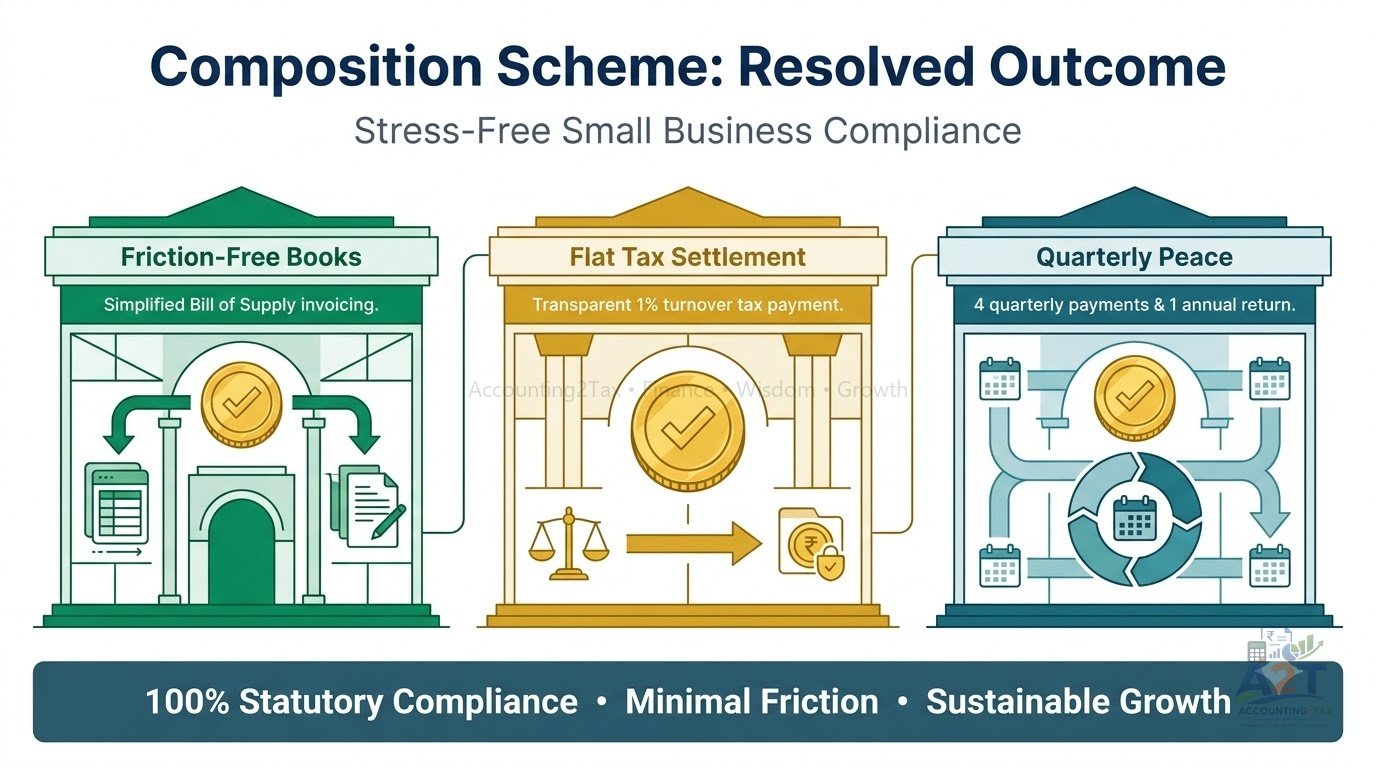
Case Study: Neighborhood Grocery Store Earning ₹80 Lakh Turnover
Consider a local retail store selling consumer goods with ₹80,00,000 annual sales (Purchase Cost = ₹65,00,000 with ₹6,50,000 GST paid to distributors):
Under Composition Scheme (1% Tax):
- Gross Sales: ₹80,00,000
- Purchase Cost (including unrecovered GST): ₹71,50,000
- Less: 1% Composition Tax on Sales: ₹80,000
- Gross Profit: ₹7,70,000
- Compliance Effort: 4 simple quarterly CMP-08 challans per year.
Under Regular Scheme (Assuming 18% Avg GST):
- Taxable Sales: ₹80,00,000 + 18% Output GST collected (₹14,40,000) = ₹94,40,000
- Less: Purchase Cost: ₹65,00,000
- Net GST Paid to Govt (₹14.4L − ₹6.5L ITC): ₹7,90,000 (Paid from customer money).
- Gross Profit: ₹15,00,000 (Before operating expenses).
(Note: In retail markets with MRP-inclusive pricing, the margin comparison differs from this scenario because you cannot simply charge GST over and above the fixed MRP base price. The Regular Scheme dealer would have to absorb the GST out of the MRP).
The Key Takeaway: In high-margin businesses or where goods have high GST, the Regular Scheme often preserves higher profit margins because you recover the GST paid on purchases. In low-margin trading with low compliance overhead, Composition saves immense accounting costs.
Frequently Asked Questions (FAQs)
Q1. Can a composition dealer sell on Amazon or Flipkart?
Answer: Yes, since 1 October 2023, composition dealers are permitted to make supplies through e-commerce operators, provided the supplies are strictly intra-state.
Q2. What happens if my turnover crosses ₹1.5 Crore during the year?
Answer: The day your turnover exceeds the ₹1.5 Crore limit, you immediately become ineligible for the Composition Scheme and must transition to the Regular Scheme, issue Tax Invoices, and collect standard GST.
Q3. Can I take the Composition Scheme for my restaurant that serves alcohol?
Answer: No. Businesses serving alcohol for human consumption are strictly ineligible for the Composition Scheme under GST.
Q4. Does a composition dealer need to file GSTR-1?
Answer: No. Composition dealers file a simple statement-cum-payment challan in Form CMP-08 every quarter, and an annual return in Form GSTR-4 by 30 June.
Q5. Can I claim ITC on the machinery I purchase if I am under the Composition Scheme?
Answer: No. Under Section 10, a composition dealer is entirely barred from claiming Input Tax Credit on inputs, input services, and capital goods. The GST paid becomes part of your asset cost.
Calculate Your GST Invoices Instantly
Model your sales margins, calculate forward GST, and compare tax structures using the Accounting2Tax GST Calculator.
Use the GST Calculator to evaluate your tax liabilities across business models.
Related Financial Wisdom
- GST Explained: Understanding India’s Goods and Services Tax — core GST guide.
- GST Registration Explained: Turnover Limits, Mandatory Triggers and Rules — registration options.
- GST Returns Explained: Understanding the GST Filing System — Form CMP-08 & GSTR-4.
- Input Tax Credit Explained: How GST Paid on Purchases Works — ITC mechanics.
- GST Compliance Checklist: Key Daily, Monthly and Annual Requirements — compliance roadmap.
Key Takeaways
- The Composition Scheme allows small businesses with turnover up to ₹1.50 Crore (goods) / ₹50 Lakh (services) to pay flat tax rates (1%, 5%, or 6%).
- Goods manufacturers/traders can provide marginal services up to 10% of turnover or ₹5,00,000, whichever is higher.
- Composition dealers file a simple quarterly payment challan (CMP-08) and an annual return (GSTR-4) due by 30 June.
- Composition taxpayers cannot collect GST from customers, cannot claim Input Tax Credit, and cannot make inter-state sales of goods.
- Since October 2023, they can supply goods through intra-state e-commerce platforms.
📚 Sources & Official Regulatory References
| Section / Form | Source | Authority | Checked On | Effective Date |
|---|---|---|---|---|
| Section 10 (Composition Levy & Turnover Thresholds) | Central Goods and Services Tax Act, 2017 | Tier 1 | 2026-08-26 | Current |
| Section 10(2A) & Notification No. 02/2019-CT (Composition Scheme for Services) | Ministry of Finance / CBIC | Tier 1 | 2026-08-26 | Current |
| Notification No. 35/2023-CT (E-Commerce Relaxation for Composition) | CBIC | Tier 1 | 2026-08-26 | 1 October 2023 |
| Notification No. 12/2024-CT (GSTR-4 Due Date Extension) | CBIC | Tier 1 | 2026-08-26 | Current |
| Form CMP-08 & Form GSTR-4 Directives | Central Board of Indirect Taxes & Customs (CBIC) | Tier 1 | 2026-08-26 | Current |
📚 Explore More in Small Business (GST)
Taxonomy Series
Discover related guides, taxonomy series, and interactive financial calculators:
This publication is strictly for educational, research, and informational purposes and does not constitute formal financial, investment, tax, or legal advice.
- Data Accuracy & Inadvertent Errors: While every reasonable effort is made to maintain accuracy, all information, interest rates, tax thresholds, formulas, and statutory data are provided on an “as-is” basis. Accounting2Tax makes no express or implied warranties regarding absolute completeness, timeliness, or typographical and computational infallibility. Statutory authorities (Ministry of Finance, RBI, CBDT, CBIC, SEBI, PFRDA) update guidelines periodically. Readers must independently verify current rates and rules on official government portals before executing financial transactions.
- Illustrations, Simulations & Limitations of Liability: Mathematical models, compounding simulations, case studies, and hypothetical return projections are conceptual tools designed solely to demonstrate financial principles. They do not constitute guaranteed returns, profit forecasts, or capital safety commitments. Accounting2Tax and its authors disclaim all liability for any direct, indirect, or consequential financial losses, tax penalties, or investment outcomes arising from inadvertent errors, omissions, calculation discrepancies, or reliance placed on this material.
- Professional Consultation: Readers must independently evaluate their individual financial goals, tax positions, and risk tolerance, and consult a SEBI-registered financial advisor or certified chartered accountant before making financial decisions.