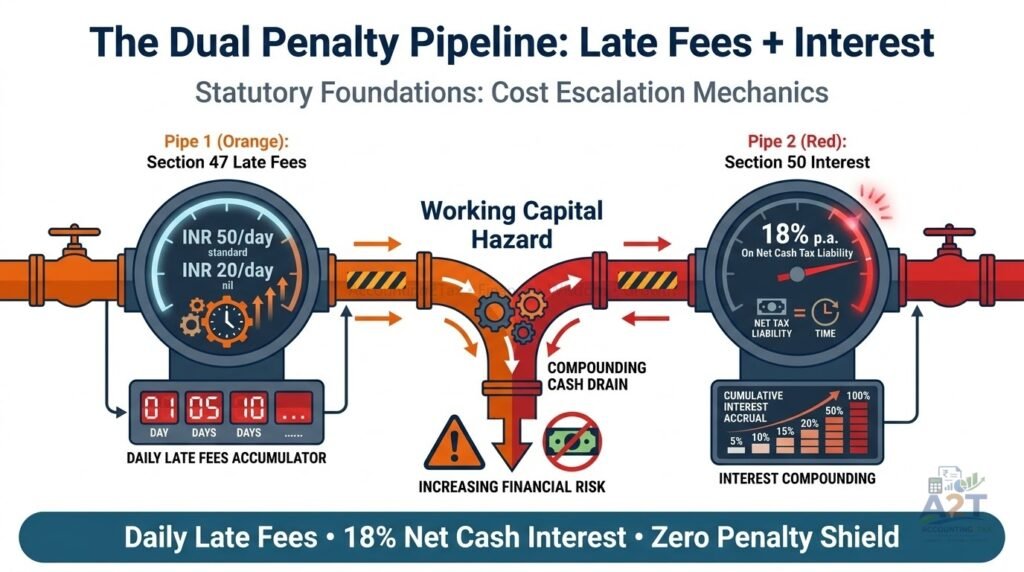
- • The Dual Penalty Pipeline: Late Fees + Penal Interest
- • 1. Statutory Late Fees under Section 47 (Turnover-Based Caps)
- • 2. Section 50 Penal Interest: The Net Cash Liability Rule
- • Distinct Statutory Consequences of Non-Filing
- • Revocation of Cancellation (Section 30 & Form GST REG-21)
Last Verified: 1 September 2026
Key verification sources: GST Council 56th Meeting (Sept 2025), CBIC Tax Information Portal, GSTN/GST Portal advisories.
In business management, delaying statutory tax filings is often viewed as a minor cash-flow postponement.
Under the Goods and Services Tax (GST) framework, however, delaying your return filing triggers aggressive statutory enforcement mechanisms.
What begins as a modest daily late fee can escalate into a commercial emergency:
– Day 1 after deadline: Daily late fees and 18% annual penal interest begin accruing.
– Month 2 of non-filing: The government blocks your ability to generate E-Way Bills (Rule 138E), freezing all outward product shipments.
– Month 3 of non-filing: The tax department issues a GSTR-3A notice, followed by a Section 62 “Best Judgment” tax demand assessing arbitrary liabilities!
– Continuous non-filing: Your GSTIN is suspended and cancelled under Section 29, and recovery officers attach your company bank accounts.
How are Section 47 Late Fees capped based on your annual turnover? How is Section 50 Penal Interest (18% per annum) calculated strictly on your Net Cash Tax Liability? What are the distinct statutory consequences of continuous non-filing, and how can a cancelled GSTIN be revived through Form GST REG-21?
This comprehensive guide breaks down the financial and operational costs of late GST return filing, details statutory calculation formulas, and provides a clear risk mitigation roadmap.
The Dual Penalty Pipeline: Late Fees + Penal Interest
When you file GSTR-3B or GSTR-1 after the statutory due date (typically the 20th of the following month for GSTR-3B), the GST portal applies two mandatory financial charges:
THE DUAL FINANCIAL CHARGE PIPELINE
                                      │
     ┌────────────────────────────────┴────────────────────────────────┐
▼ ▼
[ 1. STATUTORY LATE FEES (SEC 47) ]    [ 2. PENAL INTEREST (SEC 50) ]
Fixed daily fee for procedural delay.  18.0% per annum calculated daily.
Auto-populated in subsequent return.   Strictly on the NET CASH TAX SHORTFALL.
1. Statutory Late Fees under Section 47 (Turnover-Based Caps)
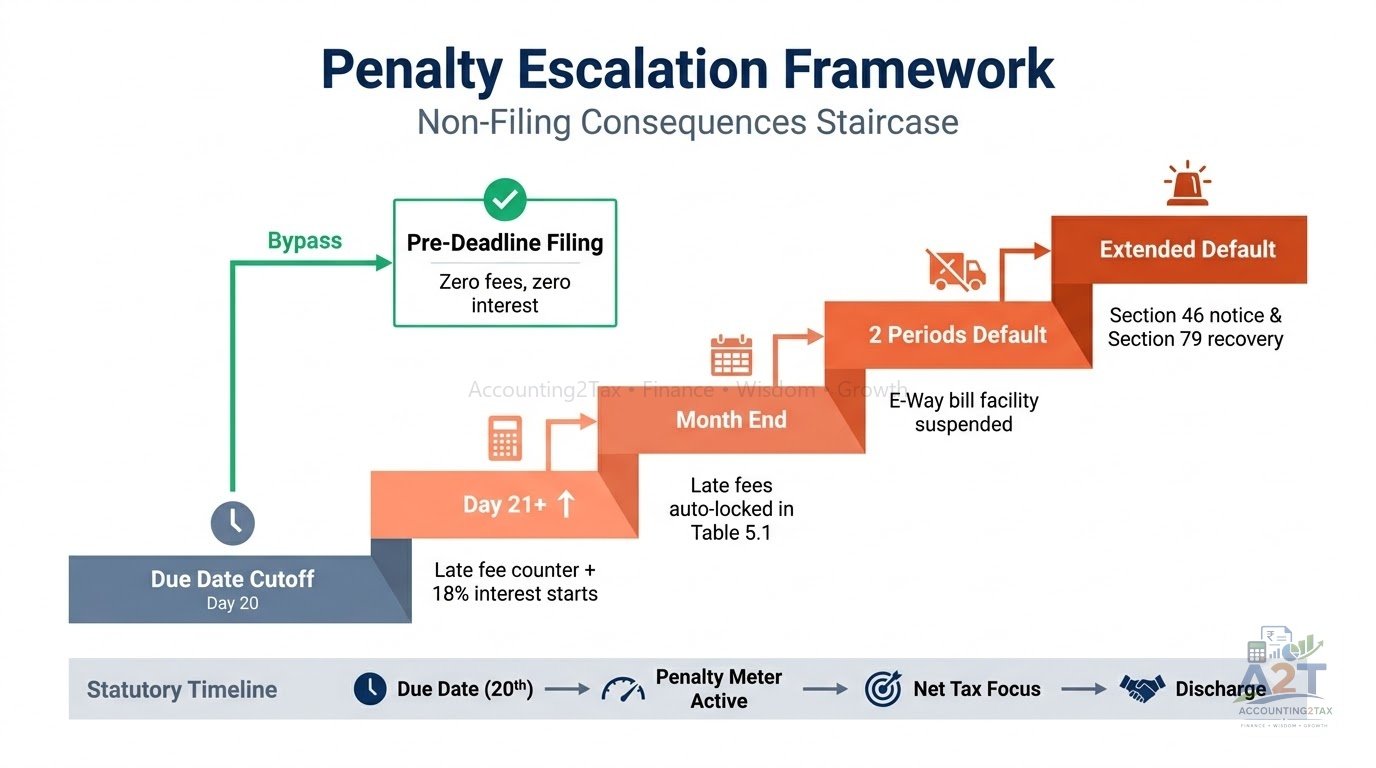
Under Section 47 of the CGST Act, late fees accrue for every single day of delay from the day after the due date until the actual date of filing:
- Regular Returns with Tax Liability: ₹50 per day (₹25 CGST + ₹25 SGST).
- Nil Returns (Zero Tax & Zero Sales): ₹20 per day (₹10 CGST + ₹10 SGST).
The Statutory Turnover-Based Maximum Caps:
To protect micro-enterprises from crushing penalties, the government established statutory maximum caps on late fees per return:
| Class of Registered Taxpayer / Annual Turnover | Maximum Late Fee per Return (CGST + SGST) |
|---|---|
| Nil Tax Liability Filers (Nil Returns) | ₹500 (₹250 CGST + ₹250 SGST) |
| Taxpayers with Turnover up to ₹1.5 Crore | ₹2,000 (₹1,000 CGST + ₹1,000 SGST) |
| Taxpayers with Turnover between ₹1.5 Cr and ₹5 Crore | ₹5,000 (₹2,500 CGST + ₹2,500 SGST) |
| Taxpayers with Turnover Exceeding ₹5 Crore | ₹10,000 (₹5,000 CGST + ₹5,000 SGST) |
2. Section 50 Penal Interest: The Net Cash Liability Rule
Under Section 50(1) of the CGST Act, interest is charged at 18% per annum on delayed tax payments.
The Landmark “Net Cash” Principle:
Following statutory amendments, interest is not charged on the gross tax liability. It is calculated strictly on the portion of tax paid through the Electronic Cash Ledger after adjusting all eligible Input Tax Credit (ITC):
 ┌─────────────────────────────────────────────────────────────────────────────┐
 │  CASE STUDY: SECTION 50 INTEREST MATH                                       │
 │  • Gross Tax Liability: ₹5,00,000                                           │
 │  • Input Tax Credit (ITC) Balance in Ledger: ₹4,00,000                      │
 │  • Net Cash Tax Paid via Challan: ₹1,00,000                                 │
 │  • Delay in Filing GSTR-3B: 60 Days                                         │
 │                                                                             │
 │  INTEREST CALCULATION:                                                      │
 │  Interest = ₹1,00,000 × 18% × (60 / 365) = ₹2,958.90                       │
 │  (If calculated on Gross ₹5L, interest would have been ₹14,794!)            │
 └─────────────────────────────────────────────────────────────────────────────┘
Distinct Statutory Consequences of Non-Filing
Failing to file GST returns does not trigger an automatic, unalterable “conveyor belt” of penalties. Instead, the law prescribes distinct statutory procedures, each with its own conditions and remedies.
1. Late Fees and Interest
Trigger: Missing the due date by even one day.
Consequence: Accumulation of daily late fees (capped by turnover) and 18% penal interest on unpaid net cash liability.
2. E-Way Bill Blocking (Rule 138E)
Trigger: Non-filing of GSTR-3B or CMP-08 for two consecutive tax periods (or two consecutive quarters for QRMP taxpayers).
Consequence: GSTIN is blocked on the E-Way Bill portal, halting goods movement.
Remedy: Unblocked automatically upon filing the pending returns.
3. Notice to Return Defaulters (GSTR-3A)
Trigger: Continued failure to file returns.
Consequence: The department issues a statutory notice in Form GSTR-3A, granting 15 days to furnish the pending return.
4. Best Judgment Assessment (Section 62)
Trigger: Failure to file the return within 15 days of the GSTR-3A notice.
Consequence: The officer issues an ex-parte assessment order (Form ASMT-13) creating a binding tax demand.
Relief (Finance Act 2023 extension): The assessment order is deemed withdrawn if the valid return is filed within 60 days. This can be extended to 61-120 days upon payment of an additional fee of ₹100/day.
5. GSTIN Suspension and Cancellation (Section 29)
Trigger: Continuous non-filing for specified periods (e.g., 6 months for regular taxpayers).
Consequence: GSTIN is suspended and subsequently cancelled.
Revocation of Cancellation (Section 30 & Form GST REG-21)
If your GST registration is cancelled due to non-filing:
- Clear All Dues: File all pending returns and pay all accumulated late fees, interest, and taxes.
- Submit Revocation Application: File Form GST REG-21 within 90 days (extendable up to 180 days by the Commissioner).
- Restoration Order: The officer issues an order in Form GST REG-22, restoring your active GSTIN status.
Master Summary: Late Return Consequences
| Delay Milestone | Statutory Provision | Operational & Legal Consequence |
|---|---|---|
| Day 1 to Day 30 | Section 47 & Section 50 | ₹50/day late fee + 18% p.a. interest on cash tax |
| 2 Consecutive Periods | Rule 138E of CGST Rules | E-Way Bill Generation BLOCKED across India |
| Post-Due Date Notice | Section 46 / Form GSTR-3A | 15-day statutory notice to file pending returns |
| Post-Notice Default | Section 62 of CGST Act | Best Judgment Assessment (Form ASMT-13) |
| 6 Months Default | Section 29(2) of CGST Act | GSTIN Suspension and Cancellation |
| Recovery Proceedings | Section 79 of CGST Act | Attachment of Company Bank Accounts & Debts |
Calculate Your Late Fees and Interest Liabilities
Model your Section 50 penal interest, calculate turnover-capped late fees, and plan tax cash flows using the Accounting2Tax Financial Tools.
Use the GST Calculator to model your statutory payouts and interest liabilities.
Related Financial Wisdom
- GST Returns Explained: Understanding the Filing System — returns overview.
- GSTR-1 and GSTR-3B: Key Differences — monthly return roles.
- GST Return Filing Mistakes and Penalty Prevention — common errors.
- GST Notices Explained: What Businesses Must Do — notice management.
- GST Compliance Checklist for Small Businesses — compliance checklist.
Key Takeaways
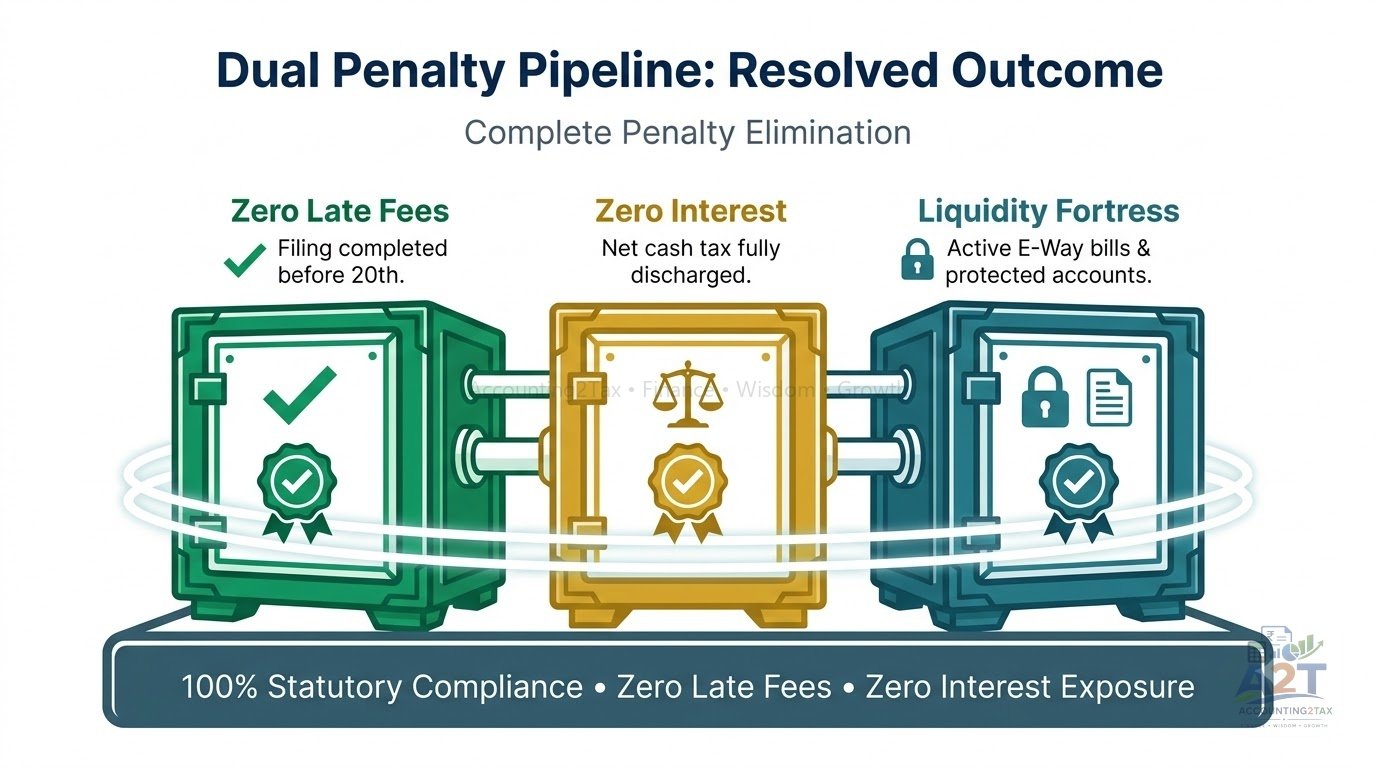
- Late fees under Section 47 accumulate daily (₹50/day regular; ₹20/day Nil) up to turnover-based maximum caps.
- Section 50 interest is strictly 18% per annum, calculated daily on the Net Cash Tax Liability (not gross tax).
- Non-filing for two consecutive tax periods (or two consecutive quarters for QRMP taxpayers) triggers automated E-Way Bill blocking under Rule 138E.
- Ignoring a GSTR-3A notice leads to a Section 62 Best Judgment Assessment order with arbitrary tax demands.
- Filing pending returns within 60 days of an ASMT-13 order automatically withdraws the ex-parte assessment (extendable to 120 days).
- Revive cancelled GST registrations using Form GST REG-21 after clearing all pending return liabilities.
Frequently Asked Questions (FAQs)
Q1. Is interest charged on my total tax liability if I file late?
Answer: No. Under Section 50(1), interest is charged only on the “Net Cash Tax Liability” (the portion paid via the electronic cash ledger), provided you had sufficient eligible ITC.
Q2. What happens to a Section 62 Assessment if I file late?
Answer: The ex-parte Best Judgment Assessment (ASMT-13) is automatically withdrawn if you file the pending return within 60 days. The Finance Act 2023 allows an extension to 120 days with an additional late fee of ₹100/day.
Q3. Does my E-Way bill get blocked immediately if I miss a filing?
Answer: No. E-Way bill blocking under Rule 138E is triggered only if you fail to file returns for two consecutive tax periods (or two consecutive quarters for QRMP taxpayers).
📚 Sources & Official Regulatory References
| Topic / Statutory Regulation | Source | Authority | Checked On | Effective Date |
|---|---|---|---|---|
| Section 47 (Late Fees) & Section 50 (Interest on Net Cash Liability) | Central Goods and Services Tax Act, 2017 | Tier 1 | 2026-08-26 | Current |
| Rule 138E (Blocking of E-Way Bill Generation for Non-Filers) | Central Goods and Services Tax Rules, 2017 | Tier 1 | 2026-08-26 | Current |
| Section 62 (Assessment of Non-Filers) & Section 29 (Cancellation of GSTIN) | Central Goods and Services Tax Act, 2017 | Tier 1 | 2026-08-26 | Current |
| Notification No. 19/2021 – Central Tax (Turnover-Based Late Fee Capping) | Central Board of Indirect Taxes and Customs (CBIC) | Tier 1 | 2026-08-26 | Current |
📚 Explore More in Returns (GST)
Taxonomy Series
Discover related guides, taxonomy series, and interactive financial calculators:
This publication is strictly for educational, research, and informational purposes and does not constitute formal financial, investment, tax, or legal advice.
- Data Accuracy & Inadvertent Errors: While every reasonable effort is made to maintain accuracy, all information, interest rates, tax thresholds, formulas, and statutory data are provided on an “as-is” basis. Accounting2Tax makes no express or implied warranties regarding absolute completeness, timeliness, or typographical and computational infallibility. Statutory authorities (Ministry of Finance, RBI, CBDT, CBIC, SEBI, PFRDA) update guidelines periodically. Readers must independently verify current rates and rules on official government portals before executing financial transactions.
- Illustrations, Simulations & Limitations of Liability: Mathematical models, compounding simulations, case studies, and hypothetical return projections are conceptual tools designed solely to demonstrate financial principles. They do not constitute guaranteed returns, profit forecasts, or capital safety commitments. Accounting2Tax and its authors disclaim all liability for any direct, indirect, or consequential financial losses, tax penalties, or investment outcomes arising from inadvertent errors, omissions, calculation discrepancies, or reliance placed on this material.
- Professional Consultation: Readers must independently evaluate their individual financial goals, tax positions, and risk tolerance, and consult a SEBI-registered financial advisor or certified chartered accountant before making financial decisions.
